


A divided UN Security Council approved a resolution threatening oil sanctions against Sudan unless the government reins in Arab militias blamed for a killing spree in Darfur and ordered an investigation of whether the attacks constitute genocide.
The vote Saturday was 11-0 with four abstentions -- China, Russia, Pakistan and Algeria.
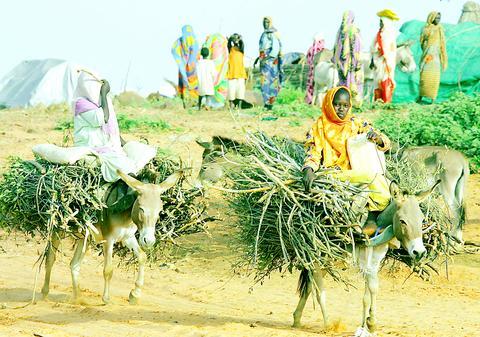
PHOTO: AFP
China, a permanent council member with veto power, said immediately after the vote that it would veto any future resolution that sought to impose sanctions on Sudan.
"I told the American government that the position of my government on sanctions is a firm one," said China's UN Ambassador Wang Guangya. "We always believe that sanctions is not a helpful means to achieve political objectives. It will only make matters worse."
The resolution adopted Saturday says the council would have to meet again to consider sanctions against Sudan's petroleum sector or other punitive measures if the government doesn't act quickly to stop the violence and bring the perpetrators to justice -- or if it doesn't cooperate with an African Union monitoring force.
The resolution strongly endorses the deployment of a beefed-up African Union force with an expanded monitoring mission that would actively try to prevent attacks and mediate to stop the conflict from escalating. More than 50,000 people have already died and over 1.2 million have fled their homes to escape the violence.
It also authorizes Secretary-General Kofi Annan, who was in the council chamber for the vote, to rapidly appoint an international commission to investigate reports of human rights violations in Darfur and determine "whether or not acts of genocide have occurred."
Last week, US President George W. Bush's administration for the first time called the attacks "genocide," a crime punishable under a 1948 UN convention.
Sudan's UN Ambassador Elfatih Erwa said the government would implement the "unfair" resolution despite "the injustices it contains." He accused the US of introducing it solely to achieve "the political objectives" of Bush's administration and Congress -- a charge immediately rejected by US Ambassador John Danforth.
While the US Congress "believes it is the only conscience of the world, and indeed that they have the divine right to decide on the destinies of peoples," Erwa said, millions of people see "the shortcomings and the faults" of the US including the killing of civilians in Afghanistan and Iraq and inflicting "torture on prisoners and innocent people in prisons in Afghanistan, Iraq and Guantanamo."
Danforth denounced the "unseemly and uncalled-for attack on the United States."
"President Bush's interest in Sudan has been intense, maybe ever since he took office," said Danforth noting that the president appointed him as his envoy to Sudan five days before the Sept. 11, 2001 terrorist attacks.
"This is not something that comes in an election year. This is something that he has ... been personally involved in for a long, long time."
But China's Wang appeared to agree with Erwa, saying some council members questioned the timing of the resolution in relation "to domestic politics."
Bush is up for re-election on Nov. 2 in a close race with Democrat John Kerry.
The US revised the resolution three times, each time softening language to try to get broader support and avert a Chinese veto. It was only after a last-minute meeting between Danforth and Wang, who unsuccessfully sought additional changes, that Beijing said it would abstain rather than exercise its veto power.
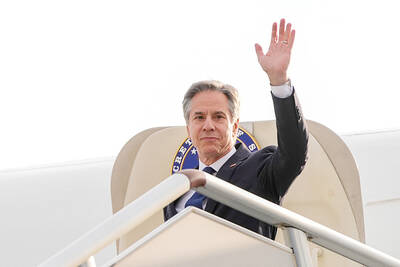
‘IN A DIFFERENT PLACE’: The envoy first visited Shanghai, where he attended a Chinese basketball playoff match, and is to meet top officials in Beijing tomorrow US Secretary of State Antony Blinken yesterday arrived in China on his second visit in a year as the US ramps up pressure on its rival over its support for Russia while also seeking to manage tensions with Beijing. The US diplomat tomorrow is to meet China’s top brass in Beijing, where he is also expected to plead for restraint as Taiwan inaugurates president-elect William Lai (賴清德), and to raise US concerns on Chinese trade practices. However, Blinken is also seeking to stabilize ties, with tensions between the world’s two largest economies easing since his previous visit in June last year. At the
Nearly half of China’s major cities are suffering “moderate to severe” levels of subsidence, putting millions of people at risk of flooding, especially as sea levels rise, according to a study of nationwide satellite data released yesterday. The authors of the paper, published by the journal Science, found that 45 percent of China’s urban land was sinking faster than 3mm per year, with 16 percent at more than 10mm per year, driven not only by declining water tables, but also the sheer weight of the built environment. With China’s urban population already in excess of 900 million people, “even a small portion

UNSETTLING IMAGES: The scene took place in front of TV crews covering the Trump trial, with a CNN anchor calling it an ‘emotional and unbelievably disturbing moment’ A man who doused himself in an accelerant and set himself on fire outside the courthouse where former US president Donald Trump is on trial has died, police said yesterday. The New York City Police Department (NYPD) said the man was declared dead by staff at an area hospital. The man was in Collect Pond Park at about 1:30pm on Friday when he took out pamphlets espousing conspiracy theories, tossed them around, then doused himself in an accelerant and set himself on fire, officials and witnesses said. A large number of police officers were nearby when it happened. Some officers and bystanders rushed

Beijing is continuing to commit genocide and crimes against humanity against Uyghurs and other Muslim minorities in its western Xinjiang province, U.S. Secretary of State Antony Blinken said in a report published on Monday, ahead of his planned visit to China this week. The State Department’s annual human rights report, which documents abuses recorded all over the world during the previous calendar year, repeated language from previous years on the treatment of Muslims in Xinjiang, but the publication raises the issue ahead of delicate talks, including on the war in Ukraine and global trade, between the top U.S. diplomat and Chinese


 RSS
RSS