


With paper bills so rancid even lepers hate to touch them, French-speaking West Africa got down to serious money-laundering yesterday, in a massive, eight-country campaign to retire more than 1 billion euros (US$1.22 billion) worth of decaying currency seen as much as vectors of disease as units of exchange.
The cash campaign -- already putting revamped, virgin bills into circulation -- aims to replace bills in circulation since 1992 that officials of the African Financial Community (CFA) say are deteriorating beyond use and ripe for counterfeiting.
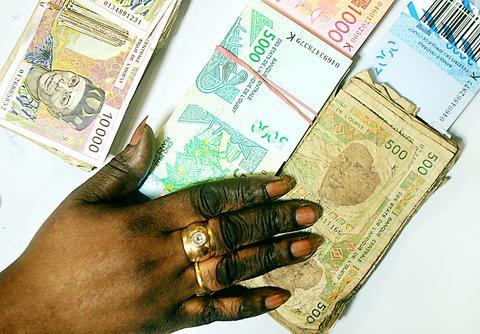
PHOTO: AP
Not to mention smelly.
"The old ones, they are just disgusting," merchant Mohammed Hussein said at his wood-shelf store front in Dakar, grimacing at a dank note sagging limply between his pinched thumbs and forefingers.
"Ninety-five percent of people who fall sick are because of filthy money," Hussein said, pulling out a bottle of liquid soap he keeps under the counter for every post-purchase scrub-down.
"You take a bill, you send it to a lab for analysis, you're going to find three million germs," he added, lathering.
In a nearby market, fish vendor Oumy Diouf protested that she tries her best to keep the bills clean.
"But sometimes our hands get wet and then we have to take money from the client,'' she explained, with suspiciously bloated fish piled on the floor around her, the hacking blade of an employee sending fish scales flying. A sewer ran open nearby.
Diouf smiled apologetically and handed a customer a fish -- followed by a fish-wet note in change.
The unloved banknotes will soon be a thing of the past. As of yesterday, West Africans have until Dec. 31 to turn in the old bills for new ones. From Jan. 1, only the new bills and coins are legal tender.
Of the eight countries affected, seven are former French colonies: Senegal, Mali, Burkina Faso, Ivory Coast, Niger, Benin and Togo, plus the former Portuguese colony of Guinea-Bissau.
Economists credit their common currency -- which predated Europe's shared euro currency by decades -- with helping promote trade and keep inflation to a developing-world success of 2 to 3 percent. Its value -- just over 500 francs to the US dollar, and 600 to the euro -- is pegged to the euro, the exchange rate guaranteed by France. By some accounts, the switch was prompted in part by a series of big-money bank robberies in Burkina Faso and Ivory Coast.
The thefts left reported millions of CFA (millions of euros/dollars) in illegal limbo.
The Dakar, Senegal-based Central Bank of West Africa, which handles the currency, refused to comment on whether the heists prompted the currency overhaul. Bank officials have said only that the change is meant to get rid of dirty money, literally and figuratively.
Counterfeiting since 2000 has been so rife that some merchants refuse to take the largest notes in the old-style currency.
The new bills -- with revised designs but the same brightly colored themes of African art and animals -- sport shiny strips to discourage faking.

Republican US lawmakers on Friday criticized US President Joe Biden’s administration after sanctioned Chinese telecoms equipment giant Huawei unveiled a laptop this week powered by an Intel artificial intelligence (AI) chip. The US placed Huawei on a trade restriction list in 2019 for contravening Iran sanctions, part of a broader effort to hobble Beijing’s technological advances. Placement on the list means the company’s suppliers have to seek a special, difficult-to-obtain license before shipping to it. One such license, issued by then-US president Donald Trump’s administration, has allowed Intel to ship central processors to Huawei for use in laptops since 2020. China hardliners
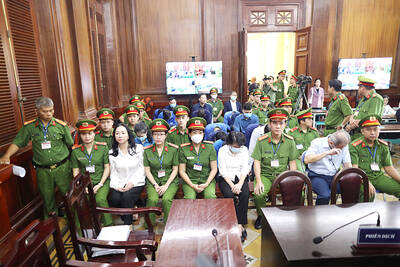
A top Vietnamese property tycoon was on Thursday sentenced to death in one of the biggest corruption cases in history, with an estimated US$27 billion in damages. A panel of three hand-picked jurors and two judges rejected all defense arguments by Truong My Lan, chair of major developer Van Thinh Phat, who was found guilty of swindling cash from Saigon Commercial Bank (SCB) over a decade. “The defendant’s actions ... eroded people’s trust in the leadership of the [Communist] Party and state,” read the verdict at the trial in Ho Chi Minh City. After the five-week trial, 85 others were also sentenced on

Conjoined twins Lori and George Schappell, who pursued separate careers, interests and relationships during lives that defied medical expectations, died this month in Pennsylvania, funeral home officials said. They were 62. The twins, listed by Guinness World Records as the oldest living conjoined twins, died on April 7 at the Hospital of the University of Pennsylvania, obituaries posted by Leibensperger Funeral Homes of Hamburg said. The cause of death was not detailed. “When we were born, the doctors didn’t think we’d make 30, but we proved them wrong,” Lori said in an interview when they turned 50, the Philadelphia Inquirer reported. The
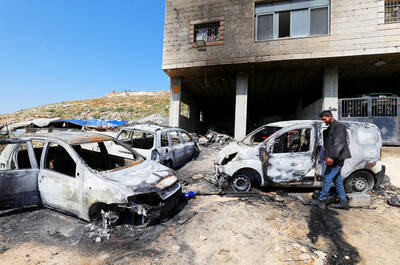
RAMPAGE: A Palestinian man was left dead after dozens of Israeli settlers searching for a missing 14-year-old boy stormed a village in the Israeli-occupied West Bank US President Joe Biden on Friday said he expected Iran to attack Israel “sooner, rather than later” and warned Tehran not to proceed. Asked by reporters about his message to Iran, Biden simply said: “Don’t,” underscoring Washington’s commitment to defend Israel. “We are devoted to the defense of Israel. We will support Israel. We will help defend Israel and Iran will not succeed,” he said. Biden said he would not divulge secure information, but said his expectation was that an attack could come “sooner, rather than later.” Israel braced on Friday for an attack by Iran or its proxies as warnings grew of


 RSS
RSS