


The Korean Peninsula is probably the most dangerous place on earth, made worse by those who extrapolate dodgy intelligence to "worst-case" scenarios that become the sand on which policy is founded.
In reality, Europe being threatened by North Korea's nuclear missiles is about as likely as the Pope converting to Islam. The most "pessimistic" estimated range of Pyongyang's projected Taepodong 2 missile would fall well short. Even concerns over last week's "mushroom cloud" in the north-east were quickly dismissed by the US and South Korea.
The truth is that North Korea is changing: it wants to come in from the cold. A country seen by many as the final remnant of the Cold War is trying to transform itself, driven by need, and necessity to embrace the market. These steps signify a willingness for engagement not seen before, but they have been overshadowed by the "nuclear crisis" triggered in Octo-ber 2002 when Pyongyang admitted to having the "know-how," but not the technology, for a highly enriched uranium route to nuclear weapons.
In fact, North Korea didn't trust the US to keep to the 1994 framework agreement which promised -- in exchange for the freezing and dismantling of Russian-designed reactors capable of producing weapons-grade plutonium -- a lifting of the 50-year economic embargo; normalization of relations; a formal commitment not to use nuclear weapons against North Korea; two proliferation-resistant nuclear reactors; and an interim supply of oil.
Pyongyang had a point. The US negotiators in 1994 were confident that after the collapse of the Soviet empire, North Korea was sure to follow. They failed to take into account that, in contrast to central and eastern Europe, North Korea's was an indigenous regime rooted in the country's history and culture.
Now, the revelation that Seoul had its own clandestine nuclear program, which went further than the one Pyongyang has admitted, undermines the righteous indignation of the US. On top of that, North Korea's military budget is a quarter of Seoul's. South Korea spends more on defense each year than the North's entire GDP.
In the 1990s, North Korea suffered badly from a series of natural and man-made disasters, including droughts and floods, and from Russia and China switching from friendship prices and counter trade to demanding pre-payment in hard currency. Starvation killed up to 3 million people, one in eight of the population. Substantial humanitarian aid slowly stabilized the situation. The World Food Program now estimates that "only" 250,000 children under six are suffering from chronic malnutrition, which will leave them stunted and brain damaged, while a million are badly malnourished. Again this year, there will be a 20 percent shortfall of cereals: 1m tonnes.
It took a while, but in July 2002 North Korea embraced the market. Salaries were increased 18-fold, food prices 26-fold, and the exchange rate for the euro -- Pyongyang's official currency for foreign exchange transactions -- 70-fold. Farmers were set attainable targets for food delivery to the state, with the surplus allowed to be sold in new markets set up around the country. As the vice-minister of state planning, Pak Chang-ryun, said: "It has worked better than fertilizer in improving productivity."
Last month North Korea went a step further, acknowledging that central planning must be curtailed because it loses local knowledge and undermines creativity. In the future, factories will be set financial targets. Managers will be able to hire and fire at will, and choose what to produce and how much to charge.
The new markets are flourishing. Crowds are buying everything from Spanish oranges to ice-cream makers. But rice price inflation is running at 400-500 percent per annum. Despite the people's distribution service delivering about 50 percent of daily needs at hugely subsidised prices, up to 5 million people no longer earn enough to feed themselves. The problem is particularly acute in the heavily industrialized northeastern cities, where few factories are working and access to homegrown food or humanitarian aid is limited. A new rich class is emerging, and they are beginning to appropriate what little is available.
Freeing the farmers to go to the market is having an impact on productivity, despite inflation. However, the same is not true in the manufacturing sector, where the boost in demand is merely sucking in imports. Without development aid to kick-start the economy, the situation will not change. North Korea, once a developed country with 70 percent of the workforce in manufacturing, is experiencing a re-ruralization of the economy, with factory managers laying off industrial workers to grow food instead.
What can be done? It is in our interest to negotiate away the country's nuclear program -- though Pakistan, the source of the technology sold or traded to North Korea and others, seems to be mysteriously escaping global condemnation. It is clear that the program can be ended with a package of economic and political incentives. If we can set the North Koreans on the broad path to emulating China and Vietnam, the world will be a safer place. With a changing regime instead of regime change, we can move on to restart the human rights dialogue.

Republican US lawmakers on Friday criticized US President Joe Biden’s administration after sanctioned Chinese telecoms equipment giant Huawei unveiled a laptop this week powered by an Intel artificial intelligence (AI) chip. The US placed Huawei on a trade restriction list in 2019 for contravening Iran sanctions, part of a broader effort to hobble Beijing’s technological advances. Placement on the list means the company’s suppliers have to seek a special, difficult-to-obtain license before shipping to it. One such license, issued by then-US president Donald Trump’s administration, has allowed Intel to ship central processors to Huawei for use in laptops since 2020. China hardliners
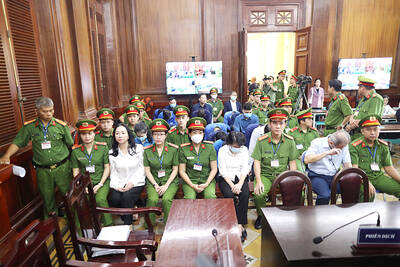
A top Vietnamese property tycoon was on Thursday sentenced to death in one of the biggest corruption cases in history, with an estimated US$27 billion in damages. A panel of three hand-picked jurors and two judges rejected all defense arguments by Truong My Lan, chair of major developer Van Thinh Phat, who was found guilty of swindling cash from Saigon Commercial Bank (SCB) over a decade. “The defendant’s actions ... eroded people’s trust in the leadership of the [Communist] Party and state,” read the verdict at the trial in Ho Chi Minh City. After the five-week trial, 85 others were also sentenced on

Conjoined twins Lori and George Schappell, who pursued separate careers, interests and relationships during lives that defied medical expectations, died this month in Pennsylvania, funeral home officials said. They were 62. The twins, listed by Guinness World Records as the oldest living conjoined twins, died on April 7 at the Hospital of the University of Pennsylvania, obituaries posted by Leibensperger Funeral Homes of Hamburg said. The cause of death was not detailed. “When we were born, the doctors didn’t think we’d make 30, but we proved them wrong,” Lori said in an interview when they turned 50, the Philadelphia Inquirer reported. The
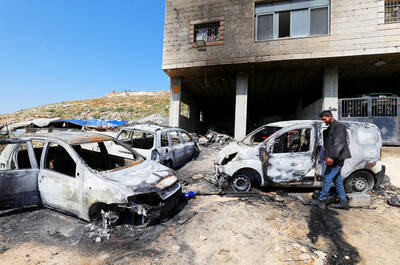
RAMPAGE: A Palestinian man was left dead after dozens of Israeli settlers searching for a missing 14-year-old boy stormed a village in the Israeli-occupied West Bank US President Joe Biden on Friday said he expected Iran to attack Israel “sooner, rather than later” and warned Tehran not to proceed. Asked by reporters about his message to Iran, Biden simply said: “Don’t,” underscoring Washington’s commitment to defend Israel. “We are devoted to the defense of Israel. We will support Israel. We will help defend Israel and Iran will not succeed,” he said. Biden said he would not divulge secure information, but said his expectation was that an attack could come “sooner, rather than later.” Israel braced on Friday for an attack by Iran or its proxies as warnings grew of


 RSS
RSS