


North Korea has invited a British diplomat to visit the site of an explosion that shot a huge mushroom cloud into the sky to verify claims that it was the planned demolition of a mountain for a hydroelectric project, a British envoy said yesterday.
Experts from the US and elsewhere say they don't believe Thursday's blast near the Chinese border was a nuclear test. But a US official cited indications the North is trying to conduct one.
North Korea denounced the speculation over a nuclear test as part of a "preposterous smear campaign" aimed at diverting world attention away from revelations about past South Korean nuclear activities, Pyongyang's official KCNA news agency said.
Speaking on the condition of anonymity, a US official said it isn't clear what happened. While the official said there isn't any reason to believe it was a nuclear test, the official also couldn't confirm the North Koreans' explanation on Monday that it was linked to construction of a hydroelectric project.
A UN official said the Comprehensive Nuclear-Test-Ban Treaty Organization, which monitors nuclear activity, had seen no signs that the explosion was a nuclear blast.
KCNA said "blastings at construction sites of hydro-power stations" had taken place.
North Korean Foreign Minister Paek Nam-sun made the same offer to visiting British Foreign Office minister Bill Rammell.
"He gave me an explanation that it wasn't an accident, it wasn't a nuclear explosion, but in fact was a deliberate detonation of a mountain as part of a hydroelectricity pro-ject," Rammell said in Beijing after a four-day visit to the North.
North Korea told Britain's ambassador in Pyongyang, David Slinn, that he can visit the blast site along with any other foreign ambassadors in Pyongyang who want to join him, Rammell said.
Slinn hoped to organize the trip as early as yesterday, he said.
South Korean Unification Minister Chung Dong-young said his country would look into whether the site "is an area for constructing a hydroelectric power plant," according to Yonhap news agency.
Andrew Kennedy, head of the Asia program at the Royal United Services Institute in London, said the North Korean explanation has "a ring of truth to it" and that if diplomats were allowed to take a Geiger counter, they would easily know whether a nuclear blast occurred.
"The North Koreans would know that with the intelligence and the surveillance satellites that the West has, it would be very easy to check. That is backed up by the North's agreement to allow the visiting British diplomat to go to the site and inspect it," he said.
"North Korea is usually trying to convince people that they do have a nuclear capability ... It's not in their interest to keep a nuclear test quiet," he added.
The size of the explosion and a 3km-wide mushroom cloud on the 56th anniversary of the founding of North Korea had raised speculation that it might be a nuclear test.
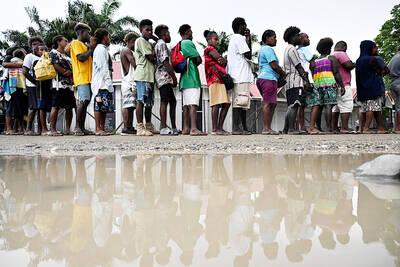
SEEKING CHANGE: A hospital worker said she did not vote in previous elections, but ‘now I can see that maybe my vote can change the system and the country’ Voting closed yesterday across the Solomon Islands in the south Pacific nation’s first general election since the government switched diplomatic allegiance from Taiwan to Beijing and struck a secret security pact that has raised fears of the Chinese navy gaining a foothold in the region. The Solomon Islands’ closer relationship with China and a troubled domestic economy weighed on voters’ minds as they cast their ballots. As many as 420,000 registered voters had their say across 50 national seats. For the first time, the national vote also coincided with elections for eight of the 10 local governments. Esther Maeluma cast her vote in the
Nearly half of China’s major cities are suffering “moderate to severe” levels of subsidence, putting millions of people at risk of flooding, especially as sea levels rise, according to a study of nationwide satellite data released yesterday. The authors of the paper, published by the journal Science, found that 45 percent of China’s urban land was sinking faster than 3mm per year, with 16 percent at more than 10mm per year, driven not only by declining water tables, but also the sheer weight of the built environment. With China’s urban population already in excess of 900 million people, “even a small portion

UNSETTLING IMAGES: The scene took place in front of TV crews covering the Trump trial, with a CNN anchor calling it an ‘emotional and unbelievably disturbing moment’ A man who doused himself in an accelerant and set himself on fire outside the courthouse where former US president Donald Trump is on trial has died, police said yesterday. The New York City Police Department (NYPD) said the man was declared dead by staff at an area hospital. The man was in Collect Pond Park at about 1:30pm on Friday when he took out pamphlets espousing conspiracy theories, tossed them around, then doused himself in an accelerant and set himself on fire, officials and witnesses said. A large number of police officers were nearby when it happened. Some officers and bystanders rushed

HYPOCRISY? The Chinese Ministry of Foreign Affairs yesterday asked whether Biden was talking about China or the US when he used the word ‘xenophobic’ US President Joe Biden on Wednesday called for a hike in steel tariffs on China, accusing Beijing of cheating as he spoke at a campaign event in Pennsylvania. Biden accused China of xenophobia, too, in a speech to union members in Pittsburgh. “They’re not competing, they’re cheating. They’re cheating and we’ve seen the damage here in America,” Biden said. Chinese steel companies “don’t need to worry about making a profit because the Chinese government is subsidizing them so heavily,” he said. Biden said he had called for the US Trade Representative to triple the tariff rates for Chinese steel and aluminum if Beijing was


 RSS
RSS