


They lived in secret. Their understanding was that they could well die that way, too.
At least 11 of them -- members of Russia's most elite special forces teams, the Alfa and Vympel units -- died as they tried to rescue hundreds of hostages in the deadly climax to the attack at Middle School No. 1 in the southern town of Beslan. Some of them, their names withheld by the authorities, were buried over the past few days in a little-known section of this huge cemetery just outside of Moscow.
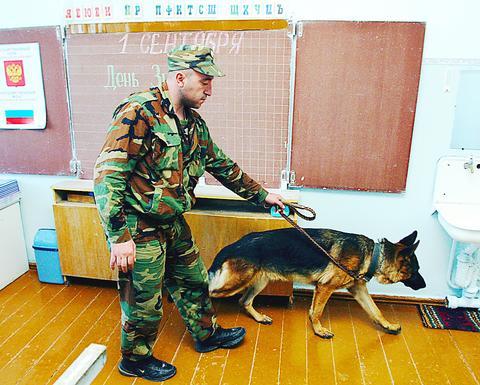
PHOTO: AP
But the precise circumstances of their deaths remain unexplained, fueling bitter questions about whether Russian government tactics may have cost lives. The questions also put an unaccustomed focus on some of the country's most covert military units in the aftermath of a horrific incident that resulted in the deaths of more than 300 hostages, about half of them children.
Alfa and Vympel are often compared to Delta Force, the elite US Army commando unit, and Britain's fabled Special Air Service. Founded as units of the KGB, the Soviet Union's intelligence and internal security agency, Alfa and Vympel now operate under its successor, the FSB, and are thought to have 400 to 500 officers altogether.
Russia's first anti-terrorism force, Alfa, was established in 1974 by Yuri Andropov, then the chairman of the KGB. Vympel, which means banner, was started several years later, and lacks some of Alfa's clout and aura. Members of both units are specially selected from among FSB officers and undergo five years of intense training.
Now, like New York City police officers and firefighters after Sept. 11, 2001, these spetznaz, or special forces fighters, are national heroes, but with a catch -- their nation knows little about them.
"They died defending Russia's children," said Mikhail Odinokov, the head manager of the Nikolsko-Arkhangelskoe cemetery, as he led a visitor to the manicured pine grove that is the private special forces cemetery, patrolled by the police and monitored by security cameras.
Near him, mourners heaped so many flowers and banners -- one read, "Tragically killed in the fight on terror"; another, "From Grandma" -- on the graves that they obscured most of the victims' names in the only place where they have been publicly recorded.
How did these men die? Odinokov paused and said, "We can't give out that kind of information."
His colleague following behind, a retired special forces officer, snorted.
"Why can't we? They are heroes, like your firefighters in America. People should know who they are."
Both men fell silent.
The ages of the dead ranged from 21 to 36. And a few names carved into the dark gray granite gravestones were visible: Alexei Turkin, born 1975. Dmitri Razumovsky, born 1968. Date of death: Sept. 3, 2004.
A day after the funerals, friends and colleagues, possibly special forces soldiers, came to lay flowers or to leave traditional funeral offerings, like a glass of vodka and a slice of bread, cigarettes and candles. Some wept, and they waved off requests for comment by a reporter.
The Russian military operation at Beslan "was a disaster" on the order of that experienced by US Special Forces in their ill-fated "Black Hawk Down" battle in Somalia in 1993, and their failed attempt to free US hostages in Iran a quarter-century ago, said Roger McDermott, a senior fellow and Eurasian military analyst at the University of Kent in England and a senior fellow of the Jamestown Foundation. But, he said, the men performed heroically.
"They were caught off guard, but largely trying to do their best trying to save these children's lives," he said.
Infuriated and grieving Russians want answers to many questions: Why did intelligence agencies fail to pick up on the hostage-takers' planning for the siege? How did the armed attackers make their way through checkpoints? Why were basic security measures not taken after the school was seized? Why was the final Russian military action so haphazard, and why did it result in so many deaths?
The official explanation, put forth by the Russian general prosecutor's office, is that an explosion in the school went off by accident and that as hostages began fleeing and their captors began shooting at them, the Alfa and Vympel forces stormed the building. According to this version, the commandos were then caught in crossfire when residents of Beslan began firing toward the school from behind.
Three Alfa and seven Vympel officers died in the fight, and another wounded commando died last week. At least 30 unit members were seriously wounded.
"They saved Russia's reputation when they rushed into battle without a plan, and without any bulletproof jackets -- in effect, contrary to their own professional training," Yulia Latynina, an independent political commentator, wrote in the newspaper Novaya Gazeta.

Conjoined twins Lori and George Schappell, who pursued separate careers, interests and relationships during lives that defied medical expectations, died this month in Pennsylvania, funeral home officials said. They were 62. The twins, listed by Guinness World Records as the oldest living conjoined twins, died on April 7 at the Hospital of the University of Pennsylvania, obituaries posted by Leibensperger Funeral Homes of Hamburg said. The cause of death was not detailed. “When we were born, the doctors didn’t think we’d make 30, but we proved them wrong,” Lori said in an interview when they turned 50, the Philadelphia Inquirer reported. The
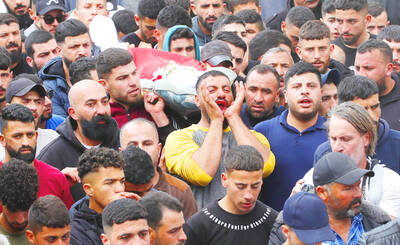
IN PURSUIT: Israel’s defense minister said the revenge attacks by Israeli settlers would make it difficult for security forces to find those responsible for the 14-year-old’s death Israeli Prime Minister Benjamin Netanyahu on Saturday condemned the “heinous murder” of an Israeli teenager in the occupied West Bank as attacks on Palestinian villages intensified following news of his death. After Benjamin Achimeir, 14, was reported missing near Ramallah on Friday, hundreds of Jewish settlers backed by Israeli forces raided nearby Palestinian villages, torching vehicles and homes, leaving at least one villager dead and dozens wounded. The attacks escalated in several villages on Saturday after Achimeir’s body was found near the Malachi Hashalom outpost. Agence France-Presse correspondents saw smoke rising from burned houses and fields. Mayor Amin Abu Alyah, of the
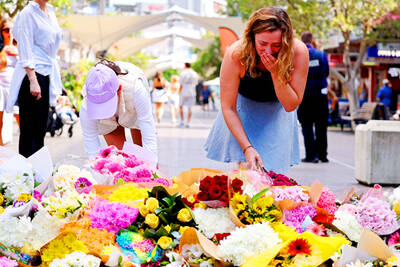
Australian police yesterday said a 40-year-old itinerant with mental illness was behind a Sydney shopping center stabbing rampage that killed six people, including a new mum whose nine-month-old baby is still in hospital with serious wounds. New South Wales Police Assistant Commissioner Anthony Cooke said the assailant — who was shot and killed by a senior police officer at the scene on Saturday — was Queensland man Joel Cauchi. Five women and one male security guard were killed in the attack as Cauchi roved through a packed shopping center in the city’s Bondi Junction neighborhood with a large knife. Twelve more people
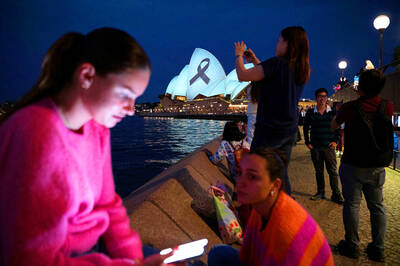
A prominent Christian leader has allegedly been stabbed at the altar during a Mass yesterday in southwest Sydney. Bishop Mar Mari Emmanuel was saying Mass at Christ The Good Shepherd Church in Wakeley just after 7pm when a man approached him at the altar and allegedly stabbed toward his head multiple times. A live stream of the Mass shows the congregation swarm forward toward Emmanuel before it was cut off. The church leader gained prominence during the COVID-19 pandemic, amassing a large online following, Officers attached to Fairfield City police area command attended a location on Welcome Street, Wakeley following reports a number


 RSS
RSS