


Legislative candidates made their final appeals to voters yesterday in a fiercely contested political showdown that could give pro-democracy opposition figures the most clout they've had since Hong Kong was returned to China.
Politicians sought to rally supporters as they wrapped up a campaign marred by sex and money scandals, and by allegations that Beijing had launched an orchestrated intimidation drive to sway votes away from the pro-democracy camp.
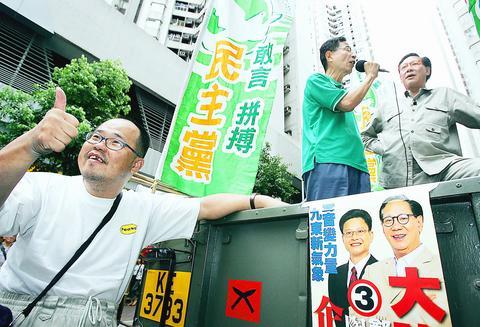
PHOTO: REUTERS
Today rank-and-file voters will directly pick 30 of the territory's 60 lawmakers. The other half are chosen by a relatively small group of special interest voters, such as business leaders, doctors and accountants, who tend to back pro-Beijing candidates.
Pro-Beijing politicians were campaigning hard yesterday on Hong Kong Island, hoping to knock out the territory's best-known opposition figure, Democratic Party lawmaker Martin Lee (
The chairman of the pro-Beijing Democratic Alliance for the Betterment of Hong Kong, Ma Lik (
"It's a very tight race," Lee acknowledged. "I'm doing my best to go for it."
Lee brought in help from a popular former radio host, Albert Cheng (
Hong Kong election officials have promised that today's polling will be free and fair.
The mass-circulation tabloid Apple Daily urged the public to turn out and back pro-democracy candidates.
"Tomorrow we can use our votes to continue the cry for democracy, to urge the central government to address and value our democratic aspirations," Apple Daily editorialized.
"How can we just let such an opportunity slip by?" the editorial said.
Pro-democracy candidates, viewed as troublemakers or even "traitors" by Beijing, are expected to win most of the popular vote, but to fall short of a legislative majority under rules critics say are unfair.
Beijing is nervously watching the outcome.
Although its political foes are unlikely to get a legislative majority, analysts predict the pro-democracy camp might end up with about 25 to 28 seats -- up from 22 now.
That would be enough to cause problems for Chief Executive Tung Chee-hwa (
The political atmosphere in Hong Kong has been highly charged since 500,000 people stunned Beijing and Hong Kong leaders by turning out on July 1 last year to march against an anti-subversion bill viewed as a threat to freedoms. Tung had to withdraw it, but voters responded by punishing pro-Bei-jing politicians with a huge defeat in November local council races.
Many Hong Kongers have been clamoring for the right to directly pick their leader in 2007 and all lawmakers in 2008, but Beijing stirred a public outrage by ruling it out -- a decision expected to create a backlash against China's allies in the election.
Critics said Beijing had violated its agreement to leave Hong Kong with a great deal of local autonomy after Britain returned the territory to China in July 1997.
Key facts and figures:
* This year's elections are considered the most democratic as six more directly elected seats are up for grabs than in the last legislative poll, in 2000.
* 159 candidates are vying for 60 seats in the chamber. Some 3.2 million of the city's 6.8 million residents are registered to vote.
* Pollsters expect a record turnout of up to 60 percent, or 1.92 million. The 2000 elections had a 53 percent turnout.
* Lawmakers represent 32 different constituencies:
30 seats are spread among five Geographical Constituencies (GCs), which contain up to seven seats each.
The balance is distributed among 27 Functional Constituencies (FC), which represent commercial and industrial sectors and trade groups. Most are single-seat constituencies, but that representing the labor sector has three.
* FC lawmakers are elected by block or individual vote. FCs are generally regarded as an undemocratic blot on the city's political landscape as each FC elector has up to 42 times the voting power of GC electors.
* Voting will take place from 7.30am to 10:30pm at 501 polling stations.
* The first results are expected around midnight and the final results are due around 2:00am.
Source:AFP
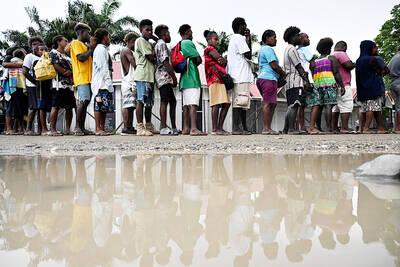
SEEKING CHANGE: A hospital worker said she did not vote in previous elections, but ‘now I can see that maybe my vote can change the system and the country’ Voting closed yesterday across the Solomon Islands in the south Pacific nation’s first general election since the government switched diplomatic allegiance from Taiwan to Beijing and struck a secret security pact that has raised fears of the Chinese navy gaining a foothold in the region. The Solomon Islands’ closer relationship with China and a troubled domestic economy weighed on voters’ minds as they cast their ballots. As many as 420,000 registered voters had their say across 50 national seats. For the first time, the national vote also coincided with elections for eight of the 10 local governments. Esther Maeluma cast her vote in the
Nearly half of China’s major cities are suffering “moderate to severe” levels of subsidence, putting millions of people at risk of flooding, especially as sea levels rise, according to a study of nationwide satellite data released yesterday. The authors of the paper, published by the journal Science, found that 45 percent of China’s urban land was sinking faster than 3mm per year, with 16 percent at more than 10mm per year, driven not only by declining water tables, but also the sheer weight of the built environment. With China’s urban population already in excess of 900 million people, “even a small portion

UNSETTLING IMAGES: The scene took place in front of TV crews covering the Trump trial, with a CNN anchor calling it an ‘emotional and unbelievably disturbing moment’ A man who doused himself in an accelerant and set himself on fire outside the courthouse where former US president Donald Trump is on trial has died, police said yesterday. The New York City Police Department (NYPD) said the man was declared dead by staff at an area hospital. The man was in Collect Pond Park at about 1:30pm on Friday when he took out pamphlets espousing conspiracy theories, tossed them around, then doused himself in an accelerant and set himself on fire, officials and witnesses said. A large number of police officers were nearby when it happened. Some officers and bystanders rushed

HYPOCRISY? The Chinese Ministry of Foreign Affairs yesterday asked whether Biden was talking about China or the US when he used the word ‘xenophobic’ US President Joe Biden on Wednesday called for a hike in steel tariffs on China, accusing Beijing of cheating as he spoke at a campaign event in Pennsylvania. Biden accused China of xenophobia, too, in a speech to union members in Pittsburgh. “They’re not competing, they’re cheating. They’re cheating and we’ve seen the damage here in America,” Biden said. Chinese steel companies “don’t need to worry about making a profit because the Chinese government is subsidizing them so heavily,” he said. Biden said he had called for the US Trade Representative to triple the tariff rates for Chinese steel and aluminum if Beijing was


 RSS
RSS