


New interrogation techniques at the scandal-plagued Abu Ghraib prison are yielding three times as many intelligence tips as in January, when commanders allowed controversial methods that have been labeled as torture.
The new methods have increased "high-value intelligence" reports from detainees from around 100 in January, when the Abu Ghraib scandal erupted, to 345 last month, the chief of detention operations in Iraq, Major General Geoffrey Miller, told reporters on Monday.
Miller, the former detention facility commander at Guantanamo Bay, asserted that civilian law-enforcement methods were more productive than the "hard" methods -- like stress positions and sleep deprivation -- that he once advocated.
"I believe ... interrogations based on rapport are the most effective way to develop intelligence and increase the validity of intelligence," he said.
Since he arrived in April, Miller has overseen a dramatic reform of interrogation procedures at Abu Ghraib as seven prison guards face criminal charges. More than two dozen intelligence officers are also expected to be indicted.
He rolled back the very same controversial measures he recommended be employed at the prison last August on a fact-finding mission as the military scrambled desperately for intelligence about a fledgling insurgency. Of those notorious tactics that were misused by intelligence officers and prison guards at Abu Ghraib last autumn -- climaxing in the physical and sexual abuse of detainees -- the only coercive method still allowed, with authorization from US generals, is solitary confinement for over 30 days.
Miller has apparently broken with the Pentagon's post Sept. 11 inclination for "extraordinary methods" to obtain intelligence, and instead is relying on civilian law enforcement procedures to defeat the insurgency.
Procedures are now "similar to what you would see civilian law enforcement authorities use ... because we think, No. 1, they get very good intelligence, and ... the accuracy improves."
At the center of this is a gentler approach.
"In my experience, to develop a rapport and treat the detainee with respect and dignity allows this rapport to develop rapidly and this exchange of information to go on very quickly," he said.
The interrogation teams at Abu Ghraib are now stocked with reservists who work in civilian law enforcement back home. Training for the teams was supervised until last month by a 30-year veteran of the Chicago police homicide division.
Miller said the new approach paid dividends last month when the number of intelligence reports jumped by 40 percent from July.

Republican US lawmakers on Friday criticized US President Joe Biden’s administration after sanctioned Chinese telecoms equipment giant Huawei unveiled a laptop this week powered by an Intel artificial intelligence (AI) chip. The US placed Huawei on a trade restriction list in 2019 for contravening Iran sanctions, part of a broader effort to hobble Beijing’s technological advances. Placement on the list means the company’s suppliers have to seek a special, difficult-to-obtain license before shipping to it. One such license, issued by then-US president Donald Trump’s administration, has allowed Intel to ship central processors to Huawei for use in laptops since 2020. China hardliners

Conjoined twins Lori and George Schappell, who pursued separate careers, interests and relationships during lives that defied medical expectations, died this month in Pennsylvania, funeral home officials said. They were 62. The twins, listed by Guinness World Records as the oldest living conjoined twins, died on April 7 at the Hospital of the University of Pennsylvania, obituaries posted by Leibensperger Funeral Homes of Hamburg said. The cause of death was not detailed. “When we were born, the doctors didn’t think we’d make 30, but we proved them wrong,” Lori said in an interview when they turned 50, the Philadelphia Inquirer reported. The
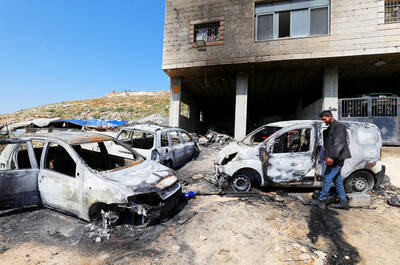
RAMPAGE: A Palestinian man was left dead after dozens of Israeli settlers searching for a missing 14-year-old boy stormed a village in the Israeli-occupied West Bank US President Joe Biden on Friday said he expected Iran to attack Israel “sooner, rather than later” and warned Tehran not to proceed. Asked by reporters about his message to Iran, Biden simply said: “Don’t,” underscoring Washington’s commitment to defend Israel. “We are devoted to the defense of Israel. We will support Israel. We will help defend Israel and Iran will not succeed,” he said. Biden said he would not divulge secure information, but said his expectation was that an attack could come “sooner, rather than later.” Israel braced on Friday for an attack by Iran or its proxies as warnings grew of

IN PURSUIT: Israel’s defense minister said the revenge attacks by Israeli settlers would make it difficult for security forces to find those responsible for the 14-year-old’s death Israeli Prime Minister Benjamin Netanyahu on Saturday condemned the “heinous murder” of an Israeli teenager in the occupied West Bank as attacks on Palestinian villages intensified following news of his death. After Benjamin Achimeir, 14, was reported missing near Ramallah on Friday, hundreds of Jewish settlers backed by Israeli forces raided nearby Palestinian villages, torching vehicles and homes, leaving at least one villager dead and dozens wounded. The attacks escalated in several villages on Saturday after Achimeir’s body was found near the Malachi Hashalom outpost. Agence France-Presse correspondents saw smoke rising from burned houses and fields. Mayor Amin Abu Alyah, of the


 RSS
RSS