


US forces battled insurgents loyal to Shiite cleric Muqtada al-Sadr in the Baghdad slum of Sadr City yesterday, killing at least 34 people, including one US soldier, and injuring 193, US and Iraqi authorities said.
US tanks moved into the neighborhood and armored personnel carriers and Bradley fighting vehicles were deployed at key intersections. Ambulances with sirens wailing rushed the wounded to hospitals as plumes of black smoke rose into the sky.

PHOTO: AFP
Several warplanes flew over the sprawling neighborhood of more than 2 million.
In a different part of the Iraqi capital, a roadside bomb explosion targeted the Baghdad governor's convoy, killing two people but leaving him uninjured, the Interior Ministry said. Three of Governor Ali al-Haidri's bodyguards were also hurt in the attack yesterday in the western neighborhood of Hay al-Adel.
The fighting in Sadr City erupted when militants attacked US forces carrying out routine patrols, said US Army Captain Brian O'Malley.
"We just kept coming under fire," he said.
O'Malley said the US soldier was killed by small arms fire and that several others were wounded.
A senior Health Ministry official, Saad al-Amili, said a total of 33 people have been killed and 193 injured in the Sadr City clashes in the past 24 hours.
An al-Sadr spokesman in Baghdad, Sheik Raed al-Kadhimi, blamed what he described as intrusive US incursions into Sadr City and attempts to arrest the cleric's followers for the latest flare up.
"Our fighters have no choice but to return fire and to face the US forces and helicopters pounding our houses," al-Kadhimi said in a statement.
The renewed fighting came after a period of calm in the impoverished neighborhood after al-Sadr called on his followers last week to observe a cease-fire and announced that he planned to enter politics.
But al-Sadr aides later said peace talks in Sadr City between the cleric's representatives and interim Prime Minister Ayad Allawi's government had stalled, with the government refusing militant demands for US troops to keep out of the troubled district.
Al-Sadr led a three-week uprising in the holy city of Najaf that ended 10 days ago with a peace deal that allowed his Mahdi militia fighters to walk away with their guns. The combat in Najaf left thousands dead and devastated much of the city.
Many Mahdi militiamen are believed to have returned to their stronghold in Sadr City.
Yesterday's violence came a day after a suicide attack on a military convoy outside Fallujah killed seven US Marines and three Iraqi soldiers, US military officials said. It was the deadliest day for American forces in four months.
A group linked to Jordanian-born militant Abu Musab al-Zarqawi -- Tawhid and Jihad -- posted a statement yesterday on a militant Web site claiming responsibility for the slayings, describing them as "a martyr operation ... that targeted American soldiers and their mercenary apostate collaborators from the Iraqi army."
The force of the blast on a dusty stretch of wasteland 15 km north of Fallujah, a hotbed of Sunni insurgents, wrecked two Humvee vehicles and hurled the suicide car's engine far from the site, witnesses said.
The bombing underscored the challenges US commanders face in securing Fallujah and surrounding Anbar province, the heartland of a Sunni Muslim insurgency bent on driving coalition forces from the country.

Republican US lawmakers on Friday criticized US President Joe Biden’s administration after sanctioned Chinese telecoms equipment giant Huawei unveiled a laptop this week powered by an Intel artificial intelligence (AI) chip. The US placed Huawei on a trade restriction list in 2019 for contravening Iran sanctions, part of a broader effort to hobble Beijing’s technological advances. Placement on the list means the company’s suppliers have to seek a special, difficult-to-obtain license before shipping to it. One such license, issued by then-US president Donald Trump’s administration, has allowed Intel to ship central processors to Huawei for use in laptops since 2020. China hardliners
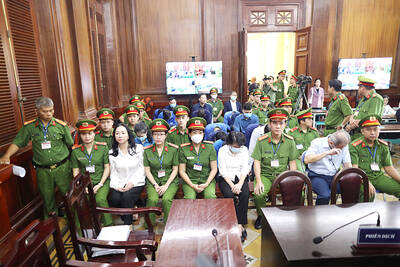
A top Vietnamese property tycoon was on Thursday sentenced to death in one of the biggest corruption cases in history, with an estimated US$27 billion in damages. A panel of three hand-picked jurors and two judges rejected all defense arguments by Truong My Lan, chair of major developer Van Thinh Phat, who was found guilty of swindling cash from Saigon Commercial Bank (SCB) over a decade. “The defendant’s actions ... eroded people’s trust in the leadership of the [Communist] Party and state,” read the verdict at the trial in Ho Chi Minh City. After the five-week trial, 85 others were also sentenced on

‘DELUSIONAL’: Targeting the families of Hamas’ leaders would not push the group to change its position or to give up its demands for Palestinians, Ismail Haniyeh said Israeli aircraft on Wednesday killed three sons of Hamas’ top political leader in the Gaza Strip, striking high-stakes targets at a time when Israel is holding delicate ceasefire negotiations with the militant group. Hamas said four of the leader’s grandchildren were also killed. Ismail Haniyeh’s sons are among the highest-profile figures to be killed in the war so far. Israel said they were Hamas operatives, and Haniyeh accused Israel of acting in “the spirit of revenge and murder.” The deaths threatened to strain the internationally mediated ceasefire talks, which appeared to gain steam in recent days even as the sides remain far
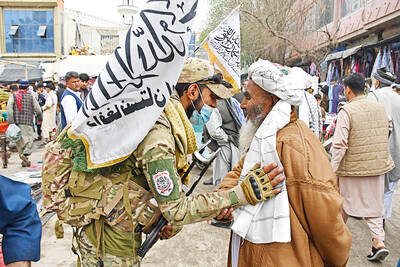
The Taliban’s reclusive supreme leader made a rare public appearance yesterday, an Afghan government spokesman said, leading thousands of worshipers in prayers marking Eid al-Fitr. Hibatullah Akhundzada has made only a handful of public appearances since inheriting the leadership of the Taliban in 2016 and leading the movement back to power with the withdrawal of US forces in 2021. Taliban government spokesman Zabihullah Mujahid said prayer in the largest mosque in Kandahar was “performed under the leadership of the supreme leader.” In a statement on X, he said the early-morning service “was attended by thousands of compatriots” in the southern province considered the


 RSS
RSS