


A US military review panel has ruled that 10 prisoners accused of links to Afghanistan's Taliban regime or the al-Qaeda network were properly classified as "enemy combatants" and should not be freed, an official said Saturday.
The panels have decided 29 of the 53 cases reviewed so far should continue to be held, said Navy Commander Beci Brenton, a Pentagon spokeswoman. There are about 585 men who are under review at the US outpost. The military has declined to provide details on the 29 cases. Brenton said the government is waiting for permission from the men's embassies.
The administrative hearings are separate from the military commissions, which began last week and have been set up to try prisoners charged with war crimes.
None of the men who have gone before the review tribunals have been charged -- a point of contention with the four prisoners' defense attorneys who say trials should not proceed before the men are able to challenge whether they should be classified as enemy combatants.
A 21-year-old and a 27-year-old who were accused al-Qaeda members refused to participate Saturday, becoming the 16th and 17th detainees to boycott the proceedings, Brenton said.
The younger detainee allegedly received weapons training at al-Qaeda's al-Farouq camp in Afghanistan and spent six months fighting against US coalition forces before surrendering. The older prisoner allegedly stayed at an al-Qaeda safe house after traveling to Afghanistan in October 2001. He allegedly helped fight the Northern Alliance, constructing circuit boards for explosives intended for use against US military forces.
Two other prisoners appeared before the tribunal but called no witnesses. The first was a 25-year-old accused of fighting for the Taliban in Konduz, Afghanistan. The second was a 46-year-old who allegedly trained at al-Farouq and met Osama bin Laden, the head of al-Qaeda, though the military declined to say when or where.
In the review hearings, the US military prohibits the release of the prisoners' names. It recently stopped providing nationalities of the men as well.
The review tribunals began on July 30 and are expected to last four months, but they may be hampered by a recent Supreme Court ruling that allows prisoners to challenge their detentions in civilian courts. The men have not been allowed to have attorneys present at the hearings.

Republican US lawmakers on Friday criticized US President Joe Biden’s administration after sanctioned Chinese telecoms equipment giant Huawei unveiled a laptop this week powered by an Intel artificial intelligence (AI) chip. The US placed Huawei on a trade restriction list in 2019 for contravening Iran sanctions, part of a broader effort to hobble Beijing’s technological advances. Placement on the list means the company’s suppliers have to seek a special, difficult-to-obtain license before shipping to it. One such license, issued by then-US president Donald Trump’s administration, has allowed Intel to ship central processors to Huawei for use in laptops since 2020. China hardliners

Conjoined twins Lori and George Schappell, who pursued separate careers, interests and relationships during lives that defied medical expectations, died this month in Pennsylvania, funeral home officials said. They were 62. The twins, listed by Guinness World Records as the oldest living conjoined twins, died on April 7 at the Hospital of the University of Pennsylvania, obituaries posted by Leibensperger Funeral Homes of Hamburg said. The cause of death was not detailed. “When we were born, the doctors didn’t think we’d make 30, but we proved them wrong,” Lori said in an interview when they turned 50, the Philadelphia Inquirer reported. The
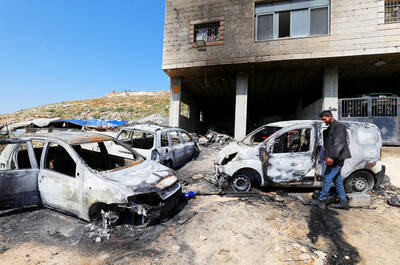
RAMPAGE: A Palestinian man was left dead after dozens of Israeli settlers searching for a missing 14-year-old boy stormed a village in the Israeli-occupied West Bank US President Joe Biden on Friday said he expected Iran to attack Israel “sooner, rather than later” and warned Tehran not to proceed. Asked by reporters about his message to Iran, Biden simply said: “Don’t,” underscoring Washington’s commitment to defend Israel. “We are devoted to the defense of Israel. We will support Israel. We will help defend Israel and Iran will not succeed,” he said. Biden said he would not divulge secure information, but said his expectation was that an attack could come “sooner, rather than later.” Israel braced on Friday for an attack by Iran or its proxies as warnings grew of

A prominent Christian leader has allegedly been stabbed at the altar during a Mass yesterday in southwest Sydney. Bishop Mar Mari Emmanuel was saying Mass at Christ The Good Shepherd Church in Wakeley just after 7pm when a man approached him at the altar and allegedly stabbed toward his head multiple times. A live stream of the Mass shows the congregation swarm forward toward Emmanuel before it was cut off. The church leader gained prominence during the COVID-19 pandemic, amassing a large online following, Officers attached to Fairfield City police area command attended a location on Welcome Street, Wakeley following reports a number


 RSS
RSS