


Al-Jazeera, the Arabic satellite station denounced and bombed by the US and banned by the Iraqi government, has begun recruiting staff for a channel in English that will show news and documentaries.
"The brief is emphatically not to do an English translation of the Arabic channel," said Nigel Parsons, the project manager. "It will have international appeal and fill a lot of gaps in existing output."
The original Arabic news channel, established in 1996 and funded by the emir of Qatar, not only bucked the trend towards frivolity and light entertainment but broke many taboos, interviewing Israeli politicians and allowing debate of a kind rarely seen on Arab television.
It began to attract worldwide attention during the Afghan war in 2001 as the only station with a round-the-clock satellite link from Kabul to the outside world -- though as the fighting closed in on the city two American "smart" bombs hit its office under suspicious circumstances.
Further publicity came in the form of taped messages from Osama bin Laden. The broadcasting of these, together with the channel's coverage of Iraq, brought notoriety in the US.
Parsons believes that, in terms of brand awareness, al-Jazeera is now one of the three top names -- along with CNN and the BBC -- in the world of TV news.
"It's a huge plus to have an existing brand to launch off the back of," he said -- though he acknowledged that there are also minuses.
One big question is how many viewers and potential advertisers will be put off by the complaints heaped on al-Jazeera by the Bush administration.
"One of the aims of the English channel will be to try and bring better understanding of each other's positions," Parsons said. "We're not going to be a strident, one-sided channel. We'll aim for balance."
This could also improve the Arabic channel by serving as a teaching model, said Abdallah Schleifer of the Adham Center for Television Journalism in Cairo.
"If done right, and I think it's going to be done right, this could be a great boost to al-Jazeera itself because it could establish their credibility in certain areas where it's a bit speckled," he said.
The English channel's target audience is worldwide -- "not just Muslims who don't speak Arabic," Parsons said. "I think we might have a ready audience there, but it is not going to be an anti-Western or anti-American channel. Absolutely not."
The aim will be to fill a gap in the market vacated by other channels.
"If you take CNN, in the [United] States, they have been dragged to the right by Fox. Internationally, they definitely had a bad war in the Gulf. They have lost some credibility on the international stage.
"Where the BBC would come into the equation is that there has been a definite retreat ... on the news channels. Levels of coverage of the developing world are 40 percent of what they were when Michael Buerk first did the Ethiopian famine."
The main reason for this gap is expense, but Parsons hopes to fill it by sharing some resources with the Arabic channel and "being creative and outsourcing". He won't talk about the budget, which has yet to be agreed with the emir. However, he insisted: "We don't have an open check book."
Parsons, who was formerly sales director of APTN, the television arm of the Associated Press news agency, has instructions to generate revenue streams for the English channel.
"They [the Qatar government] do want it to be a commercial channel, if possible, but I doubt if we'll go for the pay-TV model," he said.
The former chief of the UK's Independent Television News channel, Stuart Purvis, is skeptical about the channel's prospects.
"There's no profit to be made in this kind of enterprise ... only losses," he said, adding that even a successful channel such as Sky News loses up to ?15 million a year.
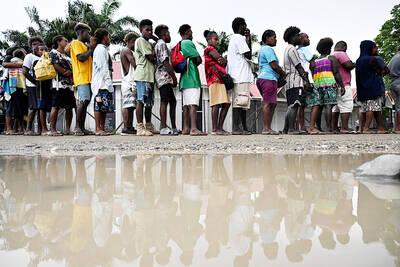
SEEKING CHANGE: A hospital worker said she did not vote in previous elections, but ‘now I can see that maybe my vote can change the system and the country’ Voting closed yesterday across the Solomon Islands in the south Pacific nation’s first general election since the government switched diplomatic allegiance from Taiwan to Beijing and struck a secret security pact that has raised fears of the Chinese navy gaining a foothold in the region. The Solomon Islands’ closer relationship with China and a troubled domestic economy weighed on voters’ minds as they cast their ballots. As many as 420,000 registered voters had their say across 50 national seats. For the first time, the national vote also coincided with elections for eight of the 10 local governments. Esther Maeluma cast her vote in the
Nearly half of China’s major cities are suffering “moderate to severe” levels of subsidence, putting millions of people at risk of flooding, especially as sea levels rise, according to a study of nationwide satellite data released yesterday. The authors of the paper, published by the journal Science, found that 45 percent of China’s urban land was sinking faster than 3mm per year, with 16 percent at more than 10mm per year, driven not only by declining water tables, but also the sheer weight of the built environment. With China’s urban population already in excess of 900 million people, “even a small portion

UNSETTLING IMAGES: The scene took place in front of TV crews covering the Trump trial, with a CNN anchor calling it an ‘emotional and unbelievably disturbing moment’ A man who doused himself in an accelerant and set himself on fire outside the courthouse where former US president Donald Trump is on trial has died, police said yesterday. The New York City Police Department (NYPD) said the man was declared dead by staff at an area hospital. The man was in Collect Pond Park at about 1:30pm on Friday when he took out pamphlets espousing conspiracy theories, tossed them around, then doused himself in an accelerant and set himself on fire, officials and witnesses said. A large number of police officers were nearby when it happened. Some officers and bystanders rushed

HYPOCRISY? The Chinese Ministry of Foreign Affairs yesterday asked whether Biden was talking about China or the US when he used the word ‘xenophobic’ US President Joe Biden on Wednesday called for a hike in steel tariffs on China, accusing Beijing of cheating as he spoke at a campaign event in Pennsylvania. Biden accused China of xenophobia, too, in a speech to union members in Pittsburgh. “They’re not competing, they’re cheating. They’re cheating and we’ve seen the damage here in America,” Biden said. Chinese steel companies “don’t need to worry about making a profit because the Chinese government is subsidizing them so heavily,” he said. Biden said he had called for the US Trade Representative to triple the tariff rates for Chinese steel and aluminum if Beijing was


 RSS
RSS