


Under a giant portrait of Mao Zedong (
In a rare visit organized by the authorities, foreign journalists were allowed a peek into life at Jiuquan, China's Cape Canaveral, which shot to world fame last October when it launched astronaut Yang Liwei (
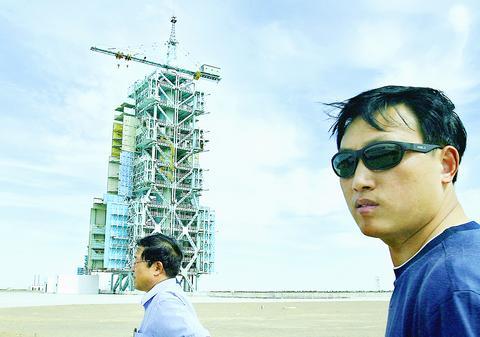
PHOTO: AFP
"This is where Yang Liwei took off," said Sun Qingquan, a spokesman for the Jiuquan Satellite Launch Center, standing next to the launch pad that blasted China's first man into space.
The mission enabled China to become only the third nation to achieve the feat, after the US and the former Soviet Union, making the launch an event staff at the center remember with excitement.
"We were pretty nervous, because the technology involved was so massive, but we didn't fear failure, and we won't fear failure next time around," Sun said.
Jiuquan is where China is expected to launch its second manned spacecraft, Shenzhou VI, on a five-day mission in the second half of next year.
The center of China's secretive space program, Jiuquan is conveniently located in splendid isolation in the country's arid northwest straddling the border of Gansu province and Inner Mongolia region.
Hours after the last major oasis town has disappeared in the rear mirror, the satellite center suddenly emerges as a mirage in the middle of brown, featureless terrain.
First to come into view is the 105-meter launch tower, Jiuquan's most recognizable feature, known to some one billion Chinese who were glued to their television sets during last year's launch.
Connected to the tower by a 1.5km rail is an 89m-tall building designed for check-ups of the Long March series of rockets, the workhorses of China's space program.
This is the South Launch Site, which has risen from the desert sand in less than a decade to serve China's endeavor to send a man, and perhaps soon also a woman, into space.
As visitors enter the gates, they encounter a futuristic-looking cityscape with orange and pale blue buildings and street names like "Space Road" and "Aeronautics South Avenue" before they are taken to the East Wing Guesthouse where food is served, astronaut-style, on aluminum trays.
"It seldom rains, and we've got lots of sun," says engineer Yun Ning, standing with shoes wrapped in plastic in the center's command and control hub. "We've got an excellent location."
Well, perhaps not that excellent if you move here with your entire family, as many of the scientists and technicians have done.
Unlike Cape Canaveral, there are no beaches within a 2,000km radius, and to make up for that, planners have been forced to think of other ways to make life tolerable for the 15,000 people living here.
"We've got three schools, a movie theater, a post office, a hospital," said Yun. "We've even got a fast-food restaurant serving fried chicken, although I don't fancy it so much."
In short, all the amenities of a moderate-sized town were available for Yang Liwei when he shared an apartment at the center with two other astronauts for the last month before his historic flight.
A not-quite queen-sized bed, a TV set and 154m2 was what Yang had at his disposal until his space suddenly shrunk to a lot less inside the Shenzhou V space capsule.
All the facilities that China allows outsiders to look at are at the South Launch Center.
A higher level of secrecy rules at the North Launch Site, which played a key role at the height of the Cold War, and probably continues to do so in China's planning for the strategic challenges of the future.
Jiuquan is so secret that even the people formally in charge, the leaders of Gansu province, have little control over what happens, and just as little information.
Hao Yuan, assistant governor of Gansu province, told reporters he would have liked to tell them more about the center, if only he knew.
"Actually, as assistant governor I envy you very much that you have the opportunity to visit the Jiuquan Satellite Launch Site. Some of the things you'd like to know, I'd like to know too," he said.

Republican US lawmakers on Friday criticized US President Joe Biden’s administration after sanctioned Chinese telecoms equipment giant Huawei unveiled a laptop this week powered by an Intel artificial intelligence (AI) chip. The US placed Huawei on a trade restriction list in 2019 for contravening Iran sanctions, part of a broader effort to hobble Beijing’s technological advances. Placement on the list means the company’s suppliers have to seek a special, difficult-to-obtain license before shipping to it. One such license, issued by then-US president Donald Trump’s administration, has allowed Intel to ship central processors to Huawei for use in laptops since 2020. China hardliners
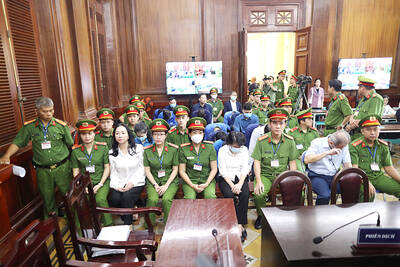
A top Vietnamese property tycoon was on Thursday sentenced to death in one of the biggest corruption cases in history, with an estimated US$27 billion in damages. A panel of three hand-picked jurors and two judges rejected all defense arguments by Truong My Lan, chair of major developer Van Thinh Phat, who was found guilty of swindling cash from Saigon Commercial Bank (SCB) over a decade. “The defendant’s actions ... eroded people’s trust in the leadership of the [Communist] Party and state,” read the verdict at the trial in Ho Chi Minh City. After the five-week trial, 85 others were also sentenced on

‘DELUSIONAL’: Targeting the families of Hamas’ leaders would not push the group to change its position or to give up its demands for Palestinians, Ismail Haniyeh said Israeli aircraft on Wednesday killed three sons of Hamas’ top political leader in the Gaza Strip, striking high-stakes targets at a time when Israel is holding delicate ceasefire negotiations with the militant group. Hamas said four of the leader’s grandchildren were also killed. Ismail Haniyeh’s sons are among the highest-profile figures to be killed in the war so far. Israel said they were Hamas operatives, and Haniyeh accused Israel of acting in “the spirit of revenge and murder.” The deaths threatened to strain the internationally mediated ceasefire talks, which appeared to gain steam in recent days even as the sides remain far
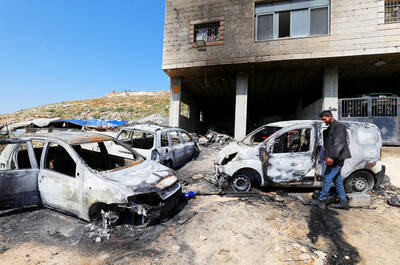
RAMPAGE: A Palestinian man was left dead after dozens of Israeli settlers searching for a missing 14-year-old boy stormed a village in the Israeli-occupied West Bank US President Joe Biden on Friday said he expected Iran to attack Israel “sooner, rather than later” and warned Tehran not to proceed. Asked by reporters about his message to Iran, Biden simply said: “Don’t,” underscoring Washington’s commitment to defend Israel. “We are devoted to the defense of Israel. We will support Israel. We will help defend Israel and Iran will not succeed,” he said. Biden said he would not divulge secure information, but said his expectation was that an attack could come “sooner, rather than later.” Israel braced on Friday for an attack by Iran or its proxies as warnings grew of


 RSS
RSS