


Mahatma Gandhi's long walk through history has paused in an unlikely spot -- the central Canadian prairie city of Winnipeg.
A life-size statue of the "father" of India, complete with his signature walking cane, has arrived in central Canada to become the showpiece of a new Museum for Human Rights.
The 500kg bronze statue created by Ram Vanji Sutar, whose sculptures of Gandhi are displayed around the world, was presented by the Indian government and is the museum's first exhibit.
"Gandhi is first on the list of the greatest people involved in the human rights movement in the past century," said Naranjan Dhalla, who helped organize the exhibit.
"He inspired other great people like Nelson Mandela and Martin Luther King. It's important to recognize his contribution [to society]."
Gandhi promoted non-violent, passive resistance during India's fight against colonial subjugation. He was assassinated in 1948, less than a year after his country gained independence from Britain.
His likeness was unveiled Friday and put on display at a downtown Winnipeg park, where it will remain until the museum opens nearby in four years.
"It is a great tribute not only to Mahatma Gandhi, but also to the whole of Indian culture, which preaches tolerance, truthfulness and non-violence," said Pratap Singh, spokesman for India's high commissioner to Canada.
"He embodies all of these values, and so having a place for him in a museum of human rights in a multicultural and multiracial society like Canada is a great honor."
India is widely viewed as a leader in the fight for human rights but still faces accusations of sectarian violence, child labor and caste discrimination.
Singh said his country has been trying to eradicate these problems since establishing a human rights commission in 1993. He also charged that most countries still struggle with human rights issues.
The museum is the brainchild of Canadian media mogul Israel Asper, who died last year of heart failure.
His daughter Gail Asper told reporters her father hoped the museum would become an incubator for change, using innovative distance learning technology, interactive displays and open forums to educate visitors about the importance of upholding the rights of others.
The 22,000m2 museum, which has survived funding disputes and criticism dealing mostly with its content, will include a so-called Tower of Hope topped with a beacon.
Plants of varied cultural significance, such as roses, sweet grass, poppies and lilies, will bloom amid ponds and waterfalls in an indoor garden.
Visitors will witness a re-creation of the 1982 Canadian Charter of Rights and Freedoms signing ceremony, as well as view and explore the constitutions and charters of all countries and nations throughout history.
"We want to show the world that we can have a mosque, a synagogue and a church on the same street and everybody [can] live together happily," Gail Asper said.
"We also want to teach children that they have a role to play in protecting human rights."
"At the end of a walk of fame that will begin with Gandhi, there will be a mirror so everyone can see that they, too, can have an impact," she said.

Republican US lawmakers on Friday criticized US President Joe Biden’s administration after sanctioned Chinese telecoms equipment giant Huawei unveiled a laptop this week powered by an Intel artificial intelligence (AI) chip. The US placed Huawei on a trade restriction list in 2019 for contravening Iran sanctions, part of a broader effort to hobble Beijing’s technological advances. Placement on the list means the company’s suppliers have to seek a special, difficult-to-obtain license before shipping to it. One such license, issued by then-US president Donald Trump’s administration, has allowed Intel to ship central processors to Huawei for use in laptops since 2020. China hardliners

Conjoined twins Lori and George Schappell, who pursued separate careers, interests and relationships during lives that defied medical expectations, died this month in Pennsylvania, funeral home officials said. They were 62. The twins, listed by Guinness World Records as the oldest living conjoined twins, died on April 7 at the Hospital of the University of Pennsylvania, obituaries posted by Leibensperger Funeral Homes of Hamburg said. The cause of death was not detailed. “When we were born, the doctors didn’t think we’d make 30, but we proved them wrong,” Lori said in an interview when they turned 50, the Philadelphia Inquirer reported. The

RAMPAGE: A Palestinian man was left dead after dozens of Israeli settlers searching for a missing 14-year-old boy stormed a village in the Israeli-occupied West Bank US President Joe Biden on Friday said he expected Iran to attack Israel “sooner, rather than later” and warned Tehran not to proceed. Asked by reporters about his message to Iran, Biden simply said: “Don’t,” underscoring Washington’s commitment to defend Israel. “We are devoted to the defense of Israel. We will support Israel. We will help defend Israel and Iran will not succeed,” he said. Biden said he would not divulge secure information, but said his expectation was that an attack could come “sooner, rather than later.” Israel braced on Friday for an attack by Iran or its proxies as warnings grew of
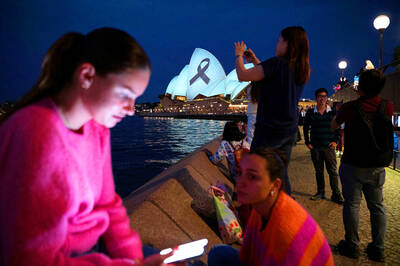
A prominent Christian leader has allegedly been stabbed at the altar during a Mass yesterday in southwest Sydney. Bishop Mar Mari Emmanuel was saying Mass at Christ The Good Shepherd Church in Wakeley just after 7pm when a man approached him at the altar and allegedly stabbed toward his head multiple times. A live stream of the Mass shows the congregation swarm forward toward Emmanuel before it was cut off. The church leader gained prominence during the COVID-19 pandemic, amassing a large online following, Officers attached to Fairfield City police area command attended a location on Welcome Street, Wakeley following reports a number


 RSS
RSS