


The chilling sights and sounds of war fill newspapers and television screens worldwide, but war itself is in decline, researchers report.
In fact, the number killed in battle has fallen to its lowest point in the post-World War II period, dipping below 20,000 a year by one measure. Peacemaking missions, meantime, are growing in number.
"International engagement is blossoming," said American researcher Monty Marshall. "There's been an enormous amount of activity to try to end these conflicts."
For months the battle reports and casualty tolls from Iraq and Afghanistan have put war in the headlines, but Swedish and Canadian nongovernmental groups tracking armed conflict globally find a general decline in numbers from peaks in the 1990s.
The authoritative Stockholm International Peace Research Institute, in a 2004 Yearbook report obtained by reporters in advance of publication, says 19 major armed conflicts were under way worldwide last year, a sharp drop from 33 wars counted in 1991. The Canadian organization Project Ploughshares, using broader criteria to define armed conflict, says in its new annual report that the number of conflicts declined to 36 last year, from a peak of 44 in 1995.
The Stockholm institute counts continuing wars that have produced 1,000 or more battle-related deaths in any single year. Project Ploughshares counts any armed conflict that produces 1,000 such deaths cumulatively.
The Stockholm report, to be released next month, notes three wars were ended as of last year -- in Angola, Rwanda and Somalia -- and a fourth, the separatist war in India's Assam state, was dropped from the "major" category after casualties were recalculated.
It lists three new wars last year -- in Liberia and in Sudan's western region of Darfur, along with the US-led invasion of Iraq. These joined such long-running conflicts as the Kashmiri insurgency in India, the leftist guerrilla war in Colombia, and the separatist war in Russia's Chechnya region.
Other major armed conflicts listed by the Stockholm researchers were in Algeria, Burundi, Peru, Indonesia's Aceh province, Myanmar, Nepal, Sri Lanka, Israel and Turkey. Their list also includes the US war on al-Qaeda, mainly in Afghanistan; the unresolved India-Pakistan conflict, and two insurgencies in the Philippines.
"Not only are the numbers declining, but the intensity" -- the bloodshed in each conflict -- "is declining," said Marshall, founder of a University of Maryland program studying political violence.
The continuing wars in Algeria, Chechnya and Turkey are among those that have subsided into low-intensity conflicts. At Canada's University of British Columbia, scholars at the Human Security Center are quantifying this by tackling the difficult task of calculating war casualties worldwide for their Human Security Report, to be released late last year.
A collaboration with Sweden's Uppsala University, that report will conservatively estimate battle-related deaths worldwide at 15,000 in 2002 and, because of the Iraq war, rising to 20,000 last year. Those estimates are down from annual tolls ranging from 40,000 to 100,000 in the 1990s, a time of major costly conflicts in such places as the former Zaire and southern Sudan, and from a post-World War II peak of 700,000 in 1951.
The Canadian center's director, Andrew Mack, said the figures don't include deaths from war-induced starvation and disease, deaths from ethnic conflicts not involving states, or unopposed massacres, such as in Rwanda in 1994.
Why the declines? Peace researchers point to crosscurrents of global events.
For one thing, the Cold War's end and breakup of the Soviet Union in 1989 to 1991 ignited civil and separatist wars in the old East bloc and elsewhere, as the superpowers' hands were lifted in places where they'd long held allies in check. Those wars surged in the early 1990s.
"The decline over the past decade measures the move away from that unusual period," said Ernie Regehr, director of Project Ploughshares.
At the same time, however, the US-Russian thaw worked against war as well, scholars said, by removing superpower support in "proxy wars," as in Ethiopia, Mozambique and Cambodia. With dwindling money and arms, warmakers had to seek peace.
The UN and regional bodies, meanwhile, were mobilizing for more effective peacemaking worldwide.
"The end of the Cold War liberated the UN" -- historically paralyzed by US-Soviet antagonism -- "to do what its founders had originally intended and more," Mack said.
Last year alone, from Ivory Coast to the Solomon Islands, 14 multilateral missions were launched to protect or reinforce peace settlements, the highest number of new peace missions begun in a single year since the Cold War, the Stockholm institute will report.

Republican US lawmakers on Friday criticized US President Joe Biden’s administration after sanctioned Chinese telecoms equipment giant Huawei unveiled a laptop this week powered by an Intel artificial intelligence (AI) chip. The US placed Huawei on a trade restriction list in 2019 for contravening Iran sanctions, part of a broader effort to hobble Beijing’s technological advances. Placement on the list means the company’s suppliers have to seek a special, difficult-to-obtain license before shipping to it. One such license, issued by then-US president Donald Trump’s administration, has allowed Intel to ship central processors to Huawei for use in laptops since 2020. China hardliners

Conjoined twins Lori and George Schappell, who pursued separate careers, interests and relationships during lives that defied medical expectations, died this month in Pennsylvania, funeral home officials said. They were 62. The twins, listed by Guinness World Records as the oldest living conjoined twins, died on April 7 at the Hospital of the University of Pennsylvania, obituaries posted by Leibensperger Funeral Homes of Hamburg said. The cause of death was not detailed. “When we were born, the doctors didn’t think we’d make 30, but we proved them wrong,” Lori said in an interview when they turned 50, the Philadelphia Inquirer reported. The
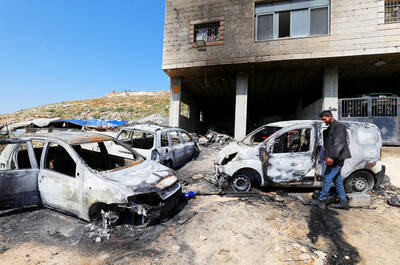
RAMPAGE: A Palestinian man was left dead after dozens of Israeli settlers searching for a missing 14-year-old boy stormed a village in the Israeli-occupied West Bank US President Joe Biden on Friday said he expected Iran to attack Israel “sooner, rather than later” and warned Tehran not to proceed. Asked by reporters about his message to Iran, Biden simply said: “Don’t,” underscoring Washington’s commitment to defend Israel. “We are devoted to the defense of Israel. We will support Israel. We will help defend Israel and Iran will not succeed,” he said. Biden said he would not divulge secure information, but said his expectation was that an attack could come “sooner, rather than later.” Israel braced on Friday for an attack by Iran or its proxies as warnings grew of
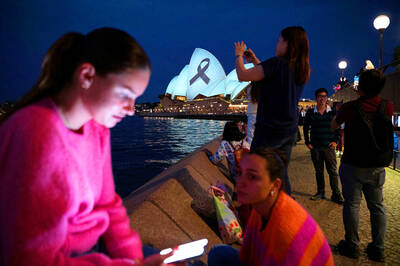
A prominent Christian leader has allegedly been stabbed at the altar during a Mass yesterday in southwest Sydney. Bishop Mar Mari Emmanuel was saying Mass at Christ The Good Shepherd Church in Wakeley just after 7pm when a man approached him at the altar and allegedly stabbed toward his head multiple times. A live stream of the Mass shows the congregation swarm forward toward Emmanuel before it was cut off. The church leader gained prominence during the COVID-19 pandemic, amassing a large online following, Officers attached to Fairfield City police area command attended a location on Welcome Street, Wakeley following reports a number


 RSS
RSS