


Bushmen seeking support for their effort to retain their ancestral lands in Botswana arrived in southern California on Thursday, beginning a journey taking them from a glitzy Hollywood fund-raiser to Capitol Hill and the UN.
The Bushmen, also known as the San people, gained fame worldwide with the 1980 film The Gods Must Be Crazy, a comedy about the discord that erupts with the discovery of a Coke bottle.
A small group is now venturing across the US to raise public awareness of and financial support for their dispute with the government of Botswana. They accuse officials of forcing them off a long-preserved stretch of land to make way for diamond mines.
The group of four Bushmen was getting a boost from Hollywood yesterday with a Beverly Hills benefit at which movie stars like Minnie Driver and Mira Sorvino were to be entertained by Jackson Browne and the Dave Matthews Band. A "diamond drop" was to accept jewelry from celebrities as a donation to a legal fund protecting Bushmen lands.
The Bushmen live in a hunter-gathering society dating back thousands of years. They have been forced by the government to get hunting permits and have been denied water rights on their ancestral lands in the Central Kalahari Game Reserve.
"For us, to stay in our land is to keep our culture," said Jumanda Gakelebone. "I'm born a Bushman. I don't have to change."
Gakelebone, who speaks English, translated for the elder Roy Sesana.
"We want to go back to the land because it's our land, our cultural land, our ancestral land," said Sesana. "I'm angry."
Sesana, who now spends most of his time in the Botswana town of Ghanzi, said relocation is tantamount to cultural murder: "[To move Bushmen] is to end up having no Bushmen at all. Bushmen, wherever they are, they're not poor people, they're rich people. ... Land can make you rich."
Sesana and Gakelebone, along with two Bushmen from South Africa and other supporters accompanying them, plan to meet with Congressional leaders and visit the UN next month.
Hearings on the Bushmen's claim to the reserve, which is about the size of Switzerland, began in July before Botswana's high court but were postponed after the Bushmen ran out of money for attorneys. Hearings are to resume in November.
The government has devoted a section of its Web site to the issue of the Bushmen. It says that many Bushmen wanted to settle down and become farmers and that agricultural use of the land is not compatible with preserving wildlife on the reserve.
In 2002, the Bushmen say about 1,800 of them were forcibly evicted from the reserve and those who resisted were beaten and tortured and now live in makeshift camps outside the reserve.
Botswana, a nation of 1.5 million people, has been viewed as a model democracy for other African nations and has been ranked among the continent's least corrupt countries by the World Economic Forum.
It has established a publicity campaign to distinguish its diamonds from those of Angola and Congo, called conflict diamonds, used to fuel bloody civil wars.
Since diamonds were discovered in the country in 1967, Botswana has prospered. Diamonds account for half of the government revenues and three-fourths of all export earnings. Sesana said that if diamond mines are planned for the reserve, the Bushmen should get a share of the profits.
The government jointly owns Debswana, the company that controls and mines the diamonds here, with the international diamond giant De Beers. Analysts say Botswana receives more than 75 percent of the profits.
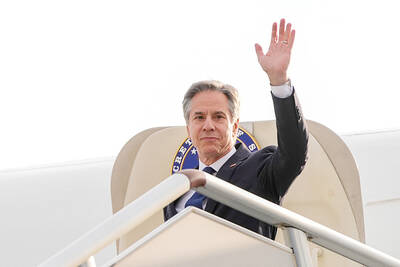
‘IN A DIFFERENT PLACE’: The envoy first visited Shanghai, where he attended a Chinese basketball playoff match, and is to meet top officials in Beijing tomorrow US Secretary of State Antony Blinken yesterday arrived in China on his second visit in a year as the US ramps up pressure on its rival over its support for Russia while also seeking to manage tensions with Beijing. The US diplomat tomorrow is to meet China’s top brass in Beijing, where he is also expected to plead for restraint as Taiwan inaugurates president-elect William Lai (賴清德), and to raise US concerns on Chinese trade practices. However, Blinken is also seeking to stabilize ties, with tensions between the world’s two largest economies easing since his previous visit in June last year. At the
Nearly half of China’s major cities are suffering “moderate to severe” levels of subsidence, putting millions of people at risk of flooding, especially as sea levels rise, according to a study of nationwide satellite data released yesterday. The authors of the paper, published by the journal Science, found that 45 percent of China’s urban land was sinking faster than 3mm per year, with 16 percent at more than 10mm per year, driven not only by declining water tables, but also the sheer weight of the built environment. With China’s urban population already in excess of 900 million people, “even a small portion

UNSETTLING IMAGES: The scene took place in front of TV crews covering the Trump trial, with a CNN anchor calling it an ‘emotional and unbelievably disturbing moment’ A man who doused himself in an accelerant and set himself on fire outside the courthouse where former US president Donald Trump is on trial has died, police said yesterday. The New York City Police Department (NYPD) said the man was declared dead by staff at an area hospital. The man was in Collect Pond Park at about 1:30pm on Friday when he took out pamphlets espousing conspiracy theories, tossed them around, then doused himself in an accelerant and set himself on fire, officials and witnesses said. A large number of police officers were nearby when it happened. Some officers and bystanders rushed
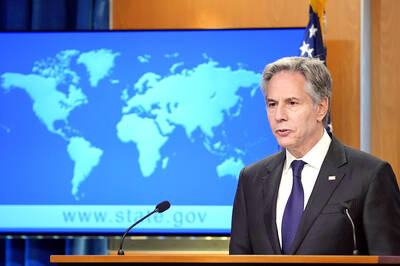
Beijing is continuing to commit genocide and crimes against humanity against Uyghurs and other Muslim minorities in its western Xinjiang province, U.S. Secretary of State Antony Blinken said in a report published on Monday, ahead of his planned visit to China this week. The State Department’s annual human rights report, which documents abuses recorded all over the world during the previous calendar year, repeated language from previous years on the treatment of Muslims in Xinjiang, but the publication raises the issue ahead of delicate talks, including on the war in Ukraine and global trade, between the top U.S. diplomat and Chinese


 RSS
RSS