


Organizing the first presidential election in Afghanistan, a country largely without power, roads or literacy, has required a leap of imagination that has encompassed everything from donkeys to satellite phones.
"Take all the roads out of France, remove the phone network, and the plumbing, add in 80 percent illiteracy, and you get a picture of what we are dealing with," said David Avery, chief of operations for joint Afghan-UN electoral commission.
In fact, Afghanistan is the size of France, Belgium and Switzerland combined, and much of the country is mountainous and remote and threatened by political violence.
And the electorate has little idea of what is at stake in the historic October 9 polls.
"It is much more than an election. Even things as simple as translating words like democracy: there is even a dispute over that," said Silvana Puizana, head of civic and voter education for Afghanistan's electoral commission Joint Electoral Management Body.
From the collection of millions of voter registration cards to how people will mark the ballot papers -- every little detail must be thought out.
For instance "you are not expecting people to have pens," to mark their ballot papers so millions of pens had to be ordered, Puizana said.
The commission also had to make elaborate arrangements in order to make sure that people could get to polling stations.
Rather than attach voters to particular districts voters will be allowed to turn up at any polling station in order to make it easier for people to cast their ballots.
Preventing people voting several times has been another headache. Already more than the estimated 9.8 million eligible voters the UN thought were in the country have registered to vote.
Voter registration numbers now stand at more than 10.5 million, according to UN numbers from Aug. 21.
Voters will have a thumb marked with indelible ink to circumvent the problem of incomplete electoral registers.
But solving one problem created another: the ink marks could attract the attention of the Taliban and other militants bent on disrupting the election and endanger voters.
After many consultations, the ink-mark system was retained, for want of anything better.
"There is a risk for everyone in this process," said Puizana.
The ballot paper was also carefully thought out. To compensate for illiteracy, the photographs of the 18 candidates are printed at the side of each square to be marked.
Once the design had been decided on, the organizers had to put out an international tender because Afghanistan lacked the technology to produce them.

Republican US lawmakers on Friday criticized US President Joe Biden’s administration after sanctioned Chinese telecoms equipment giant Huawei unveiled a laptop this week powered by an Intel artificial intelligence (AI) chip. The US placed Huawei on a trade restriction list in 2019 for contravening Iran sanctions, part of a broader effort to hobble Beijing’s technological advances. Placement on the list means the company’s suppliers have to seek a special, difficult-to-obtain license before shipping to it. One such license, issued by then-US president Donald Trump’s administration, has allowed Intel to ship central processors to Huawei for use in laptops since 2020. China hardliners
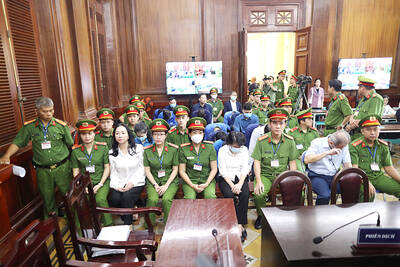
A top Vietnamese property tycoon was on Thursday sentenced to death in one of the biggest corruption cases in history, with an estimated US$27 billion in damages. A panel of three hand-picked jurors and two judges rejected all defense arguments by Truong My Lan, chair of major developer Van Thinh Phat, who was found guilty of swindling cash from Saigon Commercial Bank (SCB) over a decade. “The defendant’s actions ... eroded people’s trust in the leadership of the [Communist] Party and state,” read the verdict at the trial in Ho Chi Minh City. After the five-week trial, 85 others were also sentenced on

Conjoined twins Lori and George Schappell, who pursued separate careers, interests and relationships during lives that defied medical expectations, died this month in Pennsylvania, funeral home officials said. They were 62. The twins, listed by Guinness World Records as the oldest living conjoined twins, died on April 7 at the Hospital of the University of Pennsylvania, obituaries posted by Leibensperger Funeral Homes of Hamburg said. The cause of death was not detailed. “When we were born, the doctors didn’t think we’d make 30, but we proved them wrong,” Lori said in an interview when they turned 50, the Philadelphia Inquirer reported. The
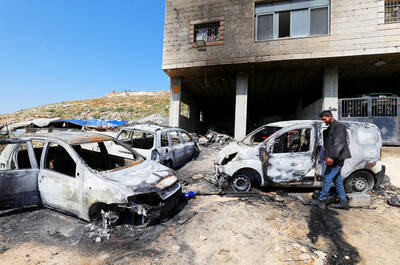
RAMPAGE: A Palestinian man was left dead after dozens of Israeli settlers searching for a missing 14-year-old boy stormed a village in the Israeli-occupied West Bank US President Joe Biden on Friday said he expected Iran to attack Israel “sooner, rather than later” and warned Tehran not to proceed. Asked by reporters about his message to Iran, Biden simply said: “Don’t,” underscoring Washington’s commitment to defend Israel. “We are devoted to the defense of Israel. We will support Israel. We will help defend Israel and Iran will not succeed,” he said. Biden said he would not divulge secure information, but said his expectation was that an attack could come “sooner, rather than later.” Israel braced on Friday for an attack by Iran or its proxies as warnings grew of


 RSS
RSS