


Nepal's capital Kathmandu was returning yesterday to normality after Maoist rebels who control much of the countryside lifted a blockade of the city but gave the government one month to compromise.
The mainly peasant guerrillas fighting to overthrow the monarchy announced late Tuesday they were lifting a mostly symbolic ring around the city of 1.5 million people that had sent produce prices soaring.
Cars and trucks clogged the streets of the Himalayan capital yesterday and fruit and vegetable vendors said costs were already going down.
"We didn't suffer a lot of losses in the blockade, but we had to pay five or 10 times more to truckers to cover their risks. Hopefully this won't happen again," said Rajan Bharati, selling vegetables by the bag at a central market.
The withdrawal of the blockade, which was enforced through fear rather than force, came hours after some 29 soldiers were reported killed in northern Nepal in the deadliest Maoist attack in weeks.
Analysts saw Tuesday's events as a bid by the Maoists to prove both their military strength and flexibility. The rebels have staged ruthless attacks around their rural strongholds but have twice entered ceasefires.
A Maoist statement said the blockade was being suspended for "about one month" after appeals from a wide range of society.
"If the government ignores our demands, we will launch protests and blockades more serious than the present ones," the statement warned.
Some 10,000 people have died since 1996 in the civil war. The government has received military and political support from Britain, India and the US.
The Maoists had said the blockade was to press the government to free colleagues allegedly in detention and to stop classifying the guerrillas as terrorists.
It was also seen as an attempt to restart peace talks on the guerrillas' terms: that the discussions focus on setting up a special assembly to draft a new constitution, in which the Maoists are likely to push to end the monarchy.
Government refusal of the Maoist demand for an assembly led to the collapse of peace bids in 2001 and last year, which were both followed by surges of bloodshed.
Lok Raj Baral, a political scientist at Tribhuvan University in Kathmandu, said the Maoists' one-month deadline would give the government time to sort out its position and resume peace talks.
"Secretly the government is surely doing its homework to make sure negotiations are successful," he said.
The Maoists never physically surrounded Kathmandu, where army trucks and helicopters escorted hundreds of vehicles in and out of the city each day, although suspected rebels killed two men in shootings during the blockade.
The guerrillas have so far not called off a separate blockade due to begin Saturday at the sole border crossing with Tibet.
The rebels, who have virtually replaced the government in vast but remote stretches of the kingdom, have little open support in Kathmandu, whose elite enjoys lifestyles similar to those in the developed world.
A cross-section of Kathmandu society ranging from social activists often at odds with the government to industrialists had protested at the blockade.
"This was a high-risk strategy for the Maoists. They tried to feel the pulse of the people but they paid a high price in alienating the common people of Kathmandu," said Kapil Shrestha, a professor and human rights activist.
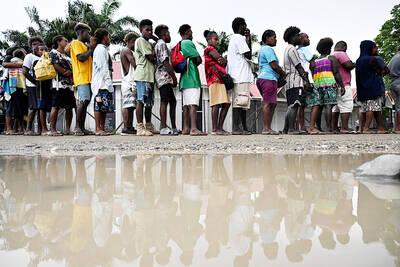
SEEKING CHANGE: A hospital worker said she did not vote in previous elections, but ‘now I can see that maybe my vote can change the system and the country’ Voting closed yesterday across the Solomon Islands in the south Pacific nation’s first general election since the government switched diplomatic allegiance from Taiwan to Beijing and struck a secret security pact that has raised fears of the Chinese navy gaining a foothold in the region. The Solomon Islands’ closer relationship with China and a troubled domestic economy weighed on voters’ minds as they cast their ballots. As many as 420,000 registered voters had their say across 50 national seats. For the first time, the national vote also coincided with elections for eight of the 10 local governments. Esther Maeluma cast her vote in the
Nearly half of China’s major cities are suffering “moderate to severe” levels of subsidence, putting millions of people at risk of flooding, especially as sea levels rise, according to a study of nationwide satellite data released yesterday. The authors of the paper, published by the journal Science, found that 45 percent of China’s urban land was sinking faster than 3mm per year, with 16 percent at more than 10mm per year, driven not only by declining water tables, but also the sheer weight of the built environment. With China’s urban population already in excess of 900 million people, “even a small portion

UNSETTLING IMAGES: The scene took place in front of TV crews covering the Trump trial, with a CNN anchor calling it an ‘emotional and unbelievably disturbing moment’ A man who doused himself in an accelerant and set himself on fire outside the courthouse where former US president Donald Trump is on trial has died, police said yesterday. The New York City Police Department (NYPD) said the man was declared dead by staff at an area hospital. The man was in Collect Pond Park at about 1:30pm on Friday when he took out pamphlets espousing conspiracy theories, tossed them around, then doused himself in an accelerant and set himself on fire, officials and witnesses said. A large number of police officers were nearby when it happened. Some officers and bystanders rushed

HYPOCRISY? The Chinese Ministry of Foreign Affairs yesterday asked whether Biden was talking about China or the US when he used the word ‘xenophobic’ US President Joe Biden on Wednesday called for a hike in steel tariffs on China, accusing Beijing of cheating as he spoke at a campaign event in Pennsylvania. Biden accused China of xenophobia, too, in a speech to union members in Pittsburgh. “They’re not competing, they’re cheating. They’re cheating and we’ve seen the damage here in America,” Biden said. Chinese steel companies “don’t need to worry about making a profit because the Chinese government is subsidizing them so heavily,” he said. Biden said he had called for the US Trade Representative to triple the tariff rates for Chinese steel and aluminum if Beijing was


 RSS
RSS