


A trial in Africa's biggest mercenary case in decades has opened in the rain-streaked capital of Equatorial Guinea, with soldiers of fortune from Europe, Africa and Asia accused in an alleged plot to take control of oil-rich country.
Soldiers with automatic weapons ringed the makeshift courtroom in a government-run convention center as the trial got underway Monday amid allegations the suspects were tortured into confessing and had little chance of getting a fair hearing.
Equatorial Guinea accuses a total of 89 alleged mercenaries of signing on to a US$5 million plot to oust President Teodoro Obiang, who has ruled this isolated nation with an iron first since executing the former dictator -- his uncle -- in 1979.
Seventy of the alleged plotters are on trial separately in Zimbabwe, where they were arrested March 6 hours before they reportedly were to depart in a leased plane for Equatorial Guinea.
A 90th defendant, a German, died in prison here after what Amnesty International said was suspected torture.
At stake in any takeover plot: hundreds of millions of dollars in annual oil revenues.
Obiang's regime -- accused by the US State Department and others of routine torture and other abuses -- is at the center of an oil boom in the Gulf of Guinea. The region is estimated to hold 10 percent of the world's oil reserves -- and some of its most corrupt governments.
Since the development of Equatorial Guinea's oil industry begin in the mid-1990s, this mildewed, rain-soaked nation of just 500,000 has had one of the fastest economic growth rates in the world, at up to 70 percent a year.
Prosecutors told the courtroom Monday that a British and South African financier and oil broker, Eli Calil, financed the plot, along with an unidentified Lebanese businessmen -- allegations denied by Calil's lawyers.
The plot's leader, Briton Simon Mann, a former Etonian turned leading African mercenary, is being held in Zimbabwe.
Prosecutors say the plan was to violently oust Obiang and replace him with Severo Moto, an opposition figure who lives in exile in Spain.
"I was told he would land in an aircraft 30 minutes after the main force has landed," said Nick du Toit, a South African arms-dealer.
Mann, the top planner, "told me that the Spanish government would recognize the Moto government, and that it had the blessing of some American higher-up politicians," testified du Toit, who is the main defendant in the trial in Equatorial Guinea.
"Whether it's true or not, I don't know," du Toit added, his legs and arms bound by iron chains.
Mann and du Toit -- separately, in Zimbabwe and Equatorial Guinea -- both appear to be giving crucial testimony against the dozens of other defendants in the trials.
Families say Du Toit and others were tortured into confessing -- "They were electrified, beaten with [clubs], beaten with fists," wife Belinda du Toit said.
But du Toit repeated much of the same confessions in court Monday, saying he was to have been paid US$1 million for supplying coordinates of the president and other coup targets. He was also to have arranged for vehicles for the mercenaries.
He and the other defendants -- a motley collection of mostly middle-aged, balding men who served in Europe's Cold War armies and South Africa's apartheid military -- appeared in court with unkempt beards. They were dressed casually in T-shirts, shorts and jeans.
Diplomats monitoring the trial cited its obvious shortcomings: the criminal charges were read out to the largely English-speaking defendants only in Spanish after an electronic translation system failed, and defendants had access to lawyers only for three hours shortly before the trial.
The formal charges against the men were also only revealed for the first time Monday. The 19 defendants were charged with attempting to assassinate a head of state, illegal possession of arms and explosives, terrorism, treason and endangering the public.

Republican US lawmakers on Friday criticized US President Joe Biden’s administration after sanctioned Chinese telecoms equipment giant Huawei unveiled a laptop this week powered by an Intel artificial intelligence (AI) chip. The US placed Huawei on a trade restriction list in 2019 for contravening Iran sanctions, part of a broader effort to hobble Beijing’s technological advances. Placement on the list means the company’s suppliers have to seek a special, difficult-to-obtain license before shipping to it. One such license, issued by then-US president Donald Trump’s administration, has allowed Intel to ship central processors to Huawei for use in laptops since 2020. China hardliners
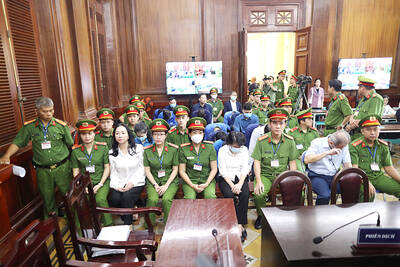
A top Vietnamese property tycoon was on Thursday sentenced to death in one of the biggest corruption cases in history, with an estimated US$27 billion in damages. A panel of three hand-picked jurors and two judges rejected all defense arguments by Truong My Lan, chair of major developer Van Thinh Phat, who was found guilty of swindling cash from Saigon Commercial Bank (SCB) over a decade. “The defendant’s actions ... eroded people’s trust in the leadership of the [Communist] Party and state,” read the verdict at the trial in Ho Chi Minh City. After the five-week trial, 85 others were also sentenced on

‘DELUSIONAL’: Targeting the families of Hamas’ leaders would not push the group to change its position or to give up its demands for Palestinians, Ismail Haniyeh said Israeli aircraft on Wednesday killed three sons of Hamas’ top political leader in the Gaza Strip, striking high-stakes targets at a time when Israel is holding delicate ceasefire negotiations with the militant group. Hamas said four of the leader’s grandchildren were also killed. Ismail Haniyeh’s sons are among the highest-profile figures to be killed in the war so far. Israel said they were Hamas operatives, and Haniyeh accused Israel of acting in “the spirit of revenge and murder.” The deaths threatened to strain the internationally mediated ceasefire talks, which appeared to gain steam in recent days even as the sides remain far
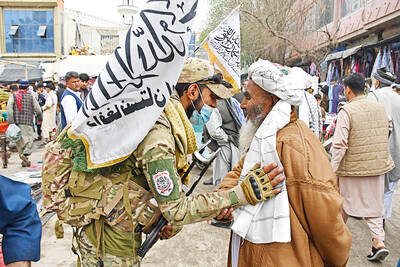
The Taliban’s reclusive supreme leader made a rare public appearance yesterday, an Afghan government spokesman said, leading thousands of worshipers in prayers marking Eid al-Fitr. Hibatullah Akhundzada has made only a handful of public appearances since inheriting the leadership of the Taliban in 2016 and leading the movement back to power with the withdrawal of US forces in 2021. Taliban government spokesman Zabihullah Mujahid said prayer in the largest mosque in Kandahar was “performed under the leadership of the supreme leader.” In a statement on X, he said the early-morning service “was attended by thousands of compatriots” in the southern province considered the


 RSS
RSS