


Akram abu Elouf's leg was blown apart by an Israeli bullet fired from a watchtower half a mile away as he led his two children upstairs to their home. Doctors patched together his thigh bone with nine metal pins; he needs further extensive surgery in Egypt if he is to walk again.
But he was told that he could not cross the checkpoint from Rafah in the Gaza Strip to Egypt because of the metal in his body.
So, two weeks ago, he had the pins removed.
For the vast majority of Gazans, the checkpoint at Rafah is the only exit to the outside world. Some need to leave for medical treatment, education and jobs; some are returning to their lives elsewhere after visiting family in Gaza.
Thousands crowd around the border for days, waiting for an opportunity to leave. Men between the ages of 16 and 35 and all people with metal inside their bodies are denied permission to cross.
Israel routinely bans the movement of young men on the grounds that they are the most likely group to be involved in militant activity, although only a small percentage of Palestinians are involved in violence. The ban on people with metal parts dates from a suicide bombing in January. Rim Saleh el Riashi approached the security gates at Gaza's Erez crossing claiming that it was a metal plate in her leg that was setting off the metal detector. When they allowed her to pass she blew herself up, killing four people.
The Israeli group Physicians for Human Rights recently issued a report detailing the bureaucratic maze people must go through to be allowed permission to leave. Even after securing permission, the report says, many Palestinians are refused passage for arbitrary and nonsensical reasons.
It particularly criticizes Israel for the ban on men and people with metal in their bodies leaving Gaza.
Shabtai Gold, a spokesman for the group, said: "It is collective punishment to prevent all men aged 16-35 and people with metal implants from leaving. It is illegal and we are completely against it.
"If Israel requires prior coordination to allow people passage, that's fine. But it should not delay people getting health care," he said.
Abu Elouf, 34, said he was shot on February 9 with a high-calibre bullet fired from a watchtower. His home and those of his brothers in the same block are splattered with bullet holes.
"There was no reason for it. We live in this border area and there is shooting day and night. They know that we are a peaceful family but I don't think that matters," he said.
After he spent 70 days in a hospital his doctors tried to arrange for treatment abroad, since Gaza has only a primitive health service.
None of the thousands of people milling around in the sun paid any attention to the sound of shooting in the distance or the dust clouds which signalled the movement of tanks around Rafah.
Mwafa Alfarra, 32, said his American wife had given birth to their first child three months ago but that he had not been able to leave.
"The Israelis want to make sure that anyone who leaves has such a hard time, they will think twice about coming back to Gaza," said Mohammad Sharafi, the civilian head of the border crossing.

Republican US lawmakers on Friday criticized US President Joe Biden’s administration after sanctioned Chinese telecoms equipment giant Huawei unveiled a laptop this week powered by an Intel artificial intelligence (AI) chip. The US placed Huawei on a trade restriction list in 2019 for contravening Iran sanctions, part of a broader effort to hobble Beijing’s technological advances. Placement on the list means the company’s suppliers have to seek a special, difficult-to-obtain license before shipping to it. One such license, issued by then-US president Donald Trump’s administration, has allowed Intel to ship central processors to Huawei for use in laptops since 2020. China hardliners

Conjoined twins Lori and George Schappell, who pursued separate careers, interests and relationships during lives that defied medical expectations, died this month in Pennsylvania, funeral home officials said. They were 62. The twins, listed by Guinness World Records as the oldest living conjoined twins, died on April 7 at the Hospital of the University of Pennsylvania, obituaries posted by Leibensperger Funeral Homes of Hamburg said. The cause of death was not detailed. “When we were born, the doctors didn’t think we’d make 30, but we proved them wrong,” Lori said in an interview when they turned 50, the Philadelphia Inquirer reported. The
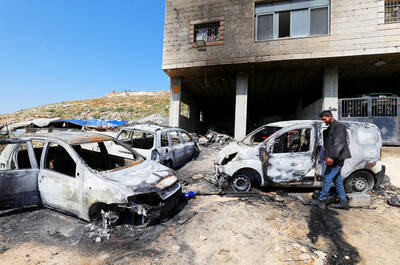
RAMPAGE: A Palestinian man was left dead after dozens of Israeli settlers searching for a missing 14-year-old boy stormed a village in the Israeli-occupied West Bank US President Joe Biden on Friday said he expected Iran to attack Israel “sooner, rather than later” and warned Tehran not to proceed. Asked by reporters about his message to Iran, Biden simply said: “Don’t,” underscoring Washington’s commitment to defend Israel. “We are devoted to the defense of Israel. We will support Israel. We will help defend Israel and Iran will not succeed,” he said. Biden said he would not divulge secure information, but said his expectation was that an attack could come “sooner, rather than later.” Israel braced on Friday for an attack by Iran or its proxies as warnings grew of

A prominent Christian leader has allegedly been stabbed at the altar during a Mass yesterday in southwest Sydney. Bishop Mar Mari Emmanuel was saying Mass at Christ The Good Shepherd Church in Wakeley just after 7pm when a man approached him at the altar and allegedly stabbed toward his head multiple times. A live stream of the Mass shows the congregation swarm forward toward Emmanuel before it was cut off. The church leader gained prominence during the COVID-19 pandemic, amassing a large online following, Officers attached to Fairfield City police area command attended a location on Welcome Street, Wakeley following reports a number


 RSS
RSS