


The Philippines will lose out on as many as 3,000 jobs in Iraq unless it lifts a ban on its nationals working there, a recruitment agency said Saturday amid protests by Filipinos desperate to work in the troubled country.
A Dubai-based firm that had offered 3,000 jobs to Filipinos had written to the main recruitment agencies here warning it would have to fill them elsewhere unless the ban was cancelled by the end of the month, said an official at one firm who asked to not be identified.
On Friday hundreds of Filipinos held the latest in a series of vocal protests in Manila demanding President Gloria Arroyo lift the ban, which was imposed in July after a Filipino truck driver was kidnapped in Iraq.
The demonstrators reiterated they were willing to take their chances in strife-torn Iraq rather than endure unemployment and poverty at home, where wages are low and the unemployment rate is around 14 percent.
"Madam President, please allow us to work in Iraq. This is for our family's future," said a placard held by one protester.
Arroyo's spokesman Ignacio Bunye said the government was monitoring the situation to determine when it would be safe to send workers back but the latest assessment found Iraq was still "really dangerous."
Filipinos clamoring to work in Iraq should take into account the government's concern for their safety, Bunye said in a radio interview.
Truck driver Angelo de la Cruz was kidnapped by Iraqi militants who threatened to behead him unless the Philippines withdrew its 51-person security contingent there.
Arroyo recalled the force and the hostage was freed. Her action was harshly criticized by close allies, the US and Australia, who said she was encouraging kidnappers.
There are as many as 4,000 Filipinos still working in Iraq despite the ban, which labor officials have warned could cost the Philippines as much as 100 million dollars in remittances.
Workers are lured by the promise of monthly wages of up to 1,000 dollars, compared to an average wage back home of less than one-tenth of that.
There are about eight million Filipinos working overseas, more than a million of them in the volatile Middle East, and their remittances to this country are a major source of foreign exchange.

Republican US lawmakers on Friday criticized US President Joe Biden’s administration after sanctioned Chinese telecoms equipment giant Huawei unveiled a laptop this week powered by an Intel artificial intelligence (AI) chip. The US placed Huawei on a trade restriction list in 2019 for contravening Iran sanctions, part of a broader effort to hobble Beijing’s technological advances. Placement on the list means the company’s suppliers have to seek a special, difficult-to-obtain license before shipping to it. One such license, issued by then-US president Donald Trump’s administration, has allowed Intel to ship central processors to Huawei for use in laptops since 2020. China hardliners

Conjoined twins Lori and George Schappell, who pursued separate careers, interests and relationships during lives that defied medical expectations, died this month in Pennsylvania, funeral home officials said. They were 62. The twins, listed by Guinness World Records as the oldest living conjoined twins, died on April 7 at the Hospital of the University of Pennsylvania, obituaries posted by Leibensperger Funeral Homes of Hamburg said. The cause of death was not detailed. “When we were born, the doctors didn’t think we’d make 30, but we proved them wrong,” Lori said in an interview when they turned 50, the Philadelphia Inquirer reported. The
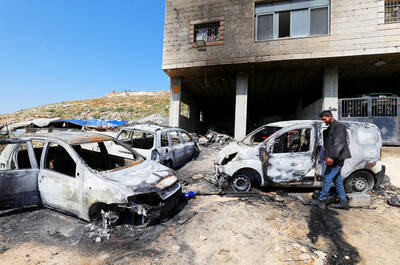
RAMPAGE: A Palestinian man was left dead after dozens of Israeli settlers searching for a missing 14-year-old boy stormed a village in the Israeli-occupied West Bank US President Joe Biden on Friday said he expected Iran to attack Israel “sooner, rather than later” and warned Tehran not to proceed. Asked by reporters about his message to Iran, Biden simply said: “Don’t,” underscoring Washington’s commitment to defend Israel. “We are devoted to the defense of Israel. We will support Israel. We will help defend Israel and Iran will not succeed,” he said. Biden said he would not divulge secure information, but said his expectation was that an attack could come “sooner, rather than later.” Israel braced on Friday for an attack by Iran or its proxies as warnings grew of

A prominent Christian leader has allegedly been stabbed at the altar during a Mass yesterday in southwest Sydney. Bishop Mar Mari Emmanuel was saying Mass at Christ The Good Shepherd Church in Wakeley just after 7pm when a man approached him at the altar and allegedly stabbed toward his head multiple times. A live stream of the Mass shows the congregation swarm forward toward Emmanuel before it was cut off. The church leader gained prominence during the COVID-19 pandemic, amassing a large online following, Officers attached to Fairfield City police area command attended a location on Welcome Street, Wakeley following reports a number


 RSS
RSS