


Venezuela's opposition will have a tough time recovering after failing to oust President Hugo Chavez in a recall vote, a setback that quickly spurred infighting among the president's foes.
For opposition leaders, the defeat was an agonizing remainder of their past failures to oust Chavez.

PHOTO: AFP
Venezuelans are torn between those who accuse Chavez of trying to impose a Cuban-style communist regime and those who say he has given the poor majority a voice in politics and greater access to health and education.
The opposition disagreed Monday on how to react following the devastating defeat, but they all flatly refused to acknowledge the president's triumph at the polls.
Chavez foes alleged widespread fraud in Sunday's referendum even though former US President Jimmy Carter and the Organization of American States endorsed the results.
Chavez won with 58 percent of the vote.
"The political leadership has not been in line with the people," said Antonio Ledezma, who urged opposition sympathizers to stage street protests.
Despite an economic recession, rising crime rates and 15 percent unemployment, Chavez won widespread support among Venezuela's poor majority by spending millions of dollars to teach adults to read, sending Cuban doctors to slums and offering loans to farmers and small businesses.
Critics say the programs, many inspired by Cuban models, are a way of spreading communist propaganda to the poor.
The opposition -- splintered into small parties with contrasting ideologies -- never came up with a clear plan for running Venezuela or even a candidate to succeed Chavez.
Chavez, whose six-year term ends in January 2007, has now gained momentum ahead of September regional elections and 2005 congressional elections. His allies already control the National Assembly and most state governments.
Seven people were wounded Monday after a group of apparently pro-Chavez motorcyclists fired into a small opposition protest in a Caracas plaza, said Caracas Fire Chief Rodolfo Briceno. Opposition lawmaker Ernesto Alvarenga was among those hurt, Briceno said.
Aura Ron denied firefighters' initial reports that her sister, Maritza, had died. Ron said her 62-year-old sister was in intensive care after being shot in the upper body.
Chavez condemned the violence, but said he wouldn't be surprised if the shooters, who waved pro-Chavez posters, were sent by opposition leaders to provoke chaos. About 200 people kept protesting after the shooting, hurling stones at passing vehicles displaying "no" signs in favor of ousting Chavez.
Other leaders of Venezuela's splintered opposition urged calm and announced plans to appeal to international organizations as a means of exposing alleged fraud.
"We must know we had the majority ... we must prove it," said Julio Borges, a staunch opponent of Chavez.
Chavez, who extended an olive branch to his adversaries, was joined by former US President Jimmy Carter and officials in Washington, in appealing for reconciliation.
"I repeat the call for union, understanding and tolerance among all," Chavez said at a press conference.

Republican US lawmakers on Friday criticized US President Joe Biden’s administration after sanctioned Chinese telecoms equipment giant Huawei unveiled a laptop this week powered by an Intel artificial intelligence (AI) chip. The US placed Huawei on a trade restriction list in 2019 for contravening Iran sanctions, part of a broader effort to hobble Beijing’s technological advances. Placement on the list means the company’s suppliers have to seek a special, difficult-to-obtain license before shipping to it. One such license, issued by then-US president Donald Trump’s administration, has allowed Intel to ship central processors to Huawei for use in laptops since 2020. China hardliners
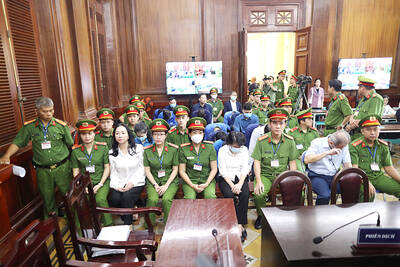
A top Vietnamese property tycoon was on Thursday sentenced to death in one of the biggest corruption cases in history, with an estimated US$27 billion in damages. A panel of three hand-picked jurors and two judges rejected all defense arguments by Truong My Lan, chair of major developer Van Thinh Phat, who was found guilty of swindling cash from Saigon Commercial Bank (SCB) over a decade. “The defendant’s actions ... eroded people’s trust in the leadership of the [Communist] Party and state,” read the verdict at the trial in Ho Chi Minh City. After the five-week trial, 85 others were also sentenced on

DISADVANTAGE: Erin O’Toole, who led the Conservatives during the election campaign in 2021, estimated that the interference cost his party as many as nine legislative seats Canada’s domestic spy agency on Monday concluded that China interfered in the past two elections, an official probe heard, the firmest evidence so far of suspected Chinese meddling in Canadian politics. Canadian Prime Minister Justin Trudeau’s Liberal Party won both the elections, held in 2019 and 2021. Under pressure from opposition lawmakers unhappy about media reports on China’s possible role, Trudeau set up a commission into foreign interference. The commission was shown a slide on Monday containing an extract of a briefing in February last year from the Canadian Security Intelligence Service (CSIS). “We know that the PRC [People’s Republic of China] clandestinely

‘DELUSIONAL’: Targeting the families of Hamas’ leaders would not push the group to change its position or to give up its demands for Palestinians, Ismail Haniyeh said Israeli aircraft on Wednesday killed three sons of Hamas’ top political leader in the Gaza Strip, striking high-stakes targets at a time when Israel is holding delicate ceasefire negotiations with the militant group. Hamas said four of the leader’s grandchildren were also killed. Ismail Haniyeh’s sons are among the highest-profile figures to be killed in the war so far. Israel said they were Hamas operatives, and Haniyeh accused Israel of acting in “the spirit of revenge and murder.” The deaths threatened to strain the internationally mediated ceasefire talks, which appeared to gain steam in recent days even as the sides remain far


 RSS
RSS