


Islamic leaders alarmed at increasing harassment since the Sept. 11, 2001, attacks are to warn community members to prepare for a backlash if terrorists target Britain.
Every Muslim household in Britain will receive a special booklet this fall warning them that they may face revenge attacks. Those whose faith is visible -- such as women who wear hijab -- will be warned to take care before going out alone.
The leaflet says that mosques and other Islamic institutions should already be checking for suspicious packages and should think about installing close-circuit TV.
The Muslim Council of Britain (MCB) prepared the pamphlet, Know Your Rights and Responsibilities, in consultation with leading clerics and the Association of Chief Police Officers.
The wallet-sized guide also repeats the organization's call for anyone who suspects possible terrorism-related activity to report it.
"After Sept. 11 we saw a number of attacks against mosques, Muslim individuals and even cemeteries, which were desecrated -- and that was because of what happened in another country," MCB spokesman Inayat Bunglawala.
"Really incendiary comments have been made about British Muslims, even in the press. If, God forbid, an attack happened here, we know that there are elements who would want to incite trouble. We urge Muslims not to allow themselves to be provoked by those who might create strife," Bunglawala said.
The MCB -- an umbrella organization with which more than 350 Islamic organizations in the UK are affiliated -- is printing 500,000 copies of the guide.
Bunglawala added: "It is far wider than terror; it tackles issues such as education and political participation as well. Parts of the Muslim community are underachieving, so it encourages parents to take a greater interest in their children's education. Peo-ple feel they are being ignored, so it urges people to join mainstream political parties and get their voices heard instead of being disheartened."
He said the guide reiterated the MCB's message that Muslims should immediately contact police if they suspected possible terror-related activity, despite attempts to mischaracterize a similar letter sent out in March -- following the Madrid train bombings -- as a call for Muslims to spy on others in the community.
"Many Muslims feel they have to do even more than average citizens to prove they are seeking the well-being of everyone in the country," he said.
The MCB has already issued a model sermon for imams to draw on, which draws a clear distinction between jihad and terrorism, to prevent disaffected young people from being seduced by extremists.
"Certain figures are trying to deliberately confuse the minds of Muslim youth about what jihad is and make it analogous to terrorism," said Abdul Jalil Sajid, the imam of Brighton Islamic Mission on the English south coast and one of those who took the lead in writing the sermon.
The sermon points out that jihad is the noble struggle to defend one's homeland from external attacks, while terrorism is an attack on innocents.
"Many of the youngsters are frustrated, because they opposed the war in Iraq and marched against it and were ignored for instance, and that may have made some of them more susceptible," Sajid added.
Muslim leaders have also been making concentrated efforts to educate the wider public about Islam in recent months in an attempt to tackle increased prejudice following Sept. 11 head-on.
The MCB will launch a project to send books on Islam to schools next month, and the Muslim Welfare House in north London is distributing ?1 million (US$1.82 million) worth of books, DVDs and videos on the subject to 300 public libraries across the country.
They have also expressed concern about the treatment of British Muslims by police. The number of Asians stopped by officers has increased by almost 300 percent in the last two years.

Republican US lawmakers on Friday criticized US President Joe Biden’s administration after sanctioned Chinese telecoms equipment giant Huawei unveiled a laptop this week powered by an Intel artificial intelligence (AI) chip. The US placed Huawei on a trade restriction list in 2019 for contravening Iran sanctions, part of a broader effort to hobble Beijing’s technological advances. Placement on the list means the company’s suppliers have to seek a special, difficult-to-obtain license before shipping to it. One such license, issued by then-US president Donald Trump’s administration, has allowed Intel to ship central processors to Huawei for use in laptops since 2020. China hardliners
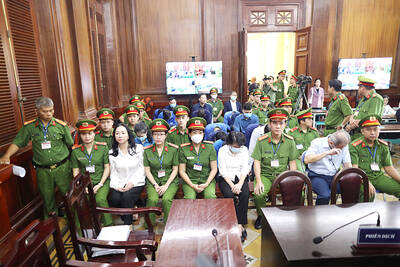
A top Vietnamese property tycoon was on Thursday sentenced to death in one of the biggest corruption cases in history, with an estimated US$27 billion in damages. A panel of three hand-picked jurors and two judges rejected all defense arguments by Truong My Lan, chair of major developer Van Thinh Phat, who was found guilty of swindling cash from Saigon Commercial Bank (SCB) over a decade. “The defendant’s actions ... eroded people’s trust in the leadership of the [Communist] Party and state,” read the verdict at the trial in Ho Chi Minh City. After the five-week trial, 85 others were also sentenced on

Conjoined twins Lori and George Schappell, who pursued separate careers, interests and relationships during lives that defied medical expectations, died this month in Pennsylvania, funeral home officials said. They were 62. The twins, listed by Guinness World Records as the oldest living conjoined twins, died on April 7 at the Hospital of the University of Pennsylvania, obituaries posted by Leibensperger Funeral Homes of Hamburg said. The cause of death was not detailed. “When we were born, the doctors didn’t think we’d make 30, but we proved them wrong,” Lori said in an interview when they turned 50, the Philadelphia Inquirer reported. The
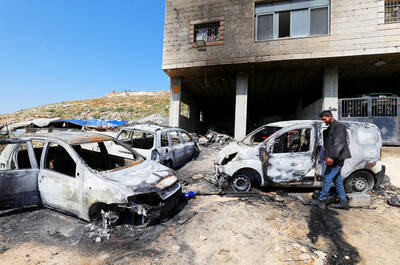
RAMPAGE: A Palestinian man was left dead after dozens of Israeli settlers searching for a missing 14-year-old boy stormed a village in the Israeli-occupied West Bank US President Joe Biden on Friday said he expected Iran to attack Israel “sooner, rather than later” and warned Tehran not to proceed. Asked by reporters about his message to Iran, Biden simply said: “Don’t,” underscoring Washington’s commitment to defend Israel. “We are devoted to the defense of Israel. We will support Israel. We will help defend Israel and Iran will not succeed,” he said. Biden said he would not divulge secure information, but said his expectation was that an attack could come “sooner, rather than later.” Israel braced on Friday for an attack by Iran or its proxies as warnings grew of


 RSS
RSS