


Unfurling a giant cloth painting of the Buddha over a mountainside beside the great Drepung monastery, monks gave Tibetan pilgrims an annual glimpse yesterday of one of Tibet's great ceremonies.
Chanting mantras and spinning prayer wheels, pilgrims gazed up in awe.
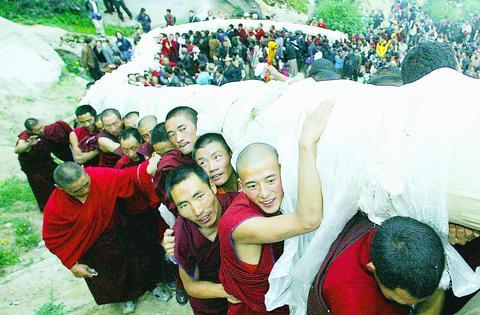
PHOTO: AFP
Few of the 150,000 pilgrims gathered for the annual Shoton, or Yoghurt Festival, questioned whether the ritual represents real religious freedom for the deeply Buddhist region of communist China or is as transient as the incense smoke burning from their offerings.
China's destruction of religion during the 1966-76 Cultural Revolution when most Tibetan monasteries were dynamited to the ground has been replaced by a tentative relaxation that tightens swiftly at a first sign of anti-Chinese sentiment in the restive Himalayan region.
The Communist Party says it made a mistake by persecuting monks and nuns in the Cultural Revolution, and that officials no longer interfere in religious life.
Tension simmers between the Tibetans' profound faith in a mystical form of Buddhism and the Chinese vision of Tibetan culture and religion, colorful but firmly under Party control.
In a display of devotion, tens of thousands of pilgrims gathered by dawn to watch the unfurling of the cloth picture of the Buddha, or thangka, many clinging to rocks to gain a vantage point, others squatting on the hillside in the hope the sacred cloth would be unfurled over their bodies.
Families of three generations made up the crowd of faithful, although some Tibetans complained that the young were losing their faith.
"I think young people have more freedom today than they used to have, but they are definitely not as devout as before," said Padma Tsering, a 23-year-old Lhasa office worker. "Being part of this ethnic minority, i think it's too bad.
"I'm a Buddhist myself because I believe Buddhism has great significance, not only reaching this place but in the whole world."
This 200m2 thangka, an embroidery by monks of Drepung monastery using gold silk thread on a cotton background, may be only seven years old but it takes center stage in a ceremony dating back hundreds of years. More than 100 monks from the monastery -- once the largest in the world with a population of 10,000 -- carried out the rolled up thangka and set it down at the foot of a nearby hill.
The crowd roared with joy as monks at the top of the hill pulled the thangka open with ropes to display an image of the Sakyamuni Buddha, or Buddha of the Present. They tossed hundreds of white silk scarfs onto the picture.
Pilgrims chanting mantras and spinning prayer wheels circumambulated the thangka, almost hidden by columns of choking smoke that swirled into the air from piles of fragrant juniper branches burnt as offerings.

Republican US lawmakers on Friday criticized US President Joe Biden’s administration after sanctioned Chinese telecoms equipment giant Huawei unveiled a laptop this week powered by an Intel artificial intelligence (AI) chip. The US placed Huawei on a trade restriction list in 2019 for contravening Iran sanctions, part of a broader effort to hobble Beijing’s technological advances. Placement on the list means the company’s suppliers have to seek a special, difficult-to-obtain license before shipping to it. One such license, issued by then-US president Donald Trump’s administration, has allowed Intel to ship central processors to Huawei for use in laptops since 2020. China hardliners

Conjoined twins Lori and George Schappell, who pursued separate careers, interests and relationships during lives that defied medical expectations, died this month in Pennsylvania, funeral home officials said. They were 62. The twins, listed by Guinness World Records as the oldest living conjoined twins, died on April 7 at the Hospital of the University of Pennsylvania, obituaries posted by Leibensperger Funeral Homes of Hamburg said. The cause of death was not detailed. “When we were born, the doctors didn’t think we’d make 30, but we proved them wrong,” Lori said in an interview when they turned 50, the Philadelphia Inquirer reported. The
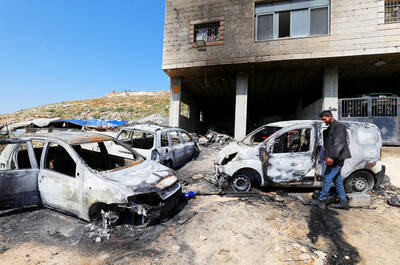
RAMPAGE: A Palestinian man was left dead after dozens of Israeli settlers searching for a missing 14-year-old boy stormed a village in the Israeli-occupied West Bank US President Joe Biden on Friday said he expected Iran to attack Israel “sooner, rather than later” and warned Tehran not to proceed. Asked by reporters about his message to Iran, Biden simply said: “Don’t,” underscoring Washington’s commitment to defend Israel. “We are devoted to the defense of Israel. We will support Israel. We will help defend Israel and Iran will not succeed,” he said. Biden said he would not divulge secure information, but said his expectation was that an attack could come “sooner, rather than later.” Israel braced on Friday for an attack by Iran or its proxies as warnings grew of
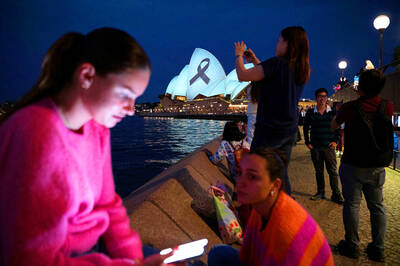
A prominent Christian leader has allegedly been stabbed at the altar during a Mass yesterday in southwest Sydney. Bishop Mar Mari Emmanuel was saying Mass at Christ The Good Shepherd Church in Wakeley just after 7pm when a man approached him at the altar and allegedly stabbed toward his head multiple times. A live stream of the Mass shows the congregation swarm forward toward Emmanuel before it was cut off. The church leader gained prominence during the COVID-19 pandemic, amassing a large online following, Officers attached to Fairfield City police area command attended a location on Welcome Street, Wakeley following reports a number


 RSS
RSS