


Hong Kong's graft-busting agency yesterday said it would appeal a court ruling that it had acted wrongly in raiding a newspaper and seizing records in a case that has raised fears about press freedoms in the city.
The Independent Commission Against Corruption (ICAC) raided offices of seven newspapers last month after they published the identity of a protected witness in a corruption case.
Yesterday the High Court granted an ICAC request to suspend a Tuesday court order requiring it to return items confiscated during its swoop on the Sing Tao Daily, one of the seven newspapers raided on July 24.
"We hope to file a notice of appeal," government lawyer Kevin Zervos, representing the ICAC, told the High Court yesterday.
He said the ICAC might file the notice later in the day.
"The stay is granted," judge Michael Hartmann told the court, saying the newspaper had no objection.
Zervos said the confiscated materials would remain sealed pending the outcome of the appeal.
Commission officials looked into confidential computer files and took away reporters' notebooks, seeking evidence of the newspapers' source for naming the witness.
The High Court ruled on Tuesday that the ICAC should not have raided the dailies.
In a verdict hailed as a victory for press freedom, the court revoked the search warrants empowering the ICAC to raid Sing Tao and ordered confiscated materials to be returned.
Lawyers said the ruling would not curb the ICAC's powers but might make it more prudent in exercising them in the future.
Sing Tao had mounted a legal challenge to the search warrants and demanded the return of the confiscated items. The Tuesday judgment could prompt the other six newspapers to follow suit.
The High Court judge said that, to seek a search warrant, the ICAC had to prove relevant materials held by journalists involved would have been destroyed. The commission had failed to prove that risk, he said.
The judge also noted that a free press was a constitutional guarantee in Hong Kong.
Lawyers said the ruling reaffirmed the importance of press freedom in the former British colony, where some journalists have practised self-censorship since the 1997 reversion to China, fearful of saying anything that will anger Beijing.
"I think it [the judgment] is in fact an assertion, a reassertion of the importance of the press and the care that law enforcement agencies must exercise before searching journalistic material," prominent lawyer and legislator Audrey Eu (
"The power of the ICAC remains the same," Eu said. "I think the importance of the judgment lies in laying down safeguards, considerations and factors to be taken into account when it is supposed to exercise its power."
Law lecturer Eric Cheung said the verdict would help protect press freedoms.
"The ruling established important protection [for press freedom]. It imposes limits on the circumstances under which they can seek search warrants."
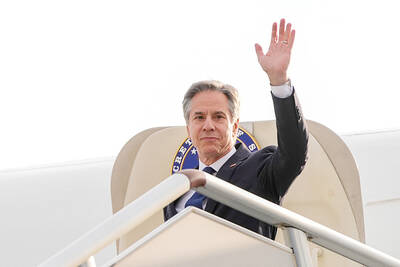
‘IN A DIFFERENT PLACE’: The envoy first visited Shanghai, where he attended a Chinese basketball playoff match, and is to meet top officials in Beijing tomorrow US Secretary of State Antony Blinken yesterday arrived in China on his second visit in a year as the US ramps up pressure on its rival over its support for Russia while also seeking to manage tensions with Beijing. The US diplomat tomorrow is to meet China’s top brass in Beijing, where he is also expected to plead for restraint as Taiwan inaugurates president-elect William Lai (賴清德), and to raise US concerns on Chinese trade practices. However, Blinken is also seeking to stabilize ties, with tensions between the world’s two largest economies easing since his previous visit in June last year. At the
Nearly half of China’s major cities are suffering “moderate to severe” levels of subsidence, putting millions of people at risk of flooding, especially as sea levels rise, according to a study of nationwide satellite data released yesterday. The authors of the paper, published by the journal Science, found that 45 percent of China’s urban land was sinking faster than 3mm per year, with 16 percent at more than 10mm per year, driven not only by declining water tables, but also the sheer weight of the built environment. With China’s urban population already in excess of 900 million people, “even a small portion

UNSETTLING IMAGES: The scene took place in front of TV crews covering the Trump trial, with a CNN anchor calling it an ‘emotional and unbelievably disturbing moment’ A man who doused himself in an accelerant and set himself on fire outside the courthouse where former US president Donald Trump is on trial has died, police said yesterday. The New York City Police Department (NYPD) said the man was declared dead by staff at an area hospital. The man was in Collect Pond Park at about 1:30pm on Friday when he took out pamphlets espousing conspiracy theories, tossed them around, then doused himself in an accelerant and set himself on fire, officials and witnesses said. A large number of police officers were nearby when it happened. Some officers and bystanders rushed

Beijing is continuing to commit genocide and crimes against humanity against Uyghurs and other Muslim minorities in its western Xinjiang province, U.S. Secretary of State Antony Blinken said in a report published on Monday, ahead of his planned visit to China this week. The State Department’s annual human rights report, which documents abuses recorded all over the world during the previous calendar year, repeated language from previous years on the treatment of Muslims in Xinjiang, but the publication raises the issue ahead of delicate talks, including on the war in Ukraine and global trade, between the top U.S. diplomat and Chinese


 RSS
RSS