


Australia's decision to end decades of non-intervention in its South Pacific backyard is paying off, Prime Minister John Howard said yesterday, before heading to a Pacific meeting on tackling economic instability.
Representatives of 16 Pacific nations, among the world's smallest and poorest, are meeting in Samoa this weekend to hammer out strategies for growth and better governance.
"Everybody is now taking the Pacific Island Forum far more seriously because they've seen what has been achieved in the Solomon Islands, and that is if Pacific countries work together in a cooperative way then they can achieve a lot," Howard said.
"There's a new spirit in the Pacific and I'm very pleased that Australia is playing its part," he said.
In a major policy shift last year, Australia abandoned its hands-off policy of the past 30 years, sending troops to end lawlessness in the Solomon Islands and has agreed to send police to Papua New Guinea, which infested with crime.
Australia fears that failed states on its Pacific doorstep could become havens for terror groups and argues that stable governments are needed to avoid such a possibility as well as to help build stronger regional economies.
Before leaving for the Pacific Islands Forum, Howard said 14 of its members that receive aid understood that Australia's annual contribution of more than A$1.2 billion (US$839 billion) to the region depended on good governance. Australia is the Pacific's largest aid donor. In recent years island states have been rocked by coups, mutinies and ethnic clashes.
"There's a recognition that small countries have got to pool their resources. There's also a recognition that good governance is crucial to attracting investment. That's a view Australia has pushed," Howard said.
"There's also an understanding that we do tie governance to aid and that that is reasonable, because the Australian taxpayer is entitled to a good return for their investment," he said.
The forum has generally welcomed the Solomon Islands intervention, which also included troops from member states New Zealand, Fiji, Papua New Guinea and Tonga.
The other forum members are the Cook Islands, Federated States of Micronesia, Kiribati, Nauru, Niue, Palau, Marshall Islands, Samoa, Tuvalu and Vanuatu.
Foreign Minister Alexander Downer said that one priority proposal to be considered at the forum today would be the benefits of creating a regional airline, a perennial subject at the annual meeting.
"There are a number of airlines and some of them are very big loss makers and costing those governments and those communities very dearly," Downer told reporters.
Air travel is crucial in a region of more than 500 inhabited islands, spread over 30 million square kilometers, with more than 1,000 languages.
But Downer said the possibility of establishing a Pacific central bank was a long way off because of the difficulties in creating a common currency and common fiscal targets.
"In the short term, that's not going to happen. In the medium to long term, who knows? It would depend how countries felt," Downer said.
In July last year, Australia led a regional team of 2,225 troops and police into the Solomon Islands, the largest military deployment in the region since World War II, to stop the nation spiralling into anarchy after years of ethnic militia fighting.
Late last month, crime-ridden Papua New Guinea approved plans for neighboring Australia to send in 230 police and 64 officials to help keep the peace and improve the country's economy.
Forum members range from Australia with a population of 20 million, to tiny Niue, which has fewer than 2,000 people.
Excluding Australia and New Zealand, the most important industries of the Pacific islands are tourism, small agriculture, fishing and textiles.
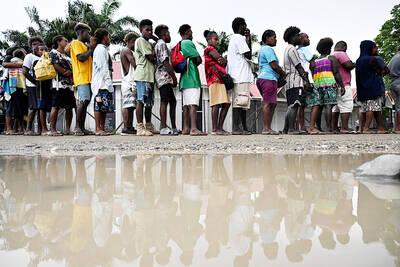
SEEKING CHANGE: A hospital worker said she did not vote in previous elections, but ‘now I can see that maybe my vote can change the system and the country’ Voting closed yesterday across the Solomon Islands in the south Pacific nation’s first general election since the government switched diplomatic allegiance from Taiwan to Beijing and struck a secret security pact that has raised fears of the Chinese navy gaining a foothold in the region. The Solomon Islands’ closer relationship with China and a troubled domestic economy weighed on voters’ minds as they cast their ballots. As many as 420,000 registered voters had their say across 50 national seats. For the first time, the national vote also coincided with elections for eight of the 10 local governments. Esther Maeluma cast her vote in the
Nearly half of China’s major cities are suffering “moderate to severe” levels of subsidence, putting millions of people at risk of flooding, especially as sea levels rise, according to a study of nationwide satellite data released yesterday. The authors of the paper, published by the journal Science, found that 45 percent of China’s urban land was sinking faster than 3mm per year, with 16 percent at more than 10mm per year, driven not only by declining water tables, but also the sheer weight of the built environment. With China’s urban population already in excess of 900 million people, “even a small portion

UNSETTLING IMAGES: The scene took place in front of TV crews covering the Trump trial, with a CNN anchor calling it an ‘emotional and unbelievably disturbing moment’ A man who doused himself in an accelerant and set himself on fire outside the courthouse where former US president Donald Trump is on trial has died, police said yesterday. The New York City Police Department (NYPD) said the man was declared dead by staff at an area hospital. The man was in Collect Pond Park at about 1:30pm on Friday when he took out pamphlets espousing conspiracy theories, tossed them around, then doused himself in an accelerant and set himself on fire, officials and witnesses said. A large number of police officers were nearby when it happened. Some officers and bystanders rushed

HYPOCRISY? The Chinese Ministry of Foreign Affairs yesterday asked whether Biden was talking about China or the US when he used the word ‘xenophobic’ US President Joe Biden on Wednesday called for a hike in steel tariffs on China, accusing Beijing of cheating as he spoke at a campaign event in Pennsylvania. Biden accused China of xenophobia, too, in a speech to union members in Pittsburgh. “They’re not competing, they’re cheating. They’re cheating and we’ve seen the damage here in America,” Biden said. Chinese steel companies “don’t need to worry about making a profit because the Chinese government is subsidizing them so heavily,” he said. Biden said he had called for the US Trade Representative to triple the tariff rates for Chinese steel and aluminum if Beijing was


 RSS
RSS