


Wissam Sagman has already tried unsuccessfully to leave the country, fearing his Christian family would not be safe in the new, chaotic Iraq.
Now, after a series of bombings at churches across the country on Sunday, his fear of his neighbors has grown and he plans to redouble his efforts to get out.

PHOTO: AFP
"These people, they love blood. They hate humanity. They hate us," Sagman said, looking around his wrecked living room, damaged from a car bomb attack on an Armenian church across the street. "They want all the Christians to leave."
The coordinated attacks hit four churches in Baghdad and one in Mosul, killing at least seven people and wounding dozens more in the first significant strike on Iraq's minority Christians since the US invasion last year.
Iraqi leaders condemned the violence on Monday, trying to quell Christian fears they were being routed from the country. Grand Ayatollah Ali al-Sistani, Iraq's most senior Shiite cleric, called the attacks "hideous crimes."
Iraq's 750,000 Christians have grown fearful at the rise of Islamic fundamentalism since the ouster of former president Saddam Hussein last year.
Hundreds have fled to neighboring Jordan and Syria.
Others are waiting to join them.
"This is my church! My church!" Thomas George, 73, cried, shaking his walking stick outside a Syrian Catholic church in Baghdad that was among those targeted Sunday.
Muslim neighbors tried to console George and Tarek Kidr, another churchgoer.
One, Sadek Rabi, said they were all facing the same violence.
"A Muslim can't go to a mosque and a Christian can't go to church now," said 32-year-old Rabi, recalling attacks in recent months on Muslim sites of worship that have killed hundreds.
On Monday, an unknown group claimed responsibility for the church bombings and warned that more attacks would come. The statement, signed by an organization calling itself the Committee of Planning and Follow-up in Iraq, was posted on an Islamic Web site.
"You wanted a crusade, and this is the result," the statement said.
Deputy Prime Minister Barham Saleh vowed authorities would hunt down those responsible.
"The interim government of Iraq is united in condemning all acts of terrorism and is determined to use all available force, both Iraqi and those of multinational forces in Iraq, to pursue and destroy the people who plan and carry out such atrocities," Saleh told reporters.
Iraq's religious leaders unanimously denounced the bombings.
"We condemn and reproach these hideous crimes," said al-Sistani. He said the assaults "targeted Iraq's unity, stability and independence" and called on the government and Iraqis to work together to end the violence.
The Association of Muslim Scho-lars, an influential Sunni Muslim group believed to have links to insurgents, issued a statement offering condolences to the victims and blaming foreign fighters for trying to instigate sectarian fighting.
"Targeting churches is another type of effort aimed at damaging Iraqi unity," the group said. "Such acts cannot be done by Iraqis."
Staying united
The Roman Catholic Chaldean Patriarch, the Reverand Emmanuel Delly, said Iraqis of all religions will stay united.
"Perhaps they wanted to divide us from our Muslim brothers, but we and the Muslims are one family -- one Iraqi family that should be protected by brotherhood and love," he said
Pope John Paul II sent Delly a condolence telegram.
"The sorrowful news ... against various Catholic communities gathered in prayer in their houses of worship struck me deeply," the pope said.
Despite the support, Kidr, like many other Christians, is looking for a way out.
"I want to go now, go to Syria and try to get to Australia," he said. "It's not safe in Iraq and it will only get worse."
The Armenian church sustained little damage but Sagman's living room, where his two young sons were watching cartoons on TV, suffered the brunt of the blast.
The front window blew in, spraying glass everywhere, knocking tables and vases over. His youngest son Hamam, 7, suffered cuts from broken shards of glass, but escaped serious injury.
"I'm tired, I didn't have any expectations from this life before, and now ... ," he broke off his sentence, his shoulders shaking as he fought to hold back tears.
Sagman was recently granted a temporary permit to stay in Syria, but hoping to settle elsewhere, he turned it down.
Now he wants to try again.
Despair
"A true Muslim would never touch a house of God," he said. "I feel despair now, only despair."
Outside, his Muslim neighbors and colleagues came to visit and offer their sympathies, sitting on chairs perched gingerly between pieces of glass and concrete.
"I didn't believe this until I came to see it with my own eyes," said Karima Hadi, one of Sagman's Muslim co-workers. She pulled back her veil to wipe the sweat from her face and tried to smile.
"We are all one heart, whether we're Muslim or Christian, this can't break us," she said.
At St. Peter's seminary in Baghdad's Dora neighborhood, the parking lot where people waited in cars to collect relatives after Sunday's evening Mass was a singed soaking mess.
An armed guard showed reporters around the scene. Unlike before, the gates to the monastery were locked, only to be opened from inside. People muttered that the church had been careless by not having a guard check entering cars.
"We've never had to do this before," said church administrator Majid Adwar, pointing to the guard's automatic rifle. "We've always considered ourselves peaceful people. We never thought this would happen."
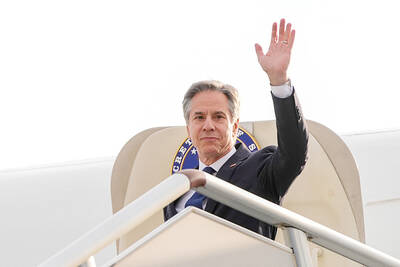
‘IN A DIFFERENT PLACE’: The envoy first visited Shanghai, where he attended a Chinese basketball playoff match, and is to meet top officials in Beijing tomorrow US Secretary of State Antony Blinken yesterday arrived in China on his second visit in a year as the US ramps up pressure on its rival over its support for Russia while also seeking to manage tensions with Beijing. The US diplomat tomorrow is to meet China’s top brass in Beijing, where he is also expected to plead for restraint as Taiwan inaugurates president-elect William Lai (賴清德), and to raise US concerns on Chinese trade practices. However, Blinken is also seeking to stabilize ties, with tensions between the world’s two largest economies easing since his previous visit in June last year. At the
Nearly half of China’s major cities are suffering “moderate to severe” levels of subsidence, putting millions of people at risk of flooding, especially as sea levels rise, according to a study of nationwide satellite data released yesterday. The authors of the paper, published by the journal Science, found that 45 percent of China’s urban land was sinking faster than 3mm per year, with 16 percent at more than 10mm per year, driven not only by declining water tables, but also the sheer weight of the built environment. With China’s urban population already in excess of 900 million people, “even a small portion

UNSETTLING IMAGES: The scene took place in front of TV crews covering the Trump trial, with a CNN anchor calling it an ‘emotional and unbelievably disturbing moment’ A man who doused himself in an accelerant and set himself on fire outside the courthouse where former US president Donald Trump is on trial has died, police said yesterday. The New York City Police Department (NYPD) said the man was declared dead by staff at an area hospital. The man was in Collect Pond Park at about 1:30pm on Friday when he took out pamphlets espousing conspiracy theories, tossed them around, then doused himself in an accelerant and set himself on fire, officials and witnesses said. A large number of police officers were nearby when it happened. Some officers and bystanders rushed
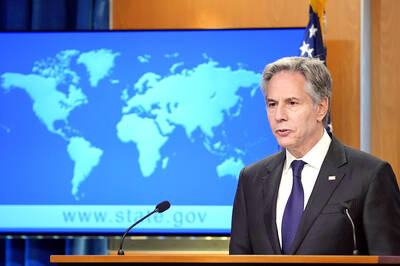
Beijing is continuing to commit genocide and crimes against humanity against Uyghurs and other Muslim minorities in its western Xinjiang province, U.S. Secretary of State Antony Blinken said in a report published on Monday, ahead of his planned visit to China this week. The State Department’s annual human rights report, which documents abuses recorded all over the world during the previous calendar year, repeated language from previous years on the treatment of Muslims in Xinjiang, but the publication raises the issue ahead of delicate talks, including on the war in Ukraine and global trade, between the top U.S. diplomat and Chinese


 RSS
RSS