


It happened quickly.
Armed men, firing into the air dragged Jordanian car dealer Mahmoud Khazaaleh from his car, blindfolded him and spirited him away.
It was not the start of one those ordeals that have grabbed headlines, in which Iraqi insurgents threaten to kill hostages to influence government policy in faraway capitals.
Khazaaleh's captors had a much simpler goal.
They took his watch, a gold ring and US$8,000 dollars he'd earned from selling a car earlier that day.
He was freed more than a month later after he came up with US$4,000 more.
Amid the chaos of postwar Iraq, such kidnappings for pure financial gain have become common, with wealthy Iraqis as well as foreigners finding themselves the victims of the crimes.
These gang members may have told outsiders that they wanted to drive foreigners out of Iraq -- but all they wanted was cash, Khazaaleh said in a telephone interview from his home in northern Jordan.
"They pretended they were observant Muslims seeking to liberate Iraq," Khazaaleh said.
"But they are only a bunch of bandits and looters who want to make use of the security vacuum to make as much money as they can," he said.
Jordanians, major trading partners with their neighbors in Iraq before and after former Iraqi president Saddam Hussein's fall, have been hit particularly hard by the violence.
The Transportation Ministry said Thursday that the kingdom had set up an area at the Iraqi border where Jordanian drivers could hand over cargo bound for Iraq to Iraqi truckers.
Iraqi truckers are seen as less likely to become victims of the kidnappings.
On Tuesday, the chief executive of a Jordanian firm working for the US military in Iraq said he would pull out of the country to win the release of two employees.
On Monday, Jordanian businessman Marwan al-Roussan was shot dead in the northern Iraqi city of Mosul, according to his sister, parliament member Nariman al-Roussan.
But what were the hostage-takers' true aims?
Khazaaleh said villagers told him that his captors had killed those too poor to meet their demands for cash.
He said the gang, called the Abu al-Abbas Group, was infamous in the region near the Iranian border where he was grabbed on May 6.
He described a well-organized criminal enterprise headed by a man called al-Qaisar, Arabic for Caesar.
Khazaaleh said that after he was kidnapped, al-Qaisar's men would gather every night outside his window to drink and count the money they had acquired from other hostages.
He heard them talk about Kuwaiti, Indian and Pakistani victims, and about women whom they had employed to pretend to be prostitutes and to scout for wealthy, "easy prey" at local hotels.
Al-Khazaaleh said the gang kept him under close watch in a rundown house, with little food and water, and forced to endure poor sanitary conditions.
"They beat me and spit in my face, cursed Jordan, my king, my people and my family and honor and threatened to kill me when I begged them to let me go," he said.
Khazaaleh eventually borrowed the additional US$4,000 from a local cleric, the father of a woman who brought him food during his captivity, to meet his kidnappers' demands.
Jordanian security officials said al-Khazaaleh had debriefed them on his kidnapping.
They declined to provide details, saying it was difficult to independently verify his abduction.
Khazaaleh, 51, said he won't work in Iraq again.
"It's impossible to do business amid the chaos and lack of security and trust," he said.

Republican US lawmakers on Friday criticized US President Joe Biden’s administration after sanctioned Chinese telecoms equipment giant Huawei unveiled a laptop this week powered by an Intel artificial intelligence (AI) chip. The US placed Huawei on a trade restriction list in 2019 for contravening Iran sanctions, part of a broader effort to hobble Beijing’s technological advances. Placement on the list means the company’s suppliers have to seek a special, difficult-to-obtain license before shipping to it. One such license, issued by then-US president Donald Trump’s administration, has allowed Intel to ship central processors to Huawei for use in laptops since 2020. China hardliners
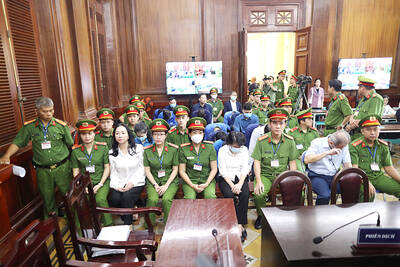
A top Vietnamese property tycoon was on Thursday sentenced to death in one of the biggest corruption cases in history, with an estimated US$27 billion in damages. A panel of three hand-picked jurors and two judges rejected all defense arguments by Truong My Lan, chair of major developer Van Thinh Phat, who was found guilty of swindling cash from Saigon Commercial Bank (SCB) over a decade. “The defendant’s actions ... eroded people’s trust in the leadership of the [Communist] Party and state,” read the verdict at the trial in Ho Chi Minh City. After the five-week trial, 85 others were also sentenced on

Conjoined twins Lori and George Schappell, who pursued separate careers, interests and relationships during lives that defied medical expectations, died this month in Pennsylvania, funeral home officials said. They were 62. The twins, listed by Guinness World Records as the oldest living conjoined twins, died on April 7 at the Hospital of the University of Pennsylvania, obituaries posted by Leibensperger Funeral Homes of Hamburg said. The cause of death was not detailed. “When we were born, the doctors didn’t think we’d make 30, but we proved them wrong,” Lori said in an interview when they turned 50, the Philadelphia Inquirer reported. The
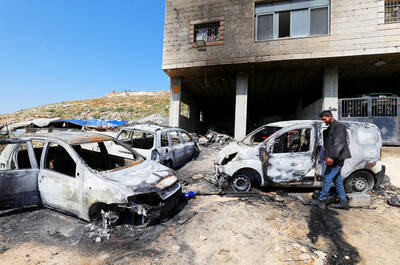
RAMPAGE: A Palestinian man was left dead after dozens of Israeli settlers searching for a missing 14-year-old boy stormed a village in the Israeli-occupied West Bank US President Joe Biden on Friday said he expected Iran to attack Israel “sooner, rather than later” and warned Tehran not to proceed. Asked by reporters about his message to Iran, Biden simply said: “Don’t,” underscoring Washington’s commitment to defend Israel. “We are devoted to the defense of Israel. We will support Israel. We will help defend Israel and Iran will not succeed,” he said. Biden said he would not divulge secure information, but said his expectation was that an attack could come “sooner, rather than later.” Israel braced on Friday for an attack by Iran or its proxies as warnings grew of


 RSS
RSS