


With green, sloping roofs and eaves imitating Chinese imperial and temple architecture, the sprawling King Yin Lei Mansion is one of this city's best-known landmarks.
Down the hill and around a corner stands Wanchai Market, one of two Bauhaus-inspired fresh-food markets known to survive in Asia. Built in the late 1930s, like the mansion, the market has harmoniously curving walls free of ornamentation, and has been a hub of the densely packed Wanchai neighborhood ever since.
Though each building is beautiful in its own way, neither would have been likely to survive the wrecking ball if developers had tried to tear them down just a few years ago.

PHOTO: AP
But when developers moved recently to raze the mansion and the market, they encountered fierce resistance from neighborhood activists; the mansion was pulled off the market Tuesday last week and will remain a private home while the market's future is still being contested.
The struggle over historic preservation, in a city where only 4 percent of homes were built before 1960, shows a new sense of identity in Hong Kong. A pride and sense of community is emerging in what has been a city of immigrants. This sense of identity is manifesting itself in everything from a new interest in old buildings to a willingness to call for free elections.
Yeung Fai, 30, sells bok choy and other vegetables in the market at the same stall that his family has operated for 40 years. Yeung said that before Britain turned Hong Kong over in 1997, he thought of himself as Chinese, in contrast to the Europeans running the city.
But now that China is in charge, Yeung sees himself differently.
"I feel proud of Hong Kong, and of being a Hong Kong person," he said.
That sentiment seems to be spreading among this territory's 7 million people, a population a little larger than Switzerland's. The stirrings of a local identity -- no one here dares call it a national identity -- has nourished this city's democracy movement, which organized yesterday's march. And it has unnerved Beijing, which sees parallels to the much more developed movement in Taiwan which wants to declare formal independence from China.
Last Friday, China's Foreign Ministry denounced the US Senate's passage in Washington of a resolution supporting democratic reforms here as interference in China's internal affairs.
While Chinese officials recently said Hong Kong would be included in new legislation being drafted to ban secession, and have warned against any advocacy of independence, there is virtual unanimity in Hong Kong that independence would be both impractical and impossible.
"If they truly believe that democracy in Hong Kong will lead to independence, then they don't understand us," said Martin Lee (
loyalty
But while independence may not be the goal, loyalty to Hong Kong is clearly growing among its residents, with consequences that are hard to predict.
The British were fond of portraying Hong Kong as little more than a barren rock before they captured it in 1841. Yet there were fishing and trading villages and even some fortifications when the British arrived, while human habitation went back at least 6,000 years. This history is increasingly seized upon here as evidence that Hong Kong has had a long cultural and political tradition and is more than just a center of commerce.
When another mansion near central Hong Kong seemed doomed to be torn down this spring to make room for a skyscraper, public protests forced the government to buy the building and announce plans to convert it into a museum.
When a sewerage project turned up 2,000-year-old pottery on the Kowloon Peninsula this spring, crowds showed up at the local history museum to see a quickly arranged exhibit of the fairly mundane artifacts.
"I was shocked that people were so interested," said Louis Ng (
Hong Kong's population has grown tenfold since the end of World War II. One popular theory of why local pride is emerging now is that many assumed in the years leading up to handover that they would have to move when the People's Liberation Army arrived.
Now they have concluded that it is safe to remain and take a longer-term interest in their homes.
generational split
Paul Yip (
Yet for all the growing enthusiasm for the past, there remains an appreciation of the benefits of the present. Vendors in the Wanchai Market were divided one recent morning about the building's future.
Old hands wanted to save it. Younger workers spoke enthusiastically of the government's promise to build a new, air-conditioned market next door if the current one was torn down.
Yeung wanted it both ways.
"The government should move us," he said, "but keep this building for the tourists."

Republican US lawmakers on Friday criticized US President Joe Biden’s administration after sanctioned Chinese telecoms equipment giant Huawei unveiled a laptop this week powered by an Intel artificial intelligence (AI) chip. The US placed Huawei on a trade restriction list in 2019 for contravening Iran sanctions, part of a broader effort to hobble Beijing’s technological advances. Placement on the list means the company’s suppliers have to seek a special, difficult-to-obtain license before shipping to it. One such license, issued by then-US president Donald Trump’s administration, has allowed Intel to ship central processors to Huawei for use in laptops since 2020. China hardliners
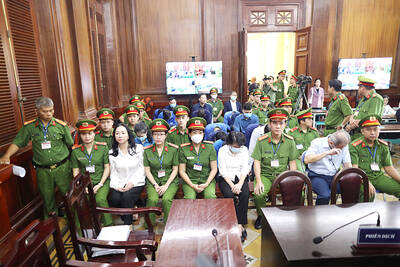
A top Vietnamese property tycoon was on Thursday sentenced to death in one of the biggest corruption cases in history, with an estimated US$27 billion in damages. A panel of three hand-picked jurors and two judges rejected all defense arguments by Truong My Lan, chair of major developer Van Thinh Phat, who was found guilty of swindling cash from Saigon Commercial Bank (SCB) over a decade. “The defendant’s actions ... eroded people’s trust in the leadership of the [Communist] Party and state,” read the verdict at the trial in Ho Chi Minh City. After the five-week trial, 85 others were also sentenced on

Conjoined twins Lori and George Schappell, who pursued separate careers, interests and relationships during lives that defied medical expectations, died this month in Pennsylvania, funeral home officials said. They were 62. The twins, listed by Guinness World Records as the oldest living conjoined twins, died on April 7 at the Hospital of the University of Pennsylvania, obituaries posted by Leibensperger Funeral Homes of Hamburg said. The cause of death was not detailed. “When we were born, the doctors didn’t think we’d make 30, but we proved them wrong,” Lori said in an interview when they turned 50, the Philadelphia Inquirer reported. The

RAMPAGE: A Palestinian man was left dead after dozens of Israeli settlers searching for a missing 14-year-old boy stormed a village in the Israeli-occupied West Bank US President Joe Biden on Friday said he expected Iran to attack Israel “sooner, rather than later” and warned Tehran not to proceed. Asked by reporters about his message to Iran, Biden simply said: “Don’t,” underscoring Washington’s commitment to defend Israel. “We are devoted to the defense of Israel. We will support Israel. We will help defend Israel and Iran will not succeed,” he said. Biden said he would not divulge secure information, but said his expectation was that an attack could come “sooner, rather than later.” Israel braced on Friday for an attack by Iran or its proxies as warnings grew of


 RSS
RSS