


The mood among expatriates in Riyadh remained somber Friday. Friday is a holiday and several groups held barbecues within compound walls. But it is only a week since the beheading of US engineer Paul Johnson, and there is genuine fear of being shot at or kidnapped.
The expats have not been comforted by the Saudi government's offer to allow them to carry guns for their own protection.
In one compound in the Saudi capital, nerves were not helped by a double murder on Thursday night although, for once, it was not related to al-Qaeda's terrorist network.
The atmosphere is comparatively relaxed in Jeddah, on the Red Sea, where the government established its summer base last week for its four-month annual escape from the heat of the capital. Ministers remain cautious in public, but in private are optimistic. There is a feeling that the worst is behind them, because of last week's killing of the senior al-Qaeda operative Abdelaziz al-Muqrin.
One official said: "Prince Sultan [the defense minister] will not say this, but with the killing [of Muqrin] we have taken the edge off al-Qaeda for the summer."
This view could turn out to be premature, and it is not one shared by the expats, many of whom remain intent on leaving.
Not since the House of Saud founded this ultra-orthodox Islamic kingdom in 1932 has the future of the country been so uncertain. "The jury is out," said one western diplomat.
Corruption
Al-Qaeda, which sprang out of Saudi Arabian soil, is only one of the challenges confronting this absolute monarchy. In-fighting in the royal family has raised doubts about an orderly succession.
King Fahd, the ruler since 1982, is 82 years old and has been incapacitated since he suffered a stroke a decade ago. There is enormous resentment at the extravagances of the royal family: Some call it patronage, others corruption.
Estimates of how much of the national oil earnings the royal family receives vary between 10 percent and 40 percent. A journalist, one of the growing number of Saudis pressing for reform, said: "There are lots of social ills. You have corruption; people eating the fat of the land."
Such criticism comes on top of a dangerous demographic imbalance, in which more than 60 percent of the population is under 18.
Resentment
Unemployment is at least 15 percent and the education system is a shambles. It is against this background that sympathy has grown in the poorer parts of Riyadh and elsewhere in Saudi for al-Qaeda, whose twin objectives are the removal of westerners from the Arabian peninsula and the overthrow of the House of Saud.
Al-Qaeda has been helped by widespread resentment, even among the most moderate of Saudis, at the US and Britain for the occupation of Iraq, support for Israel and failure to help the Palestinians.
Jamal Khashoggi, an adviser to the Saudi ambassador to London, Prince Turki al-Faisal, and a former editor of the newspaper al Watan, warned against seeing al-Qaeda as a forerunner to revolution.
Khashoggi, who was in Jeddah this week, said: "It is not an insurgency. They are small in number but dangerous. There were only four at Khobar but we saw what they can do."
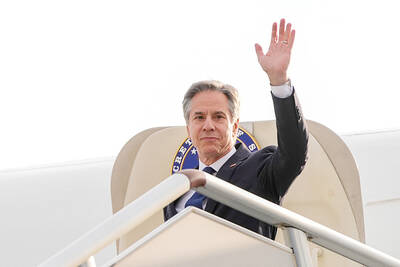
‘IN A DIFFERENT PLACE’: The envoy first visited Shanghai, where he attended a Chinese basketball playoff match, and is to meet top officials in Beijing tomorrow US Secretary of State Antony Blinken yesterday arrived in China on his second visit in a year as the US ramps up pressure on its rival over its support for Russia while also seeking to manage tensions with Beijing. The US diplomat tomorrow is to meet China’s top brass in Beijing, where he is also expected to plead for restraint as Taiwan inaugurates president-elect William Lai (賴清德), and to raise US concerns on Chinese trade practices. However, Blinken is also seeking to stabilize ties, with tensions between the world’s two largest economies easing since his previous visit in June last year. At the
Nearly half of China’s major cities are suffering “moderate to severe” levels of subsidence, putting millions of people at risk of flooding, especially as sea levels rise, according to a study of nationwide satellite data released yesterday. The authors of the paper, published by the journal Science, found that 45 percent of China’s urban land was sinking faster than 3mm per year, with 16 percent at more than 10mm per year, driven not only by declining water tables, but also the sheer weight of the built environment. With China’s urban population already in excess of 900 million people, “even a small portion

UNSETTLING IMAGES: The scene took place in front of TV crews covering the Trump trial, with a CNN anchor calling it an ‘emotional and unbelievably disturbing moment’ A man who doused himself in an accelerant and set himself on fire outside the courthouse where former US president Donald Trump is on trial has died, police said yesterday. The New York City Police Department (NYPD) said the man was declared dead by staff at an area hospital. The man was in Collect Pond Park at about 1:30pm on Friday when he took out pamphlets espousing conspiracy theories, tossed them around, then doused himself in an accelerant and set himself on fire, officials and witnesses said. A large number of police officers were nearby when it happened. Some officers and bystanders rushed

Beijing is continuing to commit genocide and crimes against humanity against Uyghurs and other Muslim minorities in its western Xinjiang province, U.S. Secretary of State Antony Blinken said in a report published on Monday, ahead of his planned visit to China this week. The State Department’s annual human rights report, which documents abuses recorded all over the world during the previous calendar year, repeated language from previous years on the treatment of Muslims in Xinjiang, but the publication raises the issue ahead of delicate talks, including on the war in Ukraine and global trade, between the top U.S. diplomat and Chinese


 RSS
RSS