


The murder of 20-year-old Raul Tinajero at the Los Angeles County Jail in April focused national attention on the violence that dominates much of the American correctional system. Tinajero had testified for the prosecution at a murder trial and had been guaranteed special protection that never materialized. The inmate against whom he testified roamed the jail for hours on a forged pass, the authorities say, until he entered Tinajero's cell and strangled him in front of his cellmates.
This marked the fifth murder of an inmate at the Los Angeles County Jail in seven months. Battered by public criticism, the jail opened its doors to reporters, who could see right away that violence was far from the only hazard associated with life behind bars. The Times' Charlie LeDuff reported that the jail commonly housed as many as six prisoners in a single cell, which meant two slept on floors wet with toilet seepage.
A staph infection was raging through the cellblocks, and inmates crowded at the bars to show their lesions. These infections are especially dangerous to people with compromised immune systems, a category that includes many prisoners. The Centers for Disease Control and Prevention has cited the Los Angeles County Jail for an outbreak of drug-resistant strains of staph, which are especially aggressive and difficult to treat.
Staph can be partly contained by giving inmates access to soap and hot water and making sure that the laundry is thoroughly washed and dried. But jails that cannot organize themselves well enough to provide clean sheets stand little chance of success against the heavyweight infectious diseases that have become endemic behind bars today. Among them are HIV, tuberculosis and hepatitis C. Complications from hepatitis kill 25,000 people each year.
The diseases that incubate behind bars don't just stay there. They come rushing back to the general population -- and to the overburdened public health system -- with the nearly 12 million inmates who are released each year.
Some states have responded to the danger of prison epidemics by gearing up to test, treat and counsel inmates. But most of the system is not so forward looking. Faced with tight budgets, many jails and prisons have backed away from testing inmates for fear that they will be required to pay for treatment.
This approach was shown to be penny wise but pound foolish when the country experienced an epidemic of drug-resistant tuberculosis -- driven mainly by former prison inmates -- during the 1990s. Though expensive, testing and treatment for TB cases behind bars are more efficient and cost-effective than mounting a full-scale assault on the disease once it hits the streets.
A similar pattern has emerged with AIDS as infected inmates leave prison and infect people outside, who then turn to the public health system.
The prison health problem registered in Congress, which in 1997 held hearings and instructed the Justice Department to perform the country's first nationwide study of the health environment of jails and prisons.
The study, a groundbreaking work entitled "The Health Status of Soon-to-Be-Released Inmates," was completed in 2000.
Critics of the government say that the report was shelved for two years before being made public - without the imprimatur of the Justice Department, which had worked on the project. Once released, the study sank so swiftly from view that even members of Congress seemed unaware that it existed.
"The Health Status of Soon-to-Be Released Inmates" is available on the Web site of the National Commission on Correctional Health Care, which worked with the government on the project.
It offers a sobering view of the corrections system, which has clearly become a major conduit for infectious disease. The rate of transmission for sexually transmittable disease behind bars is roughly 10 times that in the world outside.
In any given year, 17 percent of people with AIDS, 35 percent of people with tuberculosis and nearly a third of those with hepatitis C pass through the corrections system.
This system represents a gaping hole in the public health network, thanks in part to the fact that prisoners become ineligible for Medicaid assistance while they're behind bars. I
nmates who have the misfortune of being housed in jails and prisons without serious medical programs often have no choice but to cease treatment, which means that they get sicker and continue to pose an infection risk to others.
Once released, these same inmates spend months trying to re-enroll in the Medicaid program and get care.
The US would experience less infectious disease -- which means fewer deaths and less strain on the health system - if the public health apparatus were fully extended into the jails and prisons.
The health status report argues convincingly for a rigorous program of testing, treating and counseling that would slow the spread of disease and alert inmates to illnesses before they reached the crisis stage and became prohibitively expensive to handle.
These ideas are perfectly consistent with what we know about the importance of preventive medicine. But applying them to prison inmates will be difficult until we begin to see them not as outcasts who deserve to be cut off from the public largesse, but as fellow citizens with whom we will eventually share a common fate.

Republican US lawmakers on Friday criticized US President Joe Biden’s administration after sanctioned Chinese telecoms equipment giant Huawei unveiled a laptop this week powered by an Intel artificial intelligence (AI) chip. The US placed Huawei on a trade restriction list in 2019 for contravening Iran sanctions, part of a broader effort to hobble Beijing’s technological advances. Placement on the list means the company’s suppliers have to seek a special, difficult-to-obtain license before shipping to it. One such license, issued by then-US president Donald Trump’s administration, has allowed Intel to ship central processors to Huawei for use in laptops since 2020. China hardliners

Conjoined twins Lori and George Schappell, who pursued separate careers, interests and relationships during lives that defied medical expectations, died this month in Pennsylvania, funeral home officials said. They were 62. The twins, listed by Guinness World Records as the oldest living conjoined twins, died on April 7 at the Hospital of the University of Pennsylvania, obituaries posted by Leibensperger Funeral Homes of Hamburg said. The cause of death was not detailed. “When we were born, the doctors didn’t think we’d make 30, but we proved them wrong,” Lori said in an interview when they turned 50, the Philadelphia Inquirer reported. The
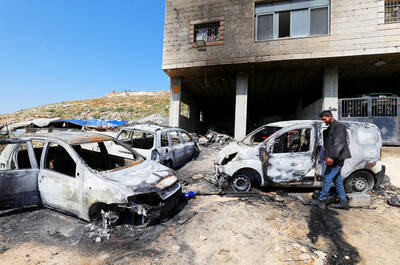
RAMPAGE: A Palestinian man was left dead after dozens of Israeli settlers searching for a missing 14-year-old boy stormed a village in the Israeli-occupied West Bank US President Joe Biden on Friday said he expected Iran to attack Israel “sooner, rather than later” and warned Tehran not to proceed. Asked by reporters about his message to Iran, Biden simply said: “Don’t,” underscoring Washington’s commitment to defend Israel. “We are devoted to the defense of Israel. We will support Israel. We will help defend Israel and Iran will not succeed,” he said. Biden said he would not divulge secure information, but said his expectation was that an attack could come “sooner, rather than later.” Israel braced on Friday for an attack by Iran or its proxies as warnings grew of

IN PURSUIT: Israel’s defense minister said the revenge attacks by Israeli settlers would make it difficult for security forces to find those responsible for the 14-year-old’s death Israeli Prime Minister Benjamin Netanyahu on Saturday condemned the “heinous murder” of an Israeli teenager in the occupied West Bank as attacks on Palestinian villages intensified following news of his death. After Benjamin Achimeir, 14, was reported missing near Ramallah on Friday, hundreds of Jewish settlers backed by Israeli forces raided nearby Palestinian villages, torching vehicles and homes, leaving at least one villager dead and dozens wounded. The attacks escalated in several villages on Saturday after Achimeir’s body was found near the Malachi Hashalom outpost. Agence France-Presse correspondents saw smoke rising from burned houses and fields. Mayor Amin Abu Alyah, of the


 RSS
RSS