


With a name like that, one would think this town would have no trouble attracting tourists.
After all, Victoria Falls, the town, is cheek-by-jowl with Victoria Falls, the waterfall -- a jaw-dropping, heartstopping torrent almost 2km wide and 100m high, its constant roar audible for some distance, its towering cloud of spray visible from the farthest horizon. Mere words do not do justice to Victoria Falls. One must see it to appreciate it.
Where better to start to see the waterfall than Victoria Falls, the town?
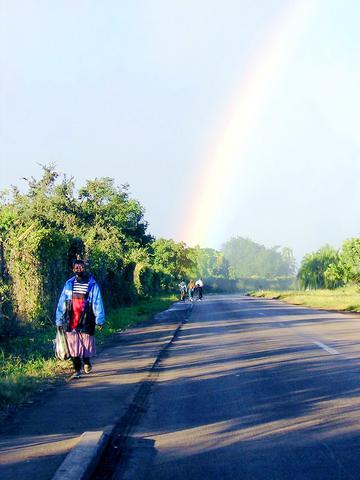
PHOTO: NY TIMES NEWS SERVICE
Until lately, the answer was "nowhere." In the contest for falls-hungry tourists, Victoria Falls towered over its only rival, Livingstone, just across the broad Zambezi River in Zambia. Lively Vic Falls embraced everyone from backpackers to jetsetters, bungee-jumpers to golfers. Livingstone, disheveled and sedentary, had some historic cachet: It is named after the explorer David Livingstone, the first European to see the falls. But for tourists, it was an afterthought.
Then Zimbabwe imploded. And the tables turned.
Suddenly, prosaic Livingstone is hot, jamming visitors into new four-star hotels and river's-edge lodges, bursting with upscale craft and souvenir shops, clubs and casinos.
Victoria Falls is not.
"There's just no one coming here," a disconsolate businessman said, a conclusion borne out by even a brief stroll in the deserted shopping district.
Since early 2000, when squatters began occupying that nation's white-owned farms in what would become a wholesale seizure of commercial farmland, tourism in Zimbabwe has hit the skids.
Things grew worse in 2002, after Zimbabwean President Robert Mugabe was re-elected in balloting marred by widespread violence. It deepened further last year, as inflation roared past 600 percent and fuel shortages became pervasive.
In truth, Zimbabwe's violence and repression have largely passed by Victoria Falls. The region is so solidly in the camp of Mugabe's political opponents -- and such an important source of scarce hard currency -- that the government has avoided measures seen in other opposition centers, such as the invasions of pro-government youth militia, which might scare tourists away.
But Zimbabwe's reputation has grown increasingly ugly, especially among tourists from members of the Commonwealth nations, mostly former British possessions. Mugabe quit the Commonwealth last December after it refused to lift its suspension of Zimbabwe in protest of its human-rights policies.
One hotelier in Victoria Falls, who refused to be named for fear of retaliation, said tourist traffic from Europe and the US has been little affected by Zimbabwe's turmoil, but that visits from Commonwealth nations have all but dried up. Some tour agencies in some Commonwealth nations have removed Zimbabwe from their lists, one South African agent said, and replaced it with package trips to Zambia.
During a recent visit to the Zambian side of Victoria Falls, Mike Carter, a New Zealand appraiser on holiday with his family, emerged raincoat-clad from the falls' drenching mist and said, "We never considered coming to Victoria Falls," the town. "We wouldn't bother going 'til they sort things out."
Zimbabwe's loss has been Zambia's gain. Livingstone's hotel occupancy since 2000 has jumped to 50 percent from an average of 36 percent, despite a brace of new hotels.
The contrast with Victoria Falls could hardly be more stark. Zimbabwean businessmen say average hotel occupancy runs between 20 percent and 30 percent, and some of the bigger four- and five-star resorts have severely pared their staff to keep from closing. The world-famous grand dame of local hostelries, the Victoria Falls Hotel, marked its centennial this month with hallways of empty rooms despite an effort to lure celebrants with a 100th-birthday package.
The plight of merchants is, if anything, bleaker. Souvenir shops on the main street to Victoria Falls sometimes pass the entire day without ringing up a single sale, one vendor said. Some wholesalers and street vendors have given up and moved their operations to Zambia, prompting a government minister to denounce them as unpatriotic in a recent meeting with the town's beleaguered businessmen.
Things could change, of course: Longtime residents remember that Vic Falls prospered most in the 1970s, when Zambia's economic policies drove that nation and its tourism close to ruin.
In the meantime, merchants and hotel operators might take a tip from a Zimbabwe tourism Web site, and try to turn their bitter plight into tourism lemonade.
Zimbabwe's national parks "are completely safe to visit, as they are far from the cities where the instability exists," the site says. "Game lodges are desperate for occupants, so prices are extremely competitive. And low lodge occupancy means you'll have thousands of hectares of pristine game country virtually all to yourself."
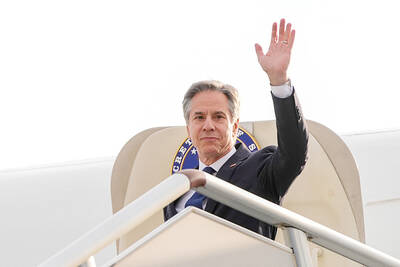
‘IN A DIFFERENT PLACE’: The envoy first visited Shanghai, where he attended a Chinese basketball playoff match, and is to meet top officials in Beijing tomorrow US Secretary of State Antony Blinken yesterday arrived in China on his second visit in a year as the US ramps up pressure on its rival over its support for Russia while also seeking to manage tensions with Beijing. The US diplomat tomorrow is to meet China’s top brass in Beijing, where he is also expected to plead for restraint as Taiwan inaugurates president-elect William Lai (賴清德), and to raise US concerns on Chinese trade practices. However, Blinken is also seeking to stabilize ties, with tensions between the world’s two largest economies easing since his previous visit in June last year. At the
Nearly half of China’s major cities are suffering “moderate to severe” levels of subsidence, putting millions of people at risk of flooding, especially as sea levels rise, according to a study of nationwide satellite data released yesterday. The authors of the paper, published by the journal Science, found that 45 percent of China’s urban land was sinking faster than 3mm per year, with 16 percent at more than 10mm per year, driven not only by declining water tables, but also the sheer weight of the built environment. With China’s urban population already in excess of 900 million people, “even a small portion

UNSETTLING IMAGES: The scene took place in front of TV crews covering the Trump trial, with a CNN anchor calling it an ‘emotional and unbelievably disturbing moment’ A man who doused himself in an accelerant and set himself on fire outside the courthouse where former US president Donald Trump is on trial has died, police said yesterday. The New York City Police Department (NYPD) said the man was declared dead by staff at an area hospital. The man was in Collect Pond Park at about 1:30pm on Friday when he took out pamphlets espousing conspiracy theories, tossed them around, then doused himself in an accelerant and set himself on fire, officials and witnesses said. A large number of police officers were nearby when it happened. Some officers and bystanders rushed

Beijing is continuing to commit genocide and crimes against humanity against Uyghurs and other Muslim minorities in its western Xinjiang province, U.S. Secretary of State Antony Blinken said in a report published on Monday, ahead of his planned visit to China this week. The State Department’s annual human rights report, which documents abuses recorded all over the world during the previous calendar year, repeated language from previous years on the treatment of Muslims in Xinjiang, but the publication raises the issue ahead of delicate talks, including on the war in Ukraine and global trade, between the top U.S. diplomat and Chinese


 RSS
RSS