


If the US government does not bring charges against former Iraqi president Saddam Hussein relatively soon, it will be technically required, because of his prisoner-of-war status, to release him after the restoration of limited sovereignty, officials with human rights and aid groups said on Monday.
None of the officials were advocating Saddam's release, and they said they want him to stand trial. But they also said that since the US insists the occupation is formally ending on June 30, when limited powers will be handed to the interim Iraqi government, the Geneva Conventions require that the Americans must, in theory, bring charges against prisoners of war or release them.
"We're not making any ultimatums or calls for release," Antonella Notari, chief spokeswoman of the International Committee of the Red Cross, told reporters in Geneva on Monday. "What we're saying is: `Saddam Hussein, as far as we understand today, is a POW, prisoner of war, protected by the third Geneva Convention as all prisoners of war are.'"

PHOTO: AFP
"In theory, when a war ends and when an occupation ends, the detaining force has to release prisoners of war or civilian detainees if there are no reasons for holding them," Notari said.
But she added that a prisoner of war who is suspected of committing criminal acts should be prosecuted and tried rather than simply released.
In an interview on the Qatar-based al-Jazeera television channel on Monday, Iraq's interim prime minister, Iyad Allawi, said the US would hand over Saddam and other regime leaders for trial within two weeks.
The State Department said Monday that the US would negotiate terms with the Iraqi interim government for holding prisoners who, like Saddam, are deemed to be threats.
Wilder Tayler, the legal director for Human Rights Watch, echoed Notari's statement that, in theory, prisoners of war should be released at the end of a conflict or occupation if they are not charged with any crimes.
"I wouldn't say there is much time for retaining somebody after that," he said.
But several technical issues can shift that rule. For one thing, the Geneva Conventions allow some room for practicality, so there is leeway to hold someone for a short time if that time is required for charges to be brought against the prisoner, he said.
In the case of Iraq, the question also arises of whether the occupation will actually end on June 30. In crucial matters, such as oversight of the armed forces, Iraq will not have true sovereignty. One could interpret Iraq's limited powers as an indication that the occupation has not ended, Tayler said.
"The technical issue is, at the moment the US transfers sovereignty, we will have to see how sovereignty works out, to be fair," he added.
Furthermore, depending on the level of violence and military action in the country, one could also argue that an international armed conflict still exists.
The main problem with using those arguments to hold onto prisoners of war is that both the Bush administration and the Iraqi government insist that Iraq will actually have full sovereignty on June 30. That actually undermines one possible reason for holding onto prisoners of war like Saddam, Tayler said. He added that, since there is no realistic chance of Saddam being released, the US should charge him soon.
"He was such a monstrosity," Tayler said. "Letting go of him is not a possibility."
When Saddam was discovered in his hidden bunker in northern Iraq in December, many Iraqis clamored for him to be tried in this country and by its citizens.
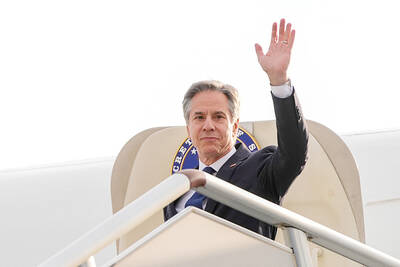
‘IN A DIFFERENT PLACE’: The envoy first visited Shanghai, where he attended a Chinese basketball playoff match, and is to meet top officials in Beijing tomorrow US Secretary of State Antony Blinken yesterday arrived in China on his second visit in a year as the US ramps up pressure on its rival over its support for Russia while also seeking to manage tensions with Beijing. The US diplomat tomorrow is to meet China’s top brass in Beijing, where he is also expected to plead for restraint as Taiwan inaugurates president-elect William Lai (賴清德), and to raise US concerns on Chinese trade practices. However, Blinken is also seeking to stabilize ties, with tensions between the world’s two largest economies easing since his previous visit in June last year. At the
Nearly half of China’s major cities are suffering “moderate to severe” levels of subsidence, putting millions of people at risk of flooding, especially as sea levels rise, according to a study of nationwide satellite data released yesterday. The authors of the paper, published by the journal Science, found that 45 percent of China’s urban land was sinking faster than 3mm per year, with 16 percent at more than 10mm per year, driven not only by declining water tables, but also the sheer weight of the built environment. With China’s urban population already in excess of 900 million people, “even a small portion

UNSETTLING IMAGES: The scene took place in front of TV crews covering the Trump trial, with a CNN anchor calling it an ‘emotional and unbelievably disturbing moment’ A man who doused himself in an accelerant and set himself on fire outside the courthouse where former US president Donald Trump is on trial has died, police said yesterday. The New York City Police Department (NYPD) said the man was declared dead by staff at an area hospital. The man was in Collect Pond Park at about 1:30pm on Friday when he took out pamphlets espousing conspiracy theories, tossed them around, then doused himself in an accelerant and set himself on fire, officials and witnesses said. A large number of police officers were nearby when it happened. Some officers and bystanders rushed

Beijing is continuing to commit genocide and crimes against humanity against Uyghurs and other Muslim minorities in its western Xinjiang province, U.S. Secretary of State Antony Blinken said in a report published on Monday, ahead of his planned visit to China this week. The State Department’s annual human rights report, which documents abuses recorded all over the world during the previous calendar year, repeated language from previous years on the treatment of Muslims in Xinjiang, but the publication raises the issue ahead of delicate talks, including on the war in Ukraine and global trade, between the top U.S. diplomat and Chinese


 RSS
RSS