


A third round of six-country talks on North Korea's nuclear ambitions will probably take place for four days beginning on June 23, South Korea said yesterday.
The two Koreas, the US, Japan and Russia have twice met with host China in Beijing without reaching agreement on dismantling the North's covert nuclear weapons programs.
"There is a consensus among the six countries on the dates, but it's not quite the stage to announce it," South Korean Foreign Minister Ban Ki-moon told reporters.
Working-level officials from the six countries will meet for two days immediately before the plenary meetings in Beijing, he said, adding that a formal announcement could come early next week.
Ban did not say what was holding up the announcement.
But in Tokyo, diplomatic sources said China had told other participants a new round would be pointless unless Washington and North Korea narrowed their differences.
"Stressing that the US and North Korea remain far apart, China is suggesting the possibility of postponing a third round of six-party talks," one source told reporters on condition of anonymity.
China insisted on the need for progress if the next round of talks were to be held, he said.
China's move may simply be an attempt to put pressure on the US and North Korea, another diplomatic source said.
"I would not say the next round of six-party talks would not be held this month. There is still a possibility of holding such talks this month," he said.
Analysts have doubts about the chances of making progress, given that neither of the protagonists -- the US and North Korea -- is expected to compromise before the US presidential election in November.
But North Korea may be forced to blink because it is likely to be concerned about how it will weather another severe winter with no compensatory fuel shipments from outside.
North Korea, for more than a decade, has been operating nuclear weapons development programs on and off. It is demanding compensation, including heavy fuel oil, from the other five countries and a non-aggression treaty from the US as a precondition to scrapping them.
Ban said South Korea will be joining a global partnership to stop the spread of weapons of mass destruction, first adopted at the meeting of the Group of Eight leaders in 2002.
The program is designed to dismantle and intercept movements of weapons and materials of mass destruction.
South Korea will not formally join a US-led Proliferation Security Initiative, an agreement among 11 countries to interdict and search shipments suspected of containing weapons of mass destruction equipment.
Ban said that was because it "may affect ongoing efforts to resolve the nuclear problem and exchange between the South and North Korea."
In Savannah, Georgia, on Tuesday, Japanese Prime Minister Junichiro Koizumi, en route to a G8 summit in nearby Sea Island, told US President George W. Bush that North Korea appeared to have become more open to a deal on halting its nuclear weapons programs.

Republican US lawmakers on Friday criticized US President Joe Biden’s administration after sanctioned Chinese telecoms equipment giant Huawei unveiled a laptop this week powered by an Intel artificial intelligence (AI) chip. The US placed Huawei on a trade restriction list in 2019 for contravening Iran sanctions, part of a broader effort to hobble Beijing’s technological advances. Placement on the list means the company’s suppliers have to seek a special, difficult-to-obtain license before shipping to it. One such license, issued by then-US president Donald Trump’s administration, has allowed Intel to ship central processors to Huawei for use in laptops since 2020. China hardliners
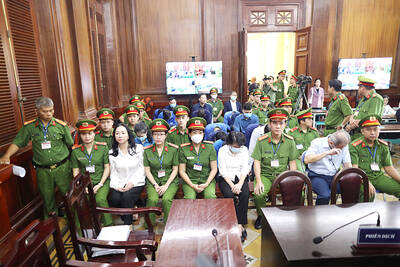
A top Vietnamese property tycoon was on Thursday sentenced to death in one of the biggest corruption cases in history, with an estimated US$27 billion in damages. A panel of three hand-picked jurors and two judges rejected all defense arguments by Truong My Lan, chair of major developer Van Thinh Phat, who was found guilty of swindling cash from Saigon Commercial Bank (SCB) over a decade. “The defendant’s actions ... eroded people’s trust in the leadership of the [Communist] Party and state,” read the verdict at the trial in Ho Chi Minh City. After the five-week trial, 85 others were also sentenced on

‘DELUSIONAL’: Targeting the families of Hamas’ leaders would not push the group to change its position or to give up its demands for Palestinians, Ismail Haniyeh said Israeli aircraft on Wednesday killed three sons of Hamas’ top political leader in the Gaza Strip, striking high-stakes targets at a time when Israel is holding delicate ceasefire negotiations with the militant group. Hamas said four of the leader’s grandchildren were also killed. Ismail Haniyeh’s sons are among the highest-profile figures to be killed in the war so far. Israel said they were Hamas operatives, and Haniyeh accused Israel of acting in “the spirit of revenge and murder.” The deaths threatened to strain the internationally mediated ceasefire talks, which appeared to gain steam in recent days even as the sides remain far

RAMPAGE: A Palestinian man was left dead after dozens of Israeli settlers searching for a missing 14-year-old boy stormed a village in the Israeli-occupied West Bank US President Joe Biden on Friday said he expected Iran to attack Israel “sooner, rather than later” and warned Tehran not to proceed. Asked by reporters about his message to Iran, Biden simply said: “Don’t,” underscoring Washington’s commitment to defend Israel. “We are devoted to the defense of Israel. We will support Israel. We will help defend Israel and Iran will not succeed,” he said. Biden said he would not divulge secure information, but said his expectation was that an attack could come “sooner, rather than later.” Israel braced on Friday for an attack by Iran or its proxies as warnings grew of


 RSS
RSS