


Chinese President Hu Jintao's (胡錦濤) visit to Eastern Europe and Central Asia is a fresh brush stroke on an emerging portrait of a new diplomacy to extend Beijing's influence, seek new sources of oil and diversify economic risk.
Hu, who doubles as Communist Party chief, left yesterday for a 10-day trip to meet leaders in Poland, Hungary, Romania and the Central Asian republic of Uzbekistan.
The trip is unlikely to gain the headlines of a summit with the US or Russia, but it offers further evidence of a more assertive diplomacy that emerged in the late 1990s and accelerated under a new leadership headed by Hu since March last year.
"There is a new confidence in China's diplomacy and a belief that China can and should play a more active role on the international stage," said Elizabeth Economy, director of Asia studies at the Council on Foreign Relations in New York.
To that end, China is forging deeper ties with more countries and exercising its new-found assertiveness. That means taking the time to visit smaller countries such as those on this trip as well as ensuring a steady and diversified flow of oil and resources, analysts say.
In East Asia, China's interests in improving ties with its neighbors and avoiding turmoil on its borders are more immediate. It has played a major role as host to talks trying to defuse the crisis over North Korea's nuclear ambitions.
Europe too is a key focal point.
While trade with Poland, Hungary and Romania is meagre, the EU is poised to surpass Japan soon as China's biggest trading partner. The significance is not lost on the leadership.
Premier Wen Jiabao (
By the time Hu wraps up his trip, the Communist Party's top three leaders -- including Wen and parliament chief Wu Bangguo (吳邦國) -- will have visited more than a dozen European countries -- including Belgium, the UK, Bulgaria, Denmark, Germany, Ireland, Italy, Norway, France and Russia.
Hu's stop in Central Asia high-lights the increasing importance China places on cultivating diplomatic friends in a volatile but resource-rich area.
Oil, of which China is the world's second-biggest importer, after the US, is a driving factor in improving ties with Central Asia. With more than half its crude imports coming from the Middle East, Beijing has been trying to diversify its sources of energy.
Last month, China took the uncharacteristic decision to circulate in the UN Security Council a document called "Iraq run by Iraqis," with strong opinions on future rule of the war-torn country.

Republican US lawmakers on Friday criticized US President Joe Biden’s administration after sanctioned Chinese telecoms equipment giant Huawei unveiled a laptop this week powered by an Intel artificial intelligence (AI) chip. The US placed Huawei on a trade restriction list in 2019 for contravening Iran sanctions, part of a broader effort to hobble Beijing’s technological advances. Placement on the list means the company’s suppliers have to seek a special, difficult-to-obtain license before shipping to it. One such license, issued by then-US president Donald Trump’s administration, has allowed Intel to ship central processors to Huawei for use in laptops since 2020. China hardliners
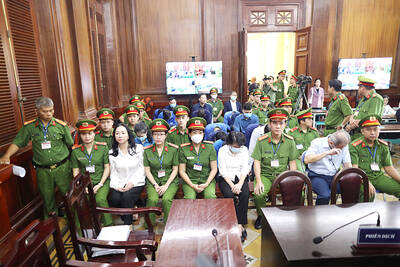
A top Vietnamese property tycoon was on Thursday sentenced to death in one of the biggest corruption cases in history, with an estimated US$27 billion in damages. A panel of three hand-picked jurors and two judges rejected all defense arguments by Truong My Lan, chair of major developer Van Thinh Phat, who was found guilty of swindling cash from Saigon Commercial Bank (SCB) over a decade. “The defendant’s actions ... eroded people’s trust in the leadership of the [Communist] Party and state,” read the verdict at the trial in Ho Chi Minh City. After the five-week trial, 85 others were also sentenced on

‘DELUSIONAL’: Targeting the families of Hamas’ leaders would not push the group to change its position or to give up its demands for Palestinians, Ismail Haniyeh said Israeli aircraft on Wednesday killed three sons of Hamas’ top political leader in the Gaza Strip, striking high-stakes targets at a time when Israel is holding delicate ceasefire negotiations with the militant group. Hamas said four of the leader’s grandchildren were also killed. Ismail Haniyeh’s sons are among the highest-profile figures to be killed in the war so far. Israel said they were Hamas operatives, and Haniyeh accused Israel of acting in “the spirit of revenge and murder.” The deaths threatened to strain the internationally mediated ceasefire talks, which appeared to gain steam in recent days even as the sides remain far
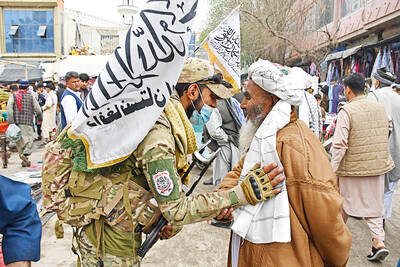
The Taliban’s reclusive supreme leader made a rare public appearance yesterday, an Afghan government spokesman said, leading thousands of worshipers in prayers marking Eid al-Fitr. Hibatullah Akhundzada has made only a handful of public appearances since inheriting the leadership of the Taliban in 2016 and leading the movement back to power with the withdrawal of US forces in 2021. Taliban government spokesman Zabihullah Mujahid said prayer in the largest mosque in Kandahar was “performed under the leadership of the supreme leader.” In a statement on X, he said the early-morning service “was attended by thousands of compatriots” in the southern province considered the


 RSS
RSS