


Beijing is backing Hong Kong's chief executive, an aide said a day after a commentary in a Chinese newspaper chided Tung Chee-hwa (
Public frustration with the unpopular Tung, handpicked by Beijing after Hong Kong reverted to Chinese rule in 1997, has fueled growing demands for full democracy in the past year, alarming leaders in Beijing.
"The Chinese government, especially the top leaders, has always been sending a clear message that it supports the Hong Kong government led by Mr Tung," said Cheng Yiu-tong (鄭耀棠), a member of Tung's Cabinet and a pro-Beijing politician.
He was responding to an article by Lau Nai-keung (劉迺強), a Hong Kong member of the Chinese People's Political and Consultative Conference (CPPCC), published in the Hong Kong edition of China Daily on Monday. The CPPCC is an advisory body to China's parliament.
"Our government is getting weaker by the day, and with universal suffrage put on hold, it becomes easy to convince a growing number of people that even our next government is likely to be as inept," Lau wrote.
The rare criticism of Tung in an official Chinese paper is likely to rekindle speculation that Beijing may sack him or convince him to resign for health reasons in a bid to defuse growing tensions in the city of nearly 7 million people.
But others believe such a move by Beijing would be unlikely because it would be seen as meddling too overtly in the former British colony's affairs.
China promised Hong Kong that it would retain a high degree of autonomy when it reverted to Chinese control, but, fearful of losing political control, it has increasingly stamped its authority over the city in recent months.
Chinese officials have embarked on a campaign to discredit pro-democracy advocates before crucial legislative elections in September.
"As for the recent debate on constitutional development, Tung appeared to have been side-stepped by the central government," Lau wrote. "Tung has become even more elusive, and more distant from the public."
He criticized the government's handling of the recent resignations of three popular radio talkshow hosts critical of Beijing, noting these had led to "all sorts of speculation."
Two of the broadcasters said they had received death threats, adding to concerns that Beijing was suppressing freedom of speech. China has denied any role in the resignations.
"The government, and in particular the chief executive, should have come out early to issue firmer statements and take sterner actions to dispel speculation," Lau wrote. "And this is the job of the government which cannot be taken over by the central [Chinese] government," Lau said.
Beijing is already preparing for what it would see as a worst-case scenario -- a victory by pro-democracy forces in the September legislative elections, Hong Kong's Sing Tao newspaper said yesterday, quoting unidentified sources close to China.
It is sending a large number of officials, academics and researchers to Hong Kong to consult on whether a democratic majority would paralyze the local government, the newspaper said.

Republican US lawmakers on Friday criticized US President Joe Biden’s administration after sanctioned Chinese telecoms equipment giant Huawei unveiled a laptop this week powered by an Intel artificial intelligence (AI) chip. The US placed Huawei on a trade restriction list in 2019 for contravening Iran sanctions, part of a broader effort to hobble Beijing’s technological advances. Placement on the list means the company’s suppliers have to seek a special, difficult-to-obtain license before shipping to it. One such license, issued by then-US president Donald Trump’s administration, has allowed Intel to ship central processors to Huawei for use in laptops since 2020. China hardliners
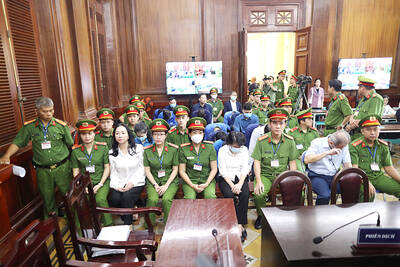
A top Vietnamese property tycoon was on Thursday sentenced to death in one of the biggest corruption cases in history, with an estimated US$27 billion in damages. A panel of three hand-picked jurors and two judges rejected all defense arguments by Truong My Lan, chair of major developer Van Thinh Phat, who was found guilty of swindling cash from Saigon Commercial Bank (SCB) over a decade. “The defendant’s actions ... eroded people’s trust in the leadership of the [Communist] Party and state,” read the verdict at the trial in Ho Chi Minh City. After the five-week trial, 85 others were also sentenced on

‘DELUSIONAL’: Targeting the families of Hamas’ leaders would not push the group to change its position or to give up its demands for Palestinians, Ismail Haniyeh said Israeli aircraft on Wednesday killed three sons of Hamas’ top political leader in the Gaza Strip, striking high-stakes targets at a time when Israel is holding delicate ceasefire negotiations with the militant group. Hamas said four of the leader’s grandchildren were also killed. Ismail Haniyeh’s sons are among the highest-profile figures to be killed in the war so far. Israel said they were Hamas operatives, and Haniyeh accused Israel of acting in “the spirit of revenge and murder.” The deaths threatened to strain the internationally mediated ceasefire talks, which appeared to gain steam in recent days even as the sides remain far

RAMPAGE: A Palestinian man was left dead after dozens of Israeli settlers searching for a missing 14-year-old boy stormed a village in the Israeli-occupied West Bank US President Joe Biden on Friday said he expected Iran to attack Israel “sooner, rather than later” and warned Tehran not to proceed. Asked by reporters about his message to Iran, Biden simply said: “Don’t,” underscoring Washington’s commitment to defend Israel. “We are devoted to the defense of Israel. We will support Israel. We will help defend Israel and Iran will not succeed,” he said. Biden said he would not divulge secure information, but said his expectation was that an attack could come “sooner, rather than later.” Israel braced on Friday for an attack by Iran or its proxies as warnings grew of


 RSS
RSS