


"We are not able to do our jobs. We are not even monitoring what is happening."
The words of Riak Gok, a UN civil education officer in the southern Afghan city of Kandahar, are echoed around Afghanistan by aid workers grounded at headquarters in large cities as concerns grow about security for September elections.
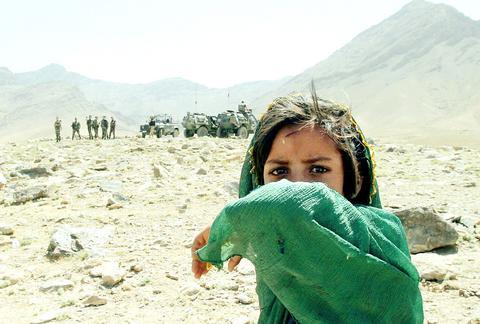
PHOTO: REUTERS
Vast swathes of the country, mainly but not exclusively in the south and east, are off limits to aid agencies, leaving countless towns, villages and homes untouched by the international community that has vowed to help them.
A growing insurgency by Islamic militants, most from the ousted Taliban regime, has made driving along even well-travelled highways too dangerous, particularly because aid groups are a prime targets of attacks.
More worrying still are signs that the threat is spreading.
Last week, five workers for Medecins Sans Frontieres (MSF), including three Westerners, were killed in Badghis, a northwestern province hitherto considered a relatively safe.
MSF has suspended its Afghan operations and five more aid groups followed suit in Badghis on Monday after a grenade was thrown at the office of an Italian NGO at the weekend.
Gok said the UN could operate in only five of 17 districts in Kandahar province, the Taliban's main stronghold before its overthrow by US-led forces in late 2001.
In Helmand, Uruzgan and Zabul provinces, the only presence is in district capitals themselves, according to Frank Adarkwah-Yiadom, regional logistics coordinator for the UN electoral secretariat in Kandahar.
Travelling by road from Kandahar to the capitals of Uruzgan and Zabul requires an armed escort.
"Everyone is willing and wanting to work, and we have everything to work with, but the problem is security. There is a lot of frustration," Adarkwah-Yiadom said.
Deteriorating security is directly linked to the approach of landmark elections the US hopes will give legitimacy to President Hamid Karzai, but which the Taliban and its allies have vowed to disrupt.
"There is no doubt that the enemy's activities have increased," said southern security chief Abdullah Laghmani. "Because the weather is warm, they can sleep in mountains and deserts at night. The reason for the increase in attacks is that elections are near."
The UN says it aims to have the large majority of the nine to 10 million eligible voters registered in time for the country's first ever direct vote.
But officials in Kandahar warn that leaving out large numbers of Pashtuns in the south due to security worries could alienate the country's largest ethnic group and its traditional ruling clan from the democratic process and play into extremists' hands.
"Once you lose the Pashtun vote, then it causes another problem," said one official who asked not to be named. "They then might start to sympathize with the Taliban."
Kandahar province spokesman Khalid Pashtun said that a security vacuum in large parts of the south, where people see little or no government presence, could be filled by militants.
"During the Taliban time, its 70,000 or so members were mainly from the local population," he said. "What happened to them? Half of those Taliban are just sitting at home.
"They see that the government is weak, and so are being encouraged to join the jihad."
The sense of alienation is heightened by the lack of contact with the international community in remote or unstable areas usually most in need of assistance.
Nick Downie, of Afghanistan NGO Security Offices in Kabul, estimates that half the country is off-limits to international aid staff. Already this year, 21 aid workers have been killed, compared with 13 in the whole of last year.
Not counting UN employees, only about 25 foreign aid workers remain in Kandahar, main base for assistance operations across the south, said Phillip Halton, local representative of Afghanistan NGO Security Offices.
Whether the security situation improves after the election, should it be held on time, is open to question. "There is a lot of effort going in to the election, but will there be greater stability the other side? It's not likely," he said.

An American scientist convicted of lying to US authorities about payments from China while he was at Harvard University has rebuilt his research lab in Shenzhen, China, to pursue technology the Chinese government has identified as a national priority: embedding electronics into the human brain. Charles Lieber, 67, is among the world’s leading researchers in brain-computer interfaces. The technology has shown promise in treating conditions such as amyotrophic lateral sclerosis and restoring movement in paralyzed people. It also has potential military applications: Scientists at the Chinese People’s Liberation Army have investigated brain interfaces as a way to engineer super soldiers by boosting
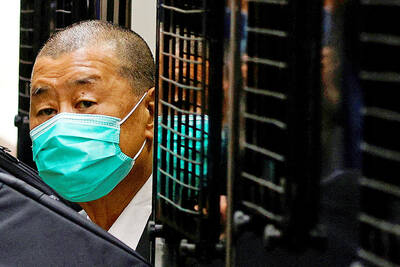
Jailed media entrepreneur Jimmy Lai (黎智英) has been awarded Deutsche Welle’s (DW) freedom of speech award for his contribution to Hong Kong’s pro-democracy movement. The German public broadcaster on Thursday said Lai would be presented in absentia with the 12th iteration of the award on June 23 at the DW Global Media Forum in Bonn. Deutsche Welle director-general Barbara Massing praised the 78-year-old founder of the now-shuttered news outlet Apple Daily for standing “unwaveringly for press freedom in Hong Kong at great personal risk.” “With Apple Daily, he gave journalists a platform for free reporting and a voice to the democracy movement in
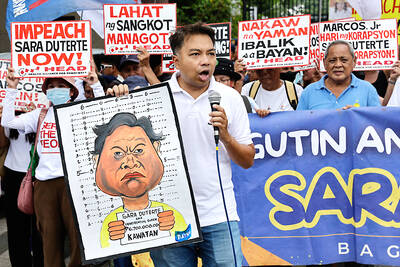
PHILIPPINE COMMITTEE: The head of the committee that made the decision said: ‘If there is nothing to hide, there is no reason to hide, there is no reason to obstruct’ A Philippine congressional committee on Wednesday ruled that there was “probable cause” to impeach Philippine Vice President Sara Duterte after hearing allegations of unexplained wealth, misuse of state funds and threats to have the president assassinated. The unanimous decision of the 53-member committee in the Philippine House of Representatives sends the two impeachment complaints to deliberations and voting by the entire lower chamber, which has more than 300 lawmakers. The complaints centered on Duterte’s alleged illegal use and mishandling of intelligence funds from the vice president’s office, and from her time as education secretary under Philippine President Ferdinand Marcos Jr. Duterte and the

As evening falls in Fiji’s capital, a steady stream of people approaches a makeshift clinic that is a first line of defense against one of the world’s fastest-growing HIV epidemics. In the South Pacific nation — a popular tourist destination of just under a million people — more than 2,000 new HIV cases were recorded last year, a 26 percent increase from 2024. The government has declared an HIV outbreak and described it as a national crisis. “It’s spreading like wildfire,” said Siteri Dinawai, 46, who came to be tested. The Moonlight Clinic, a converted minibus parked in a suburban cul-de-sac in Suva, is


 RSS
RSS