


The US reacted with indifference after Pakistan conducted its second ballistic missile test in less than a week last Friday, but experts see new evidence of an ominous trend.
An inexorable arms race in South Asia is proceeding while President George W. Bush -- focused on re-election, Iraq and the war on terrorism -- is unable or unwilling to grapple with it in a significant or effective way, they say.
"I think the US is distracted by other issues ... They have crisis overload," said Stephen Cohen of the Brookings Institution, author of books on Pakistan and India.
Lee Feinstein, a former Clinton administration official, said Pakistani President Pervez Musharraf, a key ally in Bush's war on terrorism, probably believes correctly that he can test-fire missiles without risking US pressure.
"In general the administration has been unsuccessful or unwilling to apply pressure on Pakistan with respect to its nuclear program and the missile test ... is another indication of our lack of influence or unwillingness to use it," said Feinstein, now with the Council on Foreign Relations.
But he warned that the last few times India-Pakistan tensions erupted over the disputed Himalayan region of Kashmir, "the risks increased when there has been inattention by the Americans."
On May 29, Pakistan test fired a Ghauri missile capable of carrying nuclear and other warheads up to 1,500 km. Six days later, the same missile was tested again.
The US had nothing official to say and unofficially, officials were nonchalant.
The test was "nothing particular ... There have been a whole series of tests by Pakistan and India ... These things go off every three or four months," one official told reporters.
Many experts believe if a nuclear weapon is fired in anger, it will result from an India-Pakistan conflict. The two countries stunned the world when they tested nuclear weapons in 1998.
They fought three wars after independence from the UK in 1947 and nearly did again in 2002 when New Delhi blamed Pakistan-based militants for a bloody attack on its parliament.
New details about Pakistan's capabilities came to light after Abdul Qadeer Khan, the country's nuclear progenitor, was arrested for running a nuclear black market that sold to Iran, Libya and North Korea. Musharraf later pardoned Khan.
Western diplomats have said Khan could not have acted independently and appeared to be a scapegoat for the army, which Musharraf heads.
Pakistan's recent missile tests came just after a new Indian government took office and as the two countries prepare for talks this month on reducing the risks from their nuclear rivalry, part of a peace process relaunched last year.
Musharraf suggested the tests had more to do with his domestic critics than sending a pre-talks message to India.
Cohen said Pakistan's program is driven by "technological logic" with scientists largely dictating the testing schedule. But the tests are also a signal that "my country cannot be treated lightly," Cohen said.
Ahead of the talks, the tests "could be Pakistan's way of emphasizing they are ahead in the arms race in South Asia and the Indians are behind," he added.
Feinstein said Musharraf was showing hard-liners at home he will not be outflanked on security and was also trying to create "negotiating space" ahead of the talks.
"In some sense you've got two leaders whose nationalist credentials are challenged at home and in that sense they are both weak going into these talks," Feinstein said.
The talks were initiated when the Bharatiya Janata Party governed India but it was ousted in recent elections. Pakistan views India's new government as weak, and it lacks officials with significant security experience, Cohen said.
"I think the Pakistanis believe they have strongly supported us in the war on terror and if the Indians are not forthcoming in terms of concessions on Kashmir, the talks will run down pretty quickly. That sets the stage for another crisis in fall or winter," he predicted.
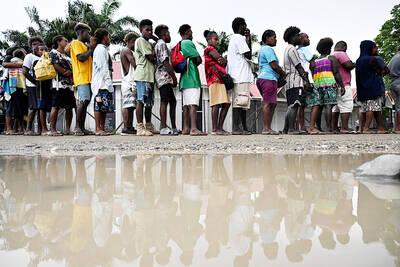
SEEKING CHANGE: A hospital worker said she did not vote in previous elections, but ‘now I can see that maybe my vote can change the system and the country’ Voting closed yesterday across the Solomon Islands in the south Pacific nation’s first general election since the government switched diplomatic allegiance from Taiwan to Beijing and struck a secret security pact that has raised fears of the Chinese navy gaining a foothold in the region. The Solomon Islands’ closer relationship with China and a troubled domestic economy weighed on voters’ minds as they cast their ballots. As many as 420,000 registered voters had their say across 50 national seats. For the first time, the national vote also coincided with elections for eight of the 10 local governments. Esther Maeluma cast her vote in the
Nearly half of China’s major cities are suffering “moderate to severe” levels of subsidence, putting millions of people at risk of flooding, especially as sea levels rise, according to a study of nationwide satellite data released yesterday. The authors of the paper, published by the journal Science, found that 45 percent of China’s urban land was sinking faster than 3mm per year, with 16 percent at more than 10mm per year, driven not only by declining water tables, but also the sheer weight of the built environment. With China’s urban population already in excess of 900 million people, “even a small portion

UNSETTLING IMAGES: The scene took place in front of TV crews covering the Trump trial, with a CNN anchor calling it an ‘emotional and unbelievably disturbing moment’ A man who doused himself in an accelerant and set himself on fire outside the courthouse where former US president Donald Trump is on trial has died, police said yesterday. The New York City Police Department (NYPD) said the man was declared dead by staff at an area hospital. The man was in Collect Pond Park at about 1:30pm on Friday when he took out pamphlets espousing conspiracy theories, tossed them around, then doused himself in an accelerant and set himself on fire, officials and witnesses said. A large number of police officers were nearby when it happened. Some officers and bystanders rushed

HYPOCRISY? The Chinese Ministry of Foreign Affairs yesterday asked whether Biden was talking about China or the US when he used the word ‘xenophobic’ US President Joe Biden on Wednesday called for a hike in steel tariffs on China, accusing Beijing of cheating as he spoke at a campaign event in Pennsylvania. Biden accused China of xenophobia, too, in a speech to union members in Pittsburgh. “They’re not competing, they’re cheating. They’re cheating and we’ve seen the damage here in America,” Biden said. Chinese steel companies “don’t need to worry about making a profit because the Chinese government is subsidizing them so heavily,” he said. Biden said he had called for the US Trade Representative to triple the tariff rates for Chinese steel and aluminum if Beijing was


 RSS
RSS