


A huge operation to tackle the world's worst unfolding humanitarian crisis was to swing into action yesterday following a warning that up to 300,000 people in Sudan could die within months even if essential aid gets through.
The UN will launch a 90-day emergency program after securing promises of funds from the US and other countries at a conference in Geneva.
The UN on Friday described a developing catastrophe in the region of Darfur and said the relief effort was crucial "to avoid massive death and starvation."
International aid agencies blame the scale of the crisis on the neglect of the international community and the obstruction by the Sudanese government of aid efforts.
About 1.2 million people, who fled their villages after being terrorized by government-armed Arab militia, are living in makeshift camps in Darfur and 100,000 in neighboring Chad. The flow of refugees to the border with Chad was continuing on Friday.
Andrew Natsios, head of USaid, a government agency, told the conference, which was held in private: "If we get relief in, we could lose a third of a million. If we do not, it could be a million."
The urgency is because of the start of the rainy season. The first rains fell this week on Mugjir in the south of the country, bringing with it the threat of polluted water supplies, disease and malnutrition.
Natsios said his predictions were based on mortality and malnutrition rates compiled recently in Sudan.
The UN asked the US and other nations for US$235 million in Geneva. The US promised US$147 million over 18 months and other countries made pledges.
UN Under-secretary General for Humanitarian Affairs Jan Egeland admitted the response to the crisis had been too slow and additional funding was needed for the remainder of this year.
"This is no wish list. This is exactly what it would take to avoid massive death and starvation," he said Friday.
"If we don't get it all, so many people will perish. It is as dramatic as that," he said.
The UN plans to spend the money raised at Geneva over the next three months on: feeding 1 million people; drilling boreholes and providing water pumps and tanks for the camps; providing basic health care for 90 percent of the displaced; helping the displaced build temporary shelters; distributing seeds and tools to 78,000 families; and deploying ceasefire monitors and human rights observers.
The rainy season will hamper the humanitarian effort as travel will become increasingly difficult and airdrops will have to be used in many places.
Britain is taking a lead in trying to get the Sudanese government to lift bureaucratic obstacles preventing humanitarian agencies moving freely into Darfur.
Hilary Benn, the UK's international development secretary, is to visit Khartoum today to press the Sudanese to end a system of permits required for internal travel for humanitarian agencies. He will also ask for blocks on aid to be lifted. The Sudanese government denies responsibility for the crisis in Darfur, but western governments claim it initially armed the Arab militia, apparently to suppress a rebellion.
An estimated 30,000 have been killed in the present bout of fighting. The US, Britain and others are calling on the Sudanese government to disarm the militia.
In an effort to tackle the militia and try to restore some security, the pan-continental African Union sent 10 monitors to Khartoum on Tuesday to oversee a shaky ceasefire agreed to in April.
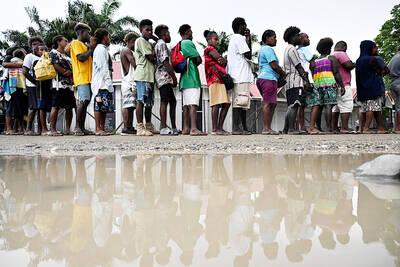
SEEKING CHANGE: A hospital worker said she did not vote in previous elections, but ‘now I can see that maybe my vote can change the system and the country’ Voting closed yesterday across the Solomon Islands in the south Pacific nation’s first general election since the government switched diplomatic allegiance from Taiwan to Beijing and struck a secret security pact that has raised fears of the Chinese navy gaining a foothold in the region. The Solomon Islands’ closer relationship with China and a troubled domestic economy weighed on voters’ minds as they cast their ballots. As many as 420,000 registered voters had their say across 50 national seats. For the first time, the national vote also coincided with elections for eight of the 10 local governments. Esther Maeluma cast her vote in the
Nearly half of China’s major cities are suffering “moderate to severe” levels of subsidence, putting millions of people at risk of flooding, especially as sea levels rise, according to a study of nationwide satellite data released yesterday. The authors of the paper, published by the journal Science, found that 45 percent of China’s urban land was sinking faster than 3mm per year, with 16 percent at more than 10mm per year, driven not only by declining water tables, but also the sheer weight of the built environment. With China’s urban population already in excess of 900 million people, “even a small portion

UNSETTLING IMAGES: The scene took place in front of TV crews covering the Trump trial, with a CNN anchor calling it an ‘emotional and unbelievably disturbing moment’ A man who doused himself in an accelerant and set himself on fire outside the courthouse where former US president Donald Trump is on trial has died, police said yesterday. The New York City Police Department (NYPD) said the man was declared dead by staff at an area hospital. The man was in Collect Pond Park at about 1:30pm on Friday when he took out pamphlets espousing conspiracy theories, tossed them around, then doused himself in an accelerant and set himself on fire, officials and witnesses said. A large number of police officers were nearby when it happened. Some officers and bystanders rushed

HYPOCRISY? The Chinese Ministry of Foreign Affairs yesterday asked whether Biden was talking about China or the US when he used the word ‘xenophobic’ US President Joe Biden on Wednesday called for a hike in steel tariffs on China, accusing Beijing of cheating as he spoke at a campaign event in Pennsylvania. Biden accused China of xenophobia, too, in a speech to union members in Pittsburgh. “They’re not competing, they’re cheating. They’re cheating and we’ve seen the damage here in America,” Biden said. Chinese steel companies “don’t need to worry about making a profit because the Chinese government is subsidizing them so heavily,” he said. Biden said he had called for the US Trade Representative to triple the tariff rates for Chinese steel and aluminum if Beijing was


 RSS
RSS