


Nearly a decade after the Oklahoma City bombing, Terry Nichols was found guilty of 161 state murder charges for helping carry out what was then the deadliest terrorist attack on American soil. He could get the death sentence he escaped when he was convicted in federal court in the 1990s.
Wednesday's verdicts came after only five hours of deliberations. Nichols was stone-faced and stared straight ahead at the judge as the verdicts were read, while his attorneys bowed their heads and clenched their hands together.
Prosecutors beamed, and family members hugged and congratulated them.
"I'm just so thrilled for these families," said a tearful Diane Leonard, whose husband died in the bombing. "After nine years, the families who lost loved ones finally have justice."
Nichols, 49, already is serving a federal life sentence for involuntary manslaughter and conspiracy in the deaths of eight federal law enforcement officials in the April 19, 1995, bombing of the Alfred Murrah Federal Building, which killed 168 people.
In this state trial, he was convicted of 161 counts of first-degree murder for the deaths of the other victims plus one victim's fetus.
The same 12-member jury will now determine Nichols' fate on the state charges: life in prison or death by injection. The penalty phase will begin Tuesday and is expected to last four to six weeks.
Prosecutors contended Nichols worked hand in hand with former army buddy Timothy McVeigh to acquire the ingredients and build the fuel-and-fertilizer bomb in a twisted plot to avenge the government siege in Waco, Texas, that left about 80 people dead exactly two years earlier.
McVeigh was executed in June 2001, and until now was the only person convicted of murder in the bombing.
"These two were partners, and their business was terrorism," prosecutor Lou Keel said during opening statements.
Prosecutors brought a mountain of circumstantial evidence during a two-month trial that included testimony from about 250 witnesses. They said Nichols bought the explosive ammonium nitrate fertilizer used in the bombing and stole detonation cord, blasting caps and other explosives.
Defense attorneys declined comment after the verdict, citing a gag order.
Prosecutors say McVeigh and Nichols began acquiring the key ingredients for the bomb seven months before the blast, then met at a park near Junction City, Kansas, to pack it inside a Ryder truck on April 18, 1995. Nichols was at his home in Kansas 320km away when the bomb went off.
Defense lawyers had planned on bringing up evidence that a shadowy group of conspirators, including members a white supremacist gang, helped McVeigh with the bombing. But Judge Steven Taylor refused to allow that evidence, saying the defense never showed that such people made any overt acts to further the bomb plot.
A total of 151 witnesses took the stand for the prosecution over 29 days of testimony that included several gruesome and tearful descriptions of the bombing.
The state's star witness was Michael Fortier, who is serving a 12-year sentence for knowing about the plot and not telling authorities.
Fortier, a close friend of McVeigh's, said McVeigh told him Nichols was deeply involved in the bomb plot and Nichols helped gather components, including the fertilizer that was mixed with high-octane fuel in the homemade bomb.
A receipt for the purchase of 900kg of ammonium nitrate fertilizer was discovered in Nichols' home by FBI agents three days after the bombing.
Fortier said McVeigh and Nichols also burglarized a Kansas rock quarry near Nichols' home in Herington, Kansas, and stole the detonation cord and blasting caps. In addition, prosecutors alleged that Nichols robbed a gun collector to finance the bomb plot.
Prosecutors linked Nichols to the explosives theft through forensic evidence from a broken padlock and said gold coins and weapons from the gun collector were found at his home.
Nearly half of China’s major cities are suffering “moderate to severe” levels of subsidence, putting millions of people at risk of flooding, especially as sea levels rise, according to a study of nationwide satellite data released yesterday. The authors of the paper, published by the journal Science, found that 45 percent of China’s urban land was sinking faster than 3mm per year, with 16 percent at more than 10mm per year, driven not only by declining water tables, but also the sheer weight of the built environment. With China’s urban population already in excess of 900 million people, “even a small portion

UNSETTLING IMAGES: The scene took place in front of TV crews covering the Trump trial, with a CNN anchor calling it an ‘emotional and unbelievably disturbing moment’ A man who doused himself in an accelerant and set himself on fire outside the courthouse where former US president Donald Trump is on trial has died, police said yesterday. The New York City Police Department (NYPD) said the man was declared dead by staff at an area hospital. The man was in Collect Pond Park at about 1:30pm on Friday when he took out pamphlets espousing conspiracy theories, tossed them around, then doused himself in an accelerant and set himself on fire, officials and witnesses said. A large number of police officers were nearby when it happened. Some officers and bystanders rushed
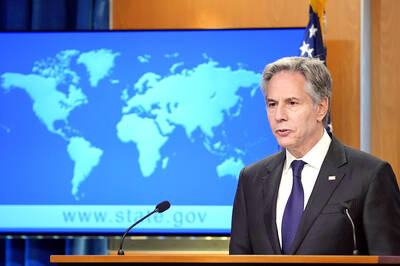
Beijing is continuing to commit genocide and crimes against humanity against Uyghurs and other Muslim minorities in its western Xinjiang province, U.S. Secretary of State Antony Blinken said in a report published on Monday, ahead of his planned visit to China this week. The State Department’s annual human rights report, which documents abuses recorded all over the world during the previous calendar year, repeated language from previous years on the treatment of Muslims in Xinjiang, but the publication raises the issue ahead of delicate talks, including on the war in Ukraine and global trade, between the top U.S. diplomat and Chinese
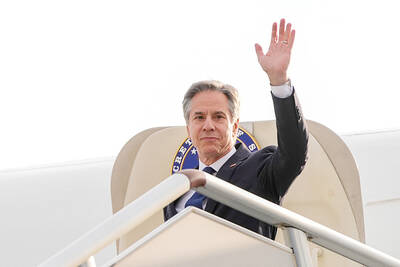
‘IN A DIFFERENT PLACE’: The envoy first visited Shanghai, where he attended a Chinese basketball playoff match, and is to meet top officials in Beijing tomorrow US Secretary of State Antony Blinken yesterday arrived in China on his second visit in a year as the US ramps up pressure on its rival over its support for Russia while also seeking to manage tensions with Beijing. The US diplomat tomorrow is to meet China’s top brass in Beijing, where he is also expected to plead for restraint as Taiwan inaugurates president-elect William Lai (賴清德), and to raise US concerns on Chinese trade practices. However, Blinken is also seeking to stabilize ties, with tensions between the world’s two largest economies easing since his previous visit in June last year. At the


 RSS
RSS