


Senator John Kerry's strategists are considering whether to strike out the centerpiece of the political convention season -- his formal adoption as the Democratic party's official candidate -- to allow him to keep pace with US President George W. Bush's fundraising juggernaut.
Campaign finance regulations restrict the parties to US$75 million in public funds once a candidate is nominated.
While Kerry will be counting the pennies come July 29, when he is formally nominated at the convention in Boston, Bush will be allowed to keep raising funds until he is confirmed at the Republican convention in New York five weeks later.
"It's definitely an option," an aide to the Kerry campaign said on Tuesday.
Bob Biersack, a spokesman for the federal election commission, said there had been no formal approach so far to rule on the legality of a delayed nomination process.
Irresistible
But the attractions of such a move may prove irresistible to party fundraisers, who do not want the Democrats to be bound by fundraising restrictions during August, when Republicans will be allowed to spend freely.
"It really is a Republican advantage, and the Kerry campaign would like to do something about it," said Thomas Mann, a scholar in governance at the Brookings Institution.
This election has broken new ground for campaign fundraising, and spending.
Although the Bush-Cheney war-chest of US$201 million easily overwhelms Kerry's US$117 million, Democratic fundraisers believe that they can compete with the Republicans.
Kerry raised US$31.3 million in April -- double the US$15.5 million that Bush brought in.
The Democrats have digested the lesson of the 2000 election, when Al Gore finished the primary season strapped for cash and unable to compete with an onslaught of television ads by Bush's campaign.
With that experience in mind, Kerry declined to accept public funds during the primaries, calculating that it would free his hand to raise and spend throughout the summer.
Predicament
Experts on election finance say the roots of Kerry's predicament lie in the campaign finance laws' failure keep pace with the accelerated primary season, which produces a putative party leader as early as March.
"The rules simply do not address the fact that there is a long period when there is a presumptive nominee, and the general election season hasn't begun," said Michael Malbin, director of the Campaign Finance Institute.
"The law still pretends that there are two seamless seasons: a nomination season, and a general election.
"They don't recognize the fact that for half a year now we have had a shadow candidate," he said.
But Malbin acknowledged that the political cost of delaying Kerry's acceptance speech might not be worth the extra funds.
The early reactions by commentators were scathing, some predicting that Kerry would sacrifice his star turn -- his acceptance speech -- for the sake of advertising buys in August, when voters are on holiday or otherwise uninterested in politics.
"It really looks like he is gaming the system," said Larry Noble, director of the Center for Responsive Politics.
"If he is going to accept public financing for the general election he should abide by all the rules and not try and twist the system to financially level the playing field," Noble said.
Nearly half of China’s major cities are suffering “moderate to severe” levels of subsidence, putting millions of people at risk of flooding, especially as sea levels rise, according to a study of nationwide satellite data released yesterday. The authors of the paper, published by the journal Science, found that 45 percent of China’s urban land was sinking faster than 3mm per year, with 16 percent at more than 10mm per year, driven not only by declining water tables, but also the sheer weight of the built environment. With China’s urban population already in excess of 900 million people, “even a small portion

UNSETTLING IMAGES: The scene took place in front of TV crews covering the Trump trial, with a CNN anchor calling it an ‘emotional and unbelievably disturbing moment’ A man who doused himself in an accelerant and set himself on fire outside the courthouse where former US president Donald Trump is on trial has died, police said yesterday. The New York City Police Department (NYPD) said the man was declared dead by staff at an area hospital. The man was in Collect Pond Park at about 1:30pm on Friday when he took out pamphlets espousing conspiracy theories, tossed them around, then doused himself in an accelerant and set himself on fire, officials and witnesses said. A large number of police officers were nearby when it happened. Some officers and bystanders rushed
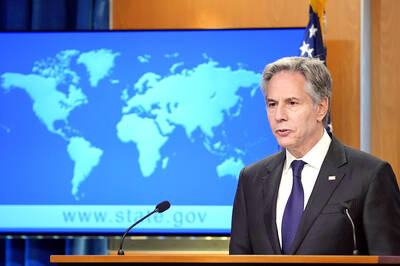
Beijing is continuing to commit genocide and crimes against humanity against Uyghurs and other Muslim minorities in its western Xinjiang province, U.S. Secretary of State Antony Blinken said in a report published on Monday, ahead of his planned visit to China this week. The State Department’s annual human rights report, which documents abuses recorded all over the world during the previous calendar year, repeated language from previous years on the treatment of Muslims in Xinjiang, but the publication raises the issue ahead of delicate talks, including on the war in Ukraine and global trade, between the top U.S. diplomat and Chinese

HYPOCRISY? The Chinese Ministry of Foreign Affairs yesterday asked whether Biden was talking about China or the US when he used the word ‘xenophobic’ US President Joe Biden on Wednesday called for a hike in steel tariffs on China, accusing Beijing of cheating as he spoke at a campaign event in Pennsylvania. Biden accused China of xenophobia, too, in a speech to union members in Pittsburgh. “They’re not competing, they’re cheating. They’re cheating and we’ve seen the damage here in America,” Biden said. Chinese steel companies “don’t need to worry about making a profit because the Chinese government is subsidizing them so heavily,” he said. Biden said he had called for the US Trade Representative to triple the tariff rates for Chinese steel and aluminum if Beijing was


 RSS
RSS