


Japan's prime minister enjoyed a boost in opinion poll ratings yesterday after his weekend summit in North Korea, where he won the release of five children of Japanese abducted by the North but earned criticism for failing to gain a full accounting of other abductees.
Polls conducted by three of Japan's top national newspapers showed substantial jumps in approval of Prime Minister Junichiro Koizumi's Cabinet -- strengthening the government less than two months before elections for the upper house of Parliament in July.
The surveys also indicated strong support for the results of Koizumi's one-day summit with Northern leader Kim Jong Il on Saturday.
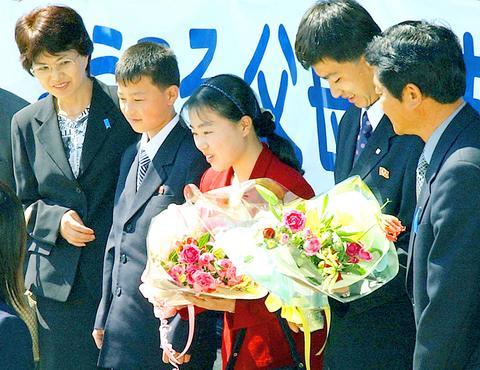
PHOTO: AP
The meeting led to Pyongyang's release of five children of Japanese citizens who were kidnapped by Northern agents in the 1970s in 1980s. The five abductees were allowed to return to Japan but their kin remained behind in the North.
The Asahi newspaper showed support for Koizumi's Cabinet rose to 54 percent in telephone interviews on Sunday, from 45 percent in a survey conducted on May 14-15.
The Mainichi newspaper poll had support increasing from 47 percent to 58 percent in the same period. The Yomiuri newspaper showed support at 54 percent.
The poll results contrasted sharply with a torrent of criticism Koizumi faced from some families of abductees, who argued he gave too much aid to Kim without winning a full accounting of what happened to all the North's victims.
In the first Koizumi-Kim meeting in 2002, North Korea admitted kidnapping 13 Japanese in the 1970s and 80s. Kim said eight had died, but allowed five survivors to return to Japan.
Since then, Japan has pushed to win the release of eight family members -- seven children and one husband -- of the five repatriated abductees, and for more details about the fates of the eight others.
Tokyo also wants an investigation into two other Japanese believed to be victims who have not been accounted for.
In Saturday's meeting, Koizumi won the release of five of the children, while the husband, American Charles Jenkins, elected to stay in North Korea with his two children over fears he could face US prosecution for his alleged desertion of his US Army unit in South Korea in 1965.
In return, Koizumi promised 250,000 tonnes of rice aid and US$10 million in medical and other humanitarian supplies.
Criticism has focused on Koizumi's failure to win a full accounting of the missing abductees, and some have accused him of naively trusting Kim's pledges and rewarding him with assistance.
"The government needs to toughen its stance in negotiations with North Korea. Resolving pending issues with North Korea will require intense efforts on the part of Japan," the Yomiuri said in an editorial yesterday.
Koizumi's government, however, insisted that the visit yielded substantial benefits, such as an agreement to investigate the fates of the missing. Pyongyang had previously said that those cases were closed.
"Obviously, that position is now changed. The visit by the prime minister prompted them to make a fresh start on the issue," Chief Cabinet Secretary Hiroyuki Hosoda said.
Despite the mixed feelings over the summit, the polls showed overall approval. Mainichi showed 62 percent of respondents approving the results, while Asahi reported 67 percent, and Yomiuri 63 percent.
The surveys, however, suggested skepticism about eventual normalization of ties between the two nations. Japan and North Korea have never had official diplomatic ties.
The Yomiuri telephoned 1,882 adults across Japan on Sunday for a response rate of 59 percent. The Asahi interviewed 1,018 adults, and the Mainichi surveyed 1,040 people. None of the polls provided a margin of error.
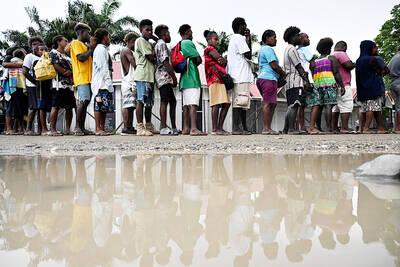
SEEKING CHANGE: A hospital worker said she did not vote in previous elections, but ‘now I can see that maybe my vote can change the system and the country’ Voting closed yesterday across the Solomon Islands in the south Pacific nation’s first general election since the government switched diplomatic allegiance from Taiwan to Beijing and struck a secret security pact that has raised fears of the Chinese navy gaining a foothold in the region. The Solomon Islands’ closer relationship with China and a troubled domestic economy weighed on voters’ minds as they cast their ballots. As many as 420,000 registered voters had their say across 50 national seats. For the first time, the national vote also coincided with elections for eight of the 10 local governments. Esther Maeluma cast her vote in the
Nearly half of China’s major cities are suffering “moderate to severe” levels of subsidence, putting millions of people at risk of flooding, especially as sea levels rise, according to a study of nationwide satellite data released yesterday. The authors of the paper, published by the journal Science, found that 45 percent of China’s urban land was sinking faster than 3mm per year, with 16 percent at more than 10mm per year, driven not only by declining water tables, but also the sheer weight of the built environment. With China’s urban population already in excess of 900 million people, “even a small portion

UNSETTLING IMAGES: The scene took place in front of TV crews covering the Trump trial, with a CNN anchor calling it an ‘emotional and unbelievably disturbing moment’ A man who doused himself in an accelerant and set himself on fire outside the courthouse where former US president Donald Trump is on trial has died, police said yesterday. The New York City Police Department (NYPD) said the man was declared dead by staff at an area hospital. The man was in Collect Pond Park at about 1:30pm on Friday when he took out pamphlets espousing conspiracy theories, tossed them around, then doused himself in an accelerant and set himself on fire, officials and witnesses said. A large number of police officers were nearby when it happened. Some officers and bystanders rushed

HYPOCRISY? The Chinese Ministry of Foreign Affairs yesterday asked whether Biden was talking about China or the US when he used the word ‘xenophobic’ US President Joe Biden on Wednesday called for a hike in steel tariffs on China, accusing Beijing of cheating as he spoke at a campaign event in Pennsylvania. Biden accused China of xenophobia, too, in a speech to union members in Pittsburgh. “They’re not competing, they’re cheating. They’re cheating and we’ve seen the damage here in America,” Biden said. Chinese steel companies “don’t need to worry about making a profit because the Chinese government is subsidizing them so heavily,” he said. Biden said he had called for the US Trade Representative to triple the tariff rates for Chinese steel and aluminum if Beijing was


 RSS
RSS