


Former New York Mayor Rudolph Giuliani passionately defended local fire fighters and police on Wednesday after the rescue departments' response to Sept. 11 received sharp criticism from the commission investigating the attacks.
Giuliani's testimony was at times interrupted by emotional hecklers, including one who shouted, "My son was murdered." Nearly 3,000 people were killed in the suicide airplane attacks on New York and Washington in 2001.
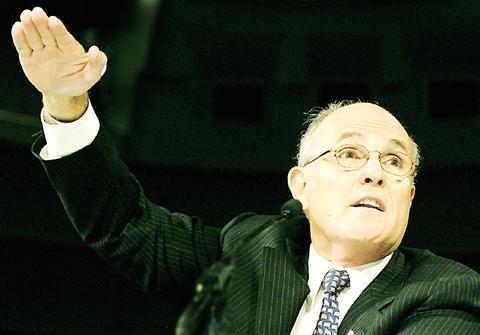
PHOTO: REUTERS
"Catastrophic emergencies and attacks have acts of great heroism attached to them. They have acts of ingenious creativity attached to them and they have mistakes that happen," Giuliani said. "When human beings are put under these conditions, that's what happens.
"Blame should be directed at one source and one source alone -- the terrorists who killed our loved ones."
He spoke after a commission staff report said rescue officials in New York and Washington were still not prepared to handle another disaster because coordination and communications flaws that hampered rescue efforts on Sept. 11 persist today.
Current Mayor Michael Bloomberg pleaded for more money to cope with terrorist threats. He said New York received only US$5.47 per capita in homeland security grants in 2004 -- the second lowest in the nation -- compared to US$38.31 per person in Wyoming, a far more rural, less-densely populated state.
During the two days of hearings, which ended on Wednesday, the commission said rivalries between the police and fire departments, equipment problems and weak coordination had hurt rescue efforts.
"Effective decision-making in New York was hampered by limited command and control and internal communications. Poor communications across agencies harmed situational awareness. Fire chiefs did not know what the NYPD [police] knew, and knew less than what TV viewers knew," Commission Chairman Thomas Kean and Vice Chairman Lee Hamilton said in a statement.
Giuliani denied any coordination difficulties. He said rescue officials "carried out the mission under great emotion, under great stress flawlessly, and that's because they have a superb command structure and a structure in which they know how to deal with emergencies."
Bloomberg told the commission that "the armchair quarterbacks forget that New York City police officers and fire fighters work together hundreds of times a day," adding that any "battle of the badges" were isolated incidents.
Angry hecklers in the audience, which included family members of victims, lashed out at Giuliani and the commission, saying they were dodging the tough questions about what went wrong in 2001.
One shouted "talk about the radios" -- a reference to communications problems on the day of the attacks. Another man was removed from the room after he demanded time to question the mayor, screaming: "Three thousand people murdered does not mean leadership. ... Let me ask the real questions."
The commission, meeting less than 3 km from where the World Trade Center towers once stood, said earlier that while progress had been made to iron out problems exposed by the attacks, rescue officials were still ill-prepared to handle a similar incident.
"It is a fair inference, given the differing situation in New York City and northern Virginia, that the problems in command, control and communications that occurred at both sites will likely recur in any emergency of a similar scale," a commission staff report said.
On Tuesday, the commission said that apart from reports of turf battles, the rescue mission suffered from communications equipment, such as radios that could not link different departments.
"The biggest failure was our inability to get the two [fire and police] to talk on the same [radio] frequency," Jerome Hauer, former director of New York City's Office of Emergency Management, acknowledged on Wednesday.
Nearly half of China’s major cities are suffering “moderate to severe” levels of subsidence, putting millions of people at risk of flooding, especially as sea levels rise, according to a study of nationwide satellite data released yesterday. The authors of the paper, published by the journal Science, found that 45 percent of China’s urban land was sinking faster than 3mm per year, with 16 percent at more than 10mm per year, driven not only by declining water tables, but also the sheer weight of the built environment. With China’s urban population already in excess of 900 million people, “even a small portion

UNSETTLING IMAGES: The scene took place in front of TV crews covering the Trump trial, with a CNN anchor calling it an ‘emotional and unbelievably disturbing moment’ A man who doused himself in an accelerant and set himself on fire outside the courthouse where former US president Donald Trump is on trial has died, police said yesterday. The New York City Police Department (NYPD) said the man was declared dead by staff at an area hospital. The man was in Collect Pond Park at about 1:30pm on Friday when he took out pamphlets espousing conspiracy theories, tossed them around, then doused himself in an accelerant and set himself on fire, officials and witnesses said. A large number of police officers were nearby when it happened. Some officers and bystanders rushed

Beijing is continuing to commit genocide and crimes against humanity against Uyghurs and other Muslim minorities in its western Xinjiang province, U.S. Secretary of State Antony Blinken said in a report published on Monday, ahead of his planned visit to China this week. The State Department’s annual human rights report, which documents abuses recorded all over the world during the previous calendar year, repeated language from previous years on the treatment of Muslims in Xinjiang, but the publication raises the issue ahead of delicate talks, including on the war in Ukraine and global trade, between the top U.S. diplomat and Chinese

HYPOCRISY? The Chinese Ministry of Foreign Affairs yesterday asked whether Biden was talking about China or the US when he used the word ‘xenophobic’ US President Joe Biden on Wednesday called for a hike in steel tariffs on China, accusing Beijing of cheating as he spoke at a campaign event in Pennsylvania. Biden accused China of xenophobia, too, in a speech to union members in Pittsburgh. “They’re not competing, they’re cheating. They’re cheating and we’ve seen the damage here in America,” Biden said. Chinese steel companies “don’t need to worry about making a profit because the Chinese government is subsidizing them so heavily,” he said. Biden said he had called for the US Trade Representative to triple the tariff rates for Chinese steel and aluminum if Beijing was


 RSS
RSS