


Almost three years after she fled from a deranged stranger on a remote Australian outback highway, Briton Joanne Lees is poised to face the man accused of killing her boyfriend and changing her life forever.
Lees will be the star witness at the committal hearing beginning today in Darwin of Bradley John Murdoch, 45, a truck driver charged with the July 2001 shooting of British holiday maker Peter Falconio and assaulting and abducting Lees.
Her evidence is crucial to the prosecution's attempt to resolve one of Australia's biggest crime mysteries, as Falconio's body has never been found, despite extensive searches involving police, Aboriginal trackers and helicopters.
Lees has kept a low profile since arriving in Australia earlier this month, staying in a secret location and refusing to speak to the press so as not to prejudice the case.
"I want Bradley Murdoch to receive a fair committal hearing as I believe this is the only way justice can prevail," she said in a statement released through the Northern Territory police.
Falconio's brothers Paul and Nick have also flown in from Britain for the committal, with Paul expected to be the first witness to take the stand today.
Lees and Falconio were in the eighth month of a world trip when tragedy struck on July 14, 2001, along the Stuart Highway north of the central Australian town of Alice Springs.
Lees told police the couple had been driving north just after dark when a man in a Toyota pick-up truck drew alongside and indicated a problem with their car.
She said Falconio stopped and got out. She heard a gunshot and never saw him again.
The gunman then seized and bound her, forcing her into his truck at pistol-point.
She later escaped, hiding in scrub for five hours as he searched for her, before finally driving away.
Lees crawled out of the bush soon after midnight, flagged down a passing truck and told a tale which set off one of the biggest manhunts in Australian history.
Police searched for the killer for a year until Murdoch, a loner who regularly ranged across the roads of the central desert, was picked up in South Australia in August 2002 over an unrelated matter.
Darwin detectives questioned him in Adelaide and he was finally extradited to the northern capital last November and charged in Falconio's death.
Lees holds the key to a successful prosecution.
She can identify the killer, and has provided potentially incriminating DNA from a shirt spotted with blood in her struggle with him.
Murdoch denies he is the man, saying police framed him.
The committal hearing is expected to last three weeks and will be covered by a large contingent of local and foreign media fascinated by the tale of a holiday turned nightmare in the outback.
The Falconio case has evoked memories of the 1986 Darwin trial of the parents of baby Azaria Chamberlain, who similarly disappeared without trace during a trip to central Australia.
Lindy Chamberlain and her husband were accused of killing their child, but later acquitted after a court accepted their story that the infant was snatched from the family campsite by a dingo -- a wild native dog.
In a book about the Chamberlain case titled The Country of Lost Children: an Australian Anxiety, author Peter Pierce suggested that fear of being lost in hostile desert or bushland has been deeply etched into the national psyche ever since Europeans colonized the continent.
Such angst about the dangers lurking in Australia's sometimes harsh environment has been apparent in the public's fascination with the Falconio saga.
The local Northern Territory government earns more than US$1.4 billion from tourism per year, hosting half a million international visitors, principally from Britain, Ireland, Germany and the US.
While it likes to promote the attractions of one of Australia's last frontier territories, it is not eager to publicize dangers.

Republican US lawmakers on Friday criticized US President Joe Biden’s administration after sanctioned Chinese telecoms equipment giant Huawei unveiled a laptop this week powered by an Intel artificial intelligence (AI) chip. The US placed Huawei on a trade restriction list in 2019 for contravening Iran sanctions, part of a broader effort to hobble Beijing’s technological advances. Placement on the list means the company’s suppliers have to seek a special, difficult-to-obtain license before shipping to it. One such license, issued by then-US president Donald Trump’s administration, has allowed Intel to ship central processors to Huawei for use in laptops since 2020. China hardliners
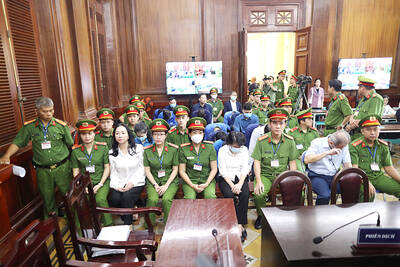
A top Vietnamese property tycoon was on Thursday sentenced to death in one of the biggest corruption cases in history, with an estimated US$27 billion in damages. A panel of three hand-picked jurors and two judges rejected all defense arguments by Truong My Lan, chair of major developer Van Thinh Phat, who was found guilty of swindling cash from Saigon Commercial Bank (SCB) over a decade. “The defendant’s actions ... eroded people’s trust in the leadership of the [Communist] Party and state,” read the verdict at the trial in Ho Chi Minh City. After the five-week trial, 85 others were also sentenced on

‘DELUSIONAL’: Targeting the families of Hamas’ leaders would not push the group to change its position or to give up its demands for Palestinians, Ismail Haniyeh said Israeli aircraft on Wednesday killed three sons of Hamas’ top political leader in the Gaza Strip, striking high-stakes targets at a time when Israel is holding delicate ceasefire negotiations with the militant group. Hamas said four of the leader’s grandchildren were also killed. Ismail Haniyeh’s sons are among the highest-profile figures to be killed in the war so far. Israel said they were Hamas operatives, and Haniyeh accused Israel of acting in “the spirit of revenge and murder.” The deaths threatened to strain the internationally mediated ceasefire talks, which appeared to gain steam in recent days even as the sides remain far
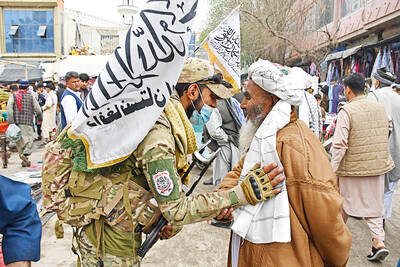
The Taliban’s reclusive supreme leader made a rare public appearance yesterday, an Afghan government spokesman said, leading thousands of worshipers in prayers marking Eid al-Fitr. Hibatullah Akhundzada has made only a handful of public appearances since inheriting the leadership of the Taliban in 2016 and leading the movement back to power with the withdrawal of US forces in 2021. Taliban government spokesman Zabihullah Mujahid said prayer in the largest mosque in Kandahar was “performed under the leadership of the supreme leader.” In a statement on X, he said the early-morning service “was attended by thousands of compatriots” in the southern province considered the


 RSS
RSS