


Once his greatest political asset, US President George W. Bush's leadership of the war against terror is becoming a potential liability.
False prewar claims about former Iraqi president Saddam Hussein's arsenal, mounting US casualties and now the sickening images of prisoner abuse in Iraq threaten to turn Americans against the war -- and against the self-professed "war president."
If the bad news continues through November presidential elections and Democratic rival John Kerry convinces voters he's a safe alternative -- two big ifs -- Bush may become an ex-war president, experts say.
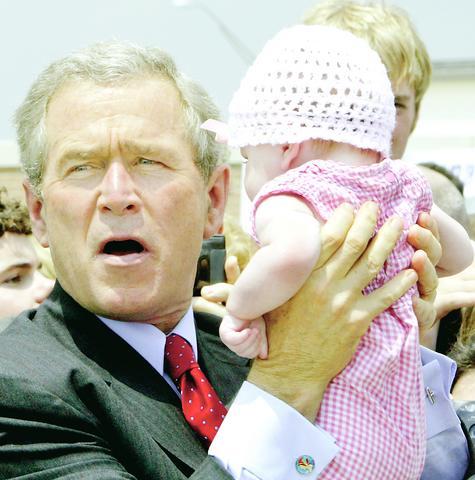
PHOTO: AFP
With newspapers and television screens filled with horrific pictures of American soldiers abusing Iraqi prisoners, Bush's approval rating is at the lowest of his presidency. Most voters are disappointed with the way things are going in the country. And, for the first time, Americans are divided on whether Bush or Kerry would better handle Iraq.
All bad signs for the commander in chief.
At the same time, a USA Today/CNN/Gallup poll shows Bush and Kerry tied in the presidential race -- an indication that, despite their doubts, key voters have not decided to deny Bush re-election. The president still holds a double-digit lead over Kerry on the question of who would deal best with terrorism.
Why isn't Bush in more trouble? Democratic and Republican strategists offer several explanations:
-- Kerry is an uneven candidate who has failed to take advantage of Bush's slump. What little voters know about the Democrat is largely negative, thanks to a multimillion-dollar White House ad campaign.
-- Dangerous times make voters wary of change. Kerry, a decorated Vietnam veteran, has just begun to introduce himself to Americans and flesh out his anti-terrorism policies.
-- The country is divided, with about 45 percent strongly behind Bush and 45 percent firmly supporting Kerry. Undecided voters are likely to withhold judgment until late in the campaign, when they know more about Kerry and the state of the nation.
"They need to soak everything in over time. What they're saying is, `We have doubts about the president, but we also have doubts about John Kerry,'" said Democratic pollster Doug Schoen.
Bush's ratings suffer with each flare-up in Iraq: The murder and mutilation of four US mercenaries whose grisly death evoked memories of the failed 1993 US mission in Somalia; congressional hearings into pre-Sept. 11 intelligence failures and whether the president failed to heed the warnings; and photos of flagged-draped coffins from Iraq.
But nothing has changed the basic structure of the Bush-Kerry race: It's close.
"Imagine the amount of information it would take for Republicans to change their minds about Bush," said Republican pollster Bill McInturff. "Conversely, even if we capture Osama bin Laden tomorrow, Bush's popularity would get a pop, sure, but would Democrats change their mind about him?"
"It's hard to imagine the race being restructured when you have a partisan divide of this intensity," he said.
While the USA Today/CNN/Gallup poll had Bush's approval rating at 46 percent, "the minute this horrible story is over it will drift back to 52 percent," McInturff argued. If Iraq subsides as an issue, the public might start noticing that new jobs are being created in America, he said.
First lady Laura Bush said she understands the public's doubts.
"Of course, we know why people are upset right now. We've just seen pictures on television and we're losing soldiers in Iraq," she said in a telephone interview, adding that Bush's overall standing has not been hurt "because they think the president is doing a real good job facing these real tough times."
"That's what they've seen since Sept. 11," she said.
America is a conflicted nation. The USA Today/CNN/Gallup poll showed that a majority of voters think going to war in Iraq wasn't worth it. The same percentage don't think it was a mistake to send troops.
An overwhelming percentage of voters said they are troubled by the prisoner abuses, but believe the cases are isolated. Far fewer lay a "great deal" of blame on Bush (22 percent) and Secretary of Defense Donald Rumsfeld (26 percent) than upon the military officers who supervised the soldiers (60 percent) and the soldiers themselves (65 percent).

Republican US lawmakers on Friday criticized US President Joe Biden’s administration after sanctioned Chinese telecoms equipment giant Huawei unveiled a laptop this week powered by an Intel artificial intelligence (AI) chip. The US placed Huawei on a trade restriction list in 2019 for contravening Iran sanctions, part of a broader effort to hobble Beijing’s technological advances. Placement on the list means the company’s suppliers have to seek a special, difficult-to-obtain license before shipping to it. One such license, issued by then-US president Donald Trump’s administration, has allowed Intel to ship central processors to Huawei for use in laptops since 2020. China hardliners

Conjoined twins Lori and George Schappell, who pursued separate careers, interests and relationships during lives that defied medical expectations, died this month in Pennsylvania, funeral home officials said. They were 62. The twins, listed by Guinness World Records as the oldest living conjoined twins, died on April 7 at the Hospital of the University of Pennsylvania, obituaries posted by Leibensperger Funeral Homes of Hamburg said. The cause of death was not detailed. “When we were born, the doctors didn’t think we’d make 30, but we proved them wrong,” Lori said in an interview when they turned 50, the Philadelphia Inquirer reported. The
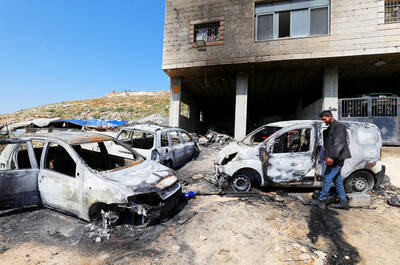
RAMPAGE: A Palestinian man was left dead after dozens of Israeli settlers searching for a missing 14-year-old boy stormed a village in the Israeli-occupied West Bank US President Joe Biden on Friday said he expected Iran to attack Israel “sooner, rather than later” and warned Tehran not to proceed. Asked by reporters about his message to Iran, Biden simply said: “Don’t,” underscoring Washington’s commitment to defend Israel. “We are devoted to the defense of Israel. We will support Israel. We will help defend Israel and Iran will not succeed,” he said. Biden said he would not divulge secure information, but said his expectation was that an attack could come “sooner, rather than later.” Israel braced on Friday for an attack by Iran or its proxies as warnings grew of

A prominent Christian leader has allegedly been stabbed at the altar during a Mass yesterday in southwest Sydney. Bishop Mar Mari Emmanuel was saying Mass at Christ The Good Shepherd Church in Wakeley just after 7pm when a man approached him at the altar and allegedly stabbed toward his head multiple times. A live stream of the Mass shows the congregation swarm forward toward Emmanuel before it was cut off. The church leader gained prominence during the COVID-19 pandemic, amassing a large online following, Officers attached to Fairfield City police area command attended a location on Welcome Street, Wakeley following reports a number


 RSS
RSS