


Planning for national elections in Iraq is ahead of schedule, but violence must decline for the UN to oversee them, the chief of the organization's electoral assistance division said Monday.
"If security does not improve, the UN won't participate in elections," said the official, Carina Perelli.
PHOTO: AP
Perelli said an estimated US$260 million had been set aside to pay for the voting, scheduled for January, and she expressed confidence that an electoral commission could be formed by the end of May, six weeks ahead of schedule.
"Security aside, we are better than on track," she said in a news conference, detailing the technical steps that had been taken.
She acknowledged that there had been a deterioration in security since she began her mission to Baghdad this year to advise on elections, but she reasoned that the act of holding elections itself could bring stability.
"We don't know how the situation is going to be," she said, "but once you announce an electoral process, if the voters start to believe in it and take ownership of it, then a process of fighting for the right to hold elections can occur."
Perelli, 46, a political scientist from Uruguay, has been chief of the electoral unit since 1998 and is experienced in setting up balloting in conflicted places like East Timor, Liberia and Afghanistan.
Asked what encouraged her to think that elections could go forward in Iraq, she said, "Basically what I have seen is a very, very strong desire and commitment to have their voices heard for the first time."
Under the current arrangement, a caretaker administration takes over from the American-led Coalition Provisional Authority on June 30, and the electoral commission, advised by Perelli and her team of experts, will then prepare the way for elections for a 275-member national assembly by Jan. 31.
That assembly will then write a constitution, and a second national election will take place in December next year.
Perelli said the plan was to hold three simultaneous elections on Jan. 31 for the assembly, for provincial assemblies in various regions of Iraq and for the assembly for the autonomous province of Kurdistan.
Nominations for the seven-member electoral commission and the non-voting post of director general of elections opened on Sunday and will continue through May 15. The final names will be vetted by a three-member panel of international election experts, and the commission applicants must pledge to drop all political party activities if chosen.
Perelli conceded that the process was "cumbersome," but she explained, "In elections, the process is as important as the outcome."

Republican US lawmakers on Friday criticized US President Joe Biden’s administration after sanctioned Chinese telecoms equipment giant Huawei unveiled a laptop this week powered by an Intel artificial intelligence (AI) chip. The US placed Huawei on a trade restriction list in 2019 for contravening Iran sanctions, part of a broader effort to hobble Beijing’s technological advances. Placement on the list means the company’s suppliers have to seek a special, difficult-to-obtain license before shipping to it. One such license, issued by then-US president Donald Trump’s administration, has allowed Intel to ship central processors to Huawei for use in laptops since 2020. China hardliners
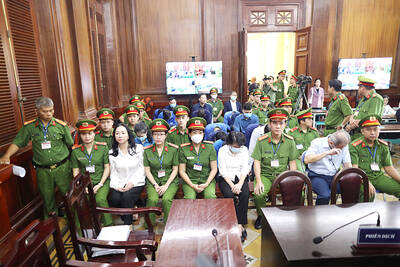
A top Vietnamese property tycoon was on Thursday sentenced to death in one of the biggest corruption cases in history, with an estimated US$27 billion in damages. A panel of three hand-picked jurors and two judges rejected all defense arguments by Truong My Lan, chair of major developer Van Thinh Phat, who was found guilty of swindling cash from Saigon Commercial Bank (SCB) over a decade. “The defendant’s actions ... eroded people’s trust in the leadership of the [Communist] Party and state,” read the verdict at the trial in Ho Chi Minh City. After the five-week trial, 85 others were also sentenced on

DISADVANTAGE: Erin O’Toole, who led the Conservatives during the election campaign in 2021, estimated that the interference cost his party as many as nine legislative seats Canada’s domestic spy agency on Monday concluded that China interfered in the past two elections, an official probe heard, the firmest evidence so far of suspected Chinese meddling in Canadian politics. Canadian Prime Minister Justin Trudeau’s Liberal Party won both the elections, held in 2019 and 2021. Under pressure from opposition lawmakers unhappy about media reports on China’s possible role, Trudeau set up a commission into foreign interference. The commission was shown a slide on Monday containing an extract of a briefing in February last year from the Canadian Security Intelligence Service (CSIS). “We know that the PRC [People’s Republic of China] clandestinely

‘DELUSIONAL’: Targeting the families of Hamas’ leaders would not push the group to change its position or to give up its demands for Palestinians, Ismail Haniyeh said Israeli aircraft on Wednesday killed three sons of Hamas’ top political leader in the Gaza Strip, striking high-stakes targets at a time when Israel is holding delicate ceasefire negotiations with the militant group. Hamas said four of the leader’s grandchildren were also killed. Ismail Haniyeh’s sons are among the highest-profile figures to be killed in the war so far. Israel said they were Hamas operatives, and Haniyeh accused Israel of acting in “the spirit of revenge and murder.” The deaths threatened to strain the internationally mediated ceasefire talks, which appeared to gain steam in recent days even as the sides remain far


 RSS
RSS