


During the Cultural Revolution, China's propaganda department often made hyperbolic charges against intellectuals -- capitalist roaders, enemies of the people -- accused of betraying Mao Zedong (
So when Jiao Guobiao (
The department is spiteful, like the Nazis, he wrote in a recent essay. It thinks itself infallible, like the pope. In the 1950s it covered up the starvation of millions of people. Today, he charged, it lies about SARS.
"Their censorship orders are totally groundless, absolutely arbitrary, at odds with the basic standards of civilization, and as counter to scientific common sense as witches and wizardry," he wrote in the article -- which has been widely circulated via the Internet in Beijing despite, not unpredictably, being banned by the Communist Party's propaganda department.
Such explicit outbursts of dissent are still rare in China. But Jiao is not alone in expressing frustration that, even after a long-awaited transition to a new generation of leaders some 18 months ago, China's political scene remains stultifying. Intellectuals, Jiao said, are "supposed to act like children who never talk back to their parents."
Many had hoped the leadership team headed by the party's chief, President Hu Jintao (胡錦濤), would tolerate more open debate. But it has instead slapped new restrictions on free speech and the media that some say remind them of the repressive years after the 1989 Tiananmen Square crackdown.
State security agents have been scouring the Internet and pressing charges against people who use it to distribute information or express opinions deemed unfavorable. The authorities harassed scholars who took part in a debate about constitutional changes, disappointing some who believed that Hu had once invited discussion about how to strengthen the rule of law.
Last month, Beijing decided against allowing full democracy in Hong Kong, even though many in the former British colony felt they were promised that right when China assumed sovereignty in 1997.
The political environment may reflect a seasonal shift to tight controls during the spring Communist Party meetings and a state of high alert ahead of the 15th anniversary of the June 4, 1989, Tiananmen massacre.
But some see worrying signs that the leadership remains instinctively hostile to political discussion and more independent news media. Scholars say they now suspect that Hu is not as forward-looking as they once hoped and at any rate must still defer to Jiang Zemin (江澤民), the military chief, who handed the formal reins of power to Hu in late 2002 but by many accounts remains a domineering influence.
"I don't think we had a real transfer of power or a turning point in leadership," said He Weifang (
The most conspicuous sign of that tension is in the news media. In recent years many newspapers, TV stations and Web-based media have flourished in a more market-driven environment. Diversity and competition seemed to foster more open discussion of sensitive topics, including corruption, legal reforms, foreign affairs, crime, business abuses and other matters that were once taboo.
But pressure to conform to political norms, which never went away, has been strongly reasserted in recent months, people in the industry say.
Propaganda officials have increased their presence inside news, culture and entertainment organizations, and have refined a system for pre-censorship that leaves less discretion in the hands of editors.
"It used to be that they would punish people who made too many mistakes," said the editor of a leading political magazine. "Now, you don't have the leeway to make mistakes."
Among topics now considered off-limits, the media are no longer permitted to investigate corruption without approval. That limits what many had seen as one of the few effective checks on official wrongdoing, reporters and editors said.
Hu and Premier Wen Jiabao (
But when two writers in Anhui Province wrote an in-depth critique of the handling of such problems, called An Investigative Report on Chinese Peasants, the book was banned and the publishing house that issued it came under pressure, possibly because the book argued that the most severe problems had been caused by officials.

Republican US lawmakers on Friday criticized US President Joe Biden’s administration after sanctioned Chinese telecoms equipment giant Huawei unveiled a laptop this week powered by an Intel artificial intelligence (AI) chip. The US placed Huawei on a trade restriction list in 2019 for contravening Iran sanctions, part of a broader effort to hobble Beijing’s technological advances. Placement on the list means the company’s suppliers have to seek a special, difficult-to-obtain license before shipping to it. One such license, issued by then-US president Donald Trump’s administration, has allowed Intel to ship central processors to Huawei for use in laptops since 2020. China hardliners

Conjoined twins Lori and George Schappell, who pursued separate careers, interests and relationships during lives that defied medical expectations, died this month in Pennsylvania, funeral home officials said. They were 62. The twins, listed by Guinness World Records as the oldest living conjoined twins, died on April 7 at the Hospital of the University of Pennsylvania, obituaries posted by Leibensperger Funeral Homes of Hamburg said. The cause of death was not detailed. “When we were born, the doctors didn’t think we’d make 30, but we proved them wrong,” Lori said in an interview when they turned 50, the Philadelphia Inquirer reported. The
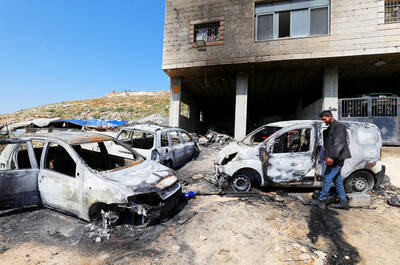
RAMPAGE: A Palestinian man was left dead after dozens of Israeli settlers searching for a missing 14-year-old boy stormed a village in the Israeli-occupied West Bank US President Joe Biden on Friday said he expected Iran to attack Israel “sooner, rather than later” and warned Tehran not to proceed. Asked by reporters about his message to Iran, Biden simply said: “Don’t,” underscoring Washington’s commitment to defend Israel. “We are devoted to the defense of Israel. We will support Israel. We will help defend Israel and Iran will not succeed,” he said. Biden said he would not divulge secure information, but said his expectation was that an attack could come “sooner, rather than later.” Israel braced on Friday for an attack by Iran or its proxies as warnings grew of
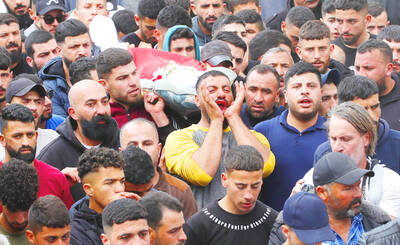
IN PURSUIT: Israel’s defense minister said the revenge attacks by Israeli settlers would make it difficult for security forces to find those responsible for the 14-year-old’s death Israeli Prime Minister Benjamin Netanyahu on Saturday condemned the “heinous murder” of an Israeli teenager in the occupied West Bank as attacks on Palestinian villages intensified following news of his death. After Benjamin Achimeir, 14, was reported missing near Ramallah on Friday, hundreds of Jewish settlers backed by Israeli forces raided nearby Palestinian villages, torching vehicles and homes, leaving at least one villager dead and dozens wounded. The attacks escalated in several villages on Saturday after Achimeir’s body was found near the Malachi Hashalom outpost. Agence France-Presse correspondents saw smoke rising from burned houses and fields. Mayor Amin Abu Alyah, of the


 RSS
RSS