


Talk in the streets is of a new Europe, a seamless superstate of common dreams. But down below, the No. 7 metro rumbles from Tolbiac to Stalingrad, evoking 15 centuries of bitter conflict.
Phantoms of the past haunt present realities as 10 more states swell the EU to 25 members in a merger of old Cold War enemies. It may take more than a single currency and catchall constitution to lay those old ghosts to rest.
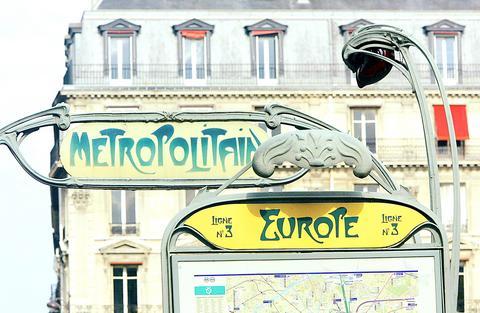
PHOTO: AP
Each capital has its own historical references that prophesy hard work ahead in forging a single European identity. In Paris, the words of the prophets are written on subway walls.
Station names like Stalingrad need little explanation. In living memory, 25 million people died on the Russian front because an Austrian-born megalomaniac tried to unite Europe under a German flag.
But Tolbiac?
"No idea," said Martine Fillatre, whose wine shop faces the Tolbiac station. Given a hint -- history -- she brightened. "Oh, right. Vercingetorix. Gauls and Romans." Not even close.
Vercingetorix is remembered at Alesia, on a different subway line, named for a brave but fruitless battle in 52BC against Julius Caesar's legions, which swept across France and settled in to stay.
Tolbiac was where Clovis, the Franks' first king, seized Alsace from Germanic tribes in 496AD. In the historical continuum, Adolf Hitler's Rhine campaign was just another round of an ancient struggle.
Depending upon how one counts, France and Germany have fought more than a dozen wars. Even now, when chances of another are beyond dim, the two continental giants are often at odds on national interest.
For optimists like Fillatre, a bold new EU offers a chance to banish the old ghosts and bury ancient quarrels.
"I'm excited by the idea," she said. "Just imagine, now we can all finally work together and build something new."
Others are more cautious. Rene Pellet, in the southern city of Draguignan, saw friends shot while he served in the French Resistance against Germany. He has also read a lot of European history.
"It is encouraging that we can now live in peace," he said. "That's not bad for a start. But are we the same people as Germans? Or Poles? I don't think so."
For many, memories have yet to dim. Past Stalingrad, the No. 7 stops at Corentin Cariou. He was a Paris councilman shot when the Nazis decided to kill 100 Frenchmen for each German sniper victim.
Some names go back to Napoleon. Austerlitz in 1805 was his grand triumph over Austria and Russia. Rivoli sealed Italy's fate. At Iena, he humbled the Prussians and, at Wagram, the Bavarians.
Elsewhere in Europe, old names recall Napoleon differently. The London-Paris train under the English Channel starts at Waterloo, named after the place where an English commander defeated Napoleon. It's the station where Queen Elizabeth II boarded when the came to Paris in March to mark 100 years of the Entente Cordiale.
Berlin's Alexanderplatz is named for the Russian czar who martialed forces against the Napoleonic legions that menaced an entire continent.
The idea of a single Europe is hardly new.
Voltaire, in 1751, saw "a kind of great republic divided into several states, some monarchical, the others mixed ... but all corresponding with one another."
Rousseau, two decades later, wrote, "There are no longer Frenchmen, Germans and Spaniards, or even English, but only Europeans."
And in 1796, Edmund Burke pronounced, "No European can be a complete exile in any part of Europe."
From Clovis to Charlemagne to Napoleon, anything approaching a united Europe was based on Christianity. Eighteen saints appear on the Paris subway map, not counting the odd cardinal.
But a short stroll in any direction from the Tolbiac station shows how the face of Europe has changed.
Past the corner McDonald's, an Islamic butcher offers hallal meat. A smattering of noodle shops leads into an Asian quarter thick with Buddhists, Shintoists and Confucians.
Paris has 14 metro lines, and each reflects a society that does not seem eager to dilute its flavor in any European melting pot. There is, for instance, the No. 1 line.
The No. 3 line stops in the heart of Paris, at a square built in 1826 to honor France's greater neighborhood. That station is Place de l'Europe.

Republican US lawmakers on Friday criticized US President Joe Biden’s administration after sanctioned Chinese telecoms equipment giant Huawei unveiled a laptop this week powered by an Intel artificial intelligence (AI) chip. The US placed Huawei on a trade restriction list in 2019 for contravening Iran sanctions, part of a broader effort to hobble Beijing’s technological advances. Placement on the list means the company’s suppliers have to seek a special, difficult-to-obtain license before shipping to it. One such license, issued by then-US president Donald Trump’s administration, has allowed Intel to ship central processors to Huawei for use in laptops since 2020. China hardliners

Conjoined twins Lori and George Schappell, who pursued separate careers, interests and relationships during lives that defied medical expectations, died this month in Pennsylvania, funeral home officials said. They were 62. The twins, listed by Guinness World Records as the oldest living conjoined twins, died on April 7 at the Hospital of the University of Pennsylvania, obituaries posted by Leibensperger Funeral Homes of Hamburg said. The cause of death was not detailed. “When we were born, the doctors didn’t think we’d make 30, but we proved them wrong,” Lori said in an interview when they turned 50, the Philadelphia Inquirer reported. The
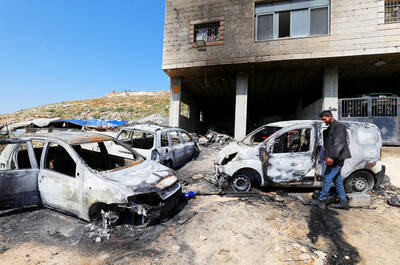
RAMPAGE: A Palestinian man was left dead after dozens of Israeli settlers searching for a missing 14-year-old boy stormed a village in the Israeli-occupied West Bank US President Joe Biden on Friday said he expected Iran to attack Israel “sooner, rather than later” and warned Tehran not to proceed. Asked by reporters about his message to Iran, Biden simply said: “Don’t,” underscoring Washington’s commitment to defend Israel. “We are devoted to the defense of Israel. We will support Israel. We will help defend Israel and Iran will not succeed,” he said. Biden said he would not divulge secure information, but said his expectation was that an attack could come “sooner, rather than later.” Israel braced on Friday for an attack by Iran or its proxies as warnings grew of
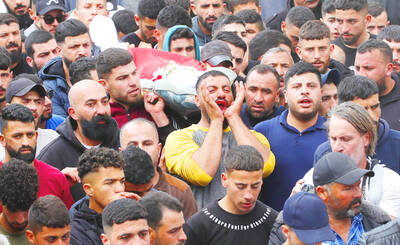
IN PURSUIT: Israel’s defense minister said the revenge attacks by Israeli settlers would make it difficult for security forces to find those responsible for the 14-year-old’s death Israeli Prime Minister Benjamin Netanyahu on Saturday condemned the “heinous murder” of an Israeli teenager in the occupied West Bank as attacks on Palestinian villages intensified following news of his death. After Benjamin Achimeir, 14, was reported missing near Ramallah on Friday, hundreds of Jewish settlers backed by Israeli forces raided nearby Palestinian villages, torching vehicles and homes, leaving at least one villager dead and dozens wounded. The attacks escalated in several villages on Saturday after Achimeir’s body was found near the Malachi Hashalom outpost. Agence France-Presse correspondents saw smoke rising from burned houses and fields. Mayor Amin Abu Alyah, of the


 RSS
RSS