


The mountain basin that cradles this town is due for a whopping earthquake, the kind that's reliably on time and can topple buildings in a heartbeat.
With their borrowed time, Utah lawmakers are shoring up the marble Capitol building against the inevitable. But they can't soon afford to brace another known deathtrap: the University of Utah's main library.
In a quake of magnitude 5 or greater, the building is expected to "pancake" on itself.
"That's why at night I study at the law library," said Dwayne Madry, 23, an undergraduate history and chemistry student.
Officials say two out of every three buildings here are considered unsafe -- even from moderate shaking.
Geologists for years have warned that the basin is due for a powerful jolt, one that returns with fair regularity about every 1,300 years.
The Wasatch fault last slipped about 1,284 years ago -- and the intervals between each of the four most recent prehistoric quakes ranged from 1,270 to 1,442 years. For experts who determined those dates, it's as close to clockwork as geology gets.
And while Salt Lake City has long been known to be vulnerable to an ancient rhythm of immense earthquakes, geologists have only recently begun to understand how savage they can be.
A magnitude 7.5 quake could kill 7,600 people in the Salt Lake basin, injure 44,000 others and cause US$12 billion in building damage, a pair of Stanford University engineers calculated in 1994.
One leading advocate for building safety says this city's aging stock of unreinforced brick and masonry buildings looks a lot like San Francisco's before the 1906 earthquake devastated much of that city.
"I'll be very candid with you," said Lawrence Reaveley, chairman of the University of Utah engineering department. A cascade of peeling, buckling and collapsing buildings will, he said, "just flat-out kill you."
Around downtown, about 20 new or strengthened buildings stand among older buildings that are likely to fail in an earthquake. That could provide a vivid, side-by-side contrast between buildings left standing and others that could crumble, says city building inspector Larry Wiley.
Across the city and valley, about 56,000 houses are built of unreinforced masonry. With any kind of ground shaking, engineers say, their brick walls will instantly crack and could topple, bringing down roofs.
The warnings are underscored by recent debate over the University of Utah's Marriott Library.
It's considered so menacing the Federal Emergency Management Agency stepped up April 5 to help pay for earthquake bracing that the Utah Legislature had refused to fund only weeks before. But FEMA offered only US$2.9 million and the legislature still has to come up with the rest of the US$45 million.
FEMA's contribution "adds credibility to the importance of this project," says Arthur Brown, a partner for Reaveley Engineers & Associates. "It would be hard for the Utah Legislature to totally ignore it."
Legislators said they didn't want to go deeper into debt to pay for the library at the same time they were borrowing heavily to overhaul the Utah Capitol.

‘IN A DIFFERENT PLACE’: The envoy first visited Shanghai, where he attended a Chinese basketball playoff match, and is to meet top officials in Beijing tomorrow US Secretary of State Antony Blinken yesterday arrived in China on his second visit in a year as the US ramps up pressure on its rival over its support for Russia while also seeking to manage tensions with Beijing. The US diplomat tomorrow is to meet China’s top brass in Beijing, where he is also expected to plead for restraint as Taiwan inaugurates president-elect William Lai (賴清德), and to raise US concerns on Chinese trade practices. However, Blinken is also seeking to stabilize ties, with tensions between the world’s two largest economies easing since his previous visit in June last year. At the
Nearly half of China’s major cities are suffering “moderate to severe” levels of subsidence, putting millions of people at risk of flooding, especially as sea levels rise, according to a study of nationwide satellite data released yesterday. The authors of the paper, published by the journal Science, found that 45 percent of China’s urban land was sinking faster than 3mm per year, with 16 percent at more than 10mm per year, driven not only by declining water tables, but also the sheer weight of the built environment. With China’s urban population already in excess of 900 million people, “even a small portion

UNSETTLING IMAGES: The scene took place in front of TV crews covering the Trump trial, with a CNN anchor calling it an ‘emotional and unbelievably disturbing moment’ A man who doused himself in an accelerant and set himself on fire outside the courthouse where former US president Donald Trump is on trial has died, police said yesterday. The New York City Police Department (NYPD) said the man was declared dead by staff at an area hospital. The man was in Collect Pond Park at about 1:30pm on Friday when he took out pamphlets espousing conspiracy theories, tossed them around, then doused himself in an accelerant and set himself on fire, officials and witnesses said. A large number of police officers were nearby when it happened. Some officers and bystanders rushed
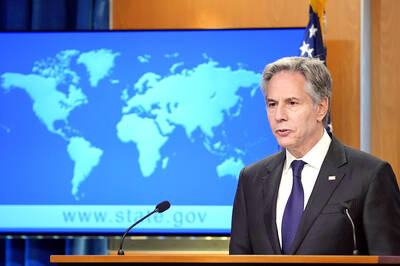
Beijing is continuing to commit genocide and crimes against humanity against Uyghurs and other Muslim minorities in its western Xinjiang province, U.S. Secretary of State Antony Blinken said in a report published on Monday, ahead of his planned visit to China this week. The State Department’s annual human rights report, which documents abuses recorded all over the world during the previous calendar year, repeated language from previous years on the treatment of Muslims in Xinjiang, but the publication raises the issue ahead of delicate talks, including on the war in Ukraine and global trade, between the top U.S. diplomat and Chinese


 RSS
RSS