


Why this particular fishing village, among the hundreds along the East African coast, may soon receive a new well courtesy of the Pentagon is no secret.
It is not because the people here have to walk long distances and brave harsh temperatures for the limited drinking water available on Pate Island, although they do. No, the US Central Command is concerned more with the loyalties of the people of Siyu than with their thirst.
It was from remote Siyu, investigators say, that the bombing of a Mombasa hotel that catered to Israeli tourists and a simultaneous failed attempt to shoot down an Israeli-chartered airliner were planned in 2002. The well is one of many public-works projects being undertaken by the US military throughout the Horn of Africa aimed at changing the locals' view of a country many of them had learned to hate.
"This is the new way of fighting a war," said Major Brice Finney, commander of the US Army's 412th Civil Affairs Battalion, based in Djibouti. "The war on terrorism is not necessarily a shooting war."
Still, these are good deeds with a strategic edge. The main purpose of the mission is to monitor the vast coastline for terrorists fleeing Afghanistan and other spots across the Gulf of Aden. All of which explains why the US military is paying such close attention to Siyu.
The island is difficult to reach, especially at low tide. Dhows must navigate north from Lamu, one of Kenya's offshore islands, through a mangrove forest, carefully avoiding the rocks. The speck of a village, home to 1,500 people, is a couple of hours by foot from the island's main settlement. The perfect hide-out, in short, for an enterprising terrorist like Fazul Abdullah Muhammad, chief suspect in the Mombasa attacks and also wanted in connection with the 1998 bombing of the US embassy in Nairobi.
Muhammad is from Comoros,another island further south. But he arrived in Siyu sometime around 2002, married a local girl and began preaching at the local madrassa. Investigators say he also recruited his young bride's father and brother, both of whom are standing trial, into his al-Qaeda operation.
Muhammad disappeared after the Mombasa bombing and is in hiding. Now it is the US military preaching to the residents of Siyu, through its public-works projects.
Not just in Siyu but throughout the Horn of Africa, sick people line up by the hundreds for checkups by military doctors. Pastoralists bring their huge herds of cows and sheep and goats for deworming by military veterinarians. Parents cheer as military engineers refurbish their children's schools.
Despite its Peace Corps-like approach, the Pentagon still has some hearts and minds to win in its periodic visits to the island.
"I don't like them here," said Sheik Mahmoud Ahmed Abdulkadir, the imam of Pwani Mosque in nearby Lamu, who has urged his followers to shun the Americans. "I feel that they are my enemy. I have no intention of harming them, but I cannot show them a smile on my face. That is hypocrisy."
A young resident of Siyu, identifying himself as Ali Muhammad, said of the soldiers: "They want us to be on their side. If they do something good, that's fine. But we know why they're doing it."
People here have become used to the sight of soldiers in their midst. Most take a practical approach, welcoming US help with open arms and putting their political and religious beliefs to the side.
"We need all the help we can get," said Bunu Mwengyealy, headmaster of Pate Primary School, a crumbling school standing on the water's edge, across the island from Siyu. A storm wiped out one classroom last year, so Mwengyealy and others were thrilled when US soldiers arrived recently to assess the campus.
But Mwengyealy does not know if his project will be approved, and he says he is having difficulty persuading local residents to pitch in -- the traditional way a school is put up -- because everybody is waiting for the Pentagon's cash.
Muslim leaders say their followers have been ignoring their warnings about accepting US largess. The people are poor and ideology takes a distant second to making ends meet.
"When I tell people, `Don't let the Americans help you,' they ask me, `What is the alternative?'" Abdulkadir said, shaking his head in frustration.
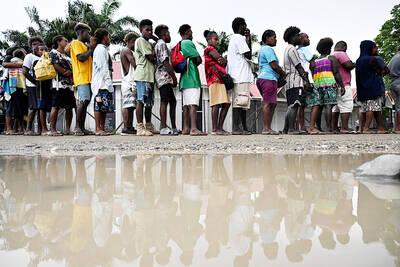
SEEKING CHANGE: A hospital worker said she did not vote in previous elections, but ‘now I can see that maybe my vote can change the system and the country’ Voting closed yesterday across the Solomon Islands in the south Pacific nation’s first general election since the government switched diplomatic allegiance from Taiwan to Beijing and struck a secret security pact that has raised fears of the Chinese navy gaining a foothold in the region. The Solomon Islands’ closer relationship with China and a troubled domestic economy weighed on voters’ minds as they cast their ballots. As many as 420,000 registered voters had their say across 50 national seats. For the first time, the national vote also coincided with elections for eight of the 10 local governments. Esther Maeluma cast her vote in the
Nearly half of China’s major cities are suffering “moderate to severe” levels of subsidence, putting millions of people at risk of flooding, especially as sea levels rise, according to a study of nationwide satellite data released yesterday. The authors of the paper, published by the journal Science, found that 45 percent of China’s urban land was sinking faster than 3mm per year, with 16 percent at more than 10mm per year, driven not only by declining water tables, but also the sheer weight of the built environment. With China’s urban population already in excess of 900 million people, “even a small portion

UNSETTLING IMAGES: The scene took place in front of TV crews covering the Trump trial, with a CNN anchor calling it an ‘emotional and unbelievably disturbing moment’ A man who doused himself in an accelerant and set himself on fire outside the courthouse where former US president Donald Trump is on trial has died, police said yesterday. The New York City Police Department (NYPD) said the man was declared dead by staff at an area hospital. The man was in Collect Pond Park at about 1:30pm on Friday when he took out pamphlets espousing conspiracy theories, tossed them around, then doused himself in an accelerant and set himself on fire, officials and witnesses said. A large number of police officers were nearby when it happened. Some officers and bystanders rushed

HYPOCRISY? The Chinese Ministry of Foreign Affairs yesterday asked whether Biden was talking about China or the US when he used the word ‘xenophobic’ US President Joe Biden on Wednesday called for a hike in steel tariffs on China, accusing Beijing of cheating as he spoke at a campaign event in Pennsylvania. Biden accused China of xenophobia, too, in a speech to union members in Pittsburgh. “They’re not competing, they’re cheating. They’re cheating and we’ve seen the damage here in America,” Biden said. Chinese steel companies “don’t need to worry about making a profit because the Chinese government is subsidizing them so heavily,” he said. Biden said he had called for the US Trade Representative to triple the tariff rates for Chinese steel and aluminum if Beijing was


 RSS
RSS