


Several Supreme Court justices expressed concern Wednesday that Americans captured in President George W. Bush's "war on terrorism" could be held for decades in US military jails without any legal rights.
Several justices also asked whether enemy combatants captured on a foreign battlefield and brought to the US should get a military review or hearing, if not a US court hearing, to challenge their detention.
"Have we ever had a situation like this ... (where the detention) could last 25 or 50 years?" Justice Sandra Day O'Connor asked the government's lawyer.
At issue is whether Bush has the power to order American citizens, whether captured overseas or arrested in the United States as terrorism suspects, to be held indefinitely without any charges or hearings or access to a lawyer.
The two cases before the high court seek to balance competing civil liberties and national security claims, challenging the Bush administration's assertion of sweeping presidential powers since Sept. 11, 2001.
The rulings, which are due by the end of June, could produce the most important US Supreme Court decisions on the government's war powers since World War II.
One case involved Yaser Hamdi, a former Taliban fighter captured in Afghanistan. The other involved Jose Padilla, an ex-gang member suspected of plotting with al Qaeda to set off a radioactive "dirty bomb" in the US.
Several justices appeared to be oncerned by Bush's position that detained individuals could be held until the war on terrorism or other wars end.
Justice David Souter summarized the government's position as: "Don't worry about the timing question. We'll tell you when it's over."
Justice Stephen Breyer asked if there would be no court hearing for such suspects even if the conflict dragged on as long as the 100 Years War in Europe.
Hamdi and Padilla have been declared enemy combatants and confined in a military brig in South Carolina. They each have been held for about two years without any of the protections customarily afforded by the US legal system.
Justice Department lawyer Paul Clement argued that giving detainees access to lawyers would hurt the military's ability to gain information in interrogations.
Justice John Paul Stevens challenged that view. He said a lawyer could explain that providing information would be a way to end the detention. "It might be a motivation to talk," Stevens said.
Clement told the justices the U.S. military had not used torture against such vulnerable detainees. He said even traditional prisoners of war were not entitled to a lawyer to challenge their detention, but only received attorneys when charged with war crimes.
Justice Ruth Bader Ginsburg asked why the government treated Hamdi and Padilla differently from accused Sept. 11 conspirator Zacarias Moussaoui and American Taliban fighter John Walker Lindh, who were prosecuted in the U.S. criminal justice system.
"How does the government justify some going through the criminal process and some being held indefinitely?" she asked.
Justice Antonin Scalia asked Hamdi's lawyer whether his position would put "unreasonable demands upon a war situation."
O'Connor expressed concern about releasing suspects like Padilla. "What do we do?" she asked. "Just turn loose a ticking time bomb?"
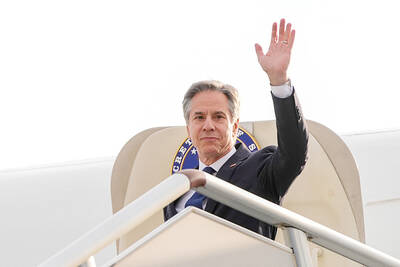
‘IN A DIFFERENT PLACE’: The envoy first visited Shanghai, where he attended a Chinese basketball playoff match, and is to meet top officials in Beijing tomorrow US Secretary of State Antony Blinken yesterday arrived in China on his second visit in a year as the US ramps up pressure on its rival over its support for Russia while also seeking to manage tensions with Beijing. The US diplomat tomorrow is to meet China’s top brass in Beijing, where he is also expected to plead for restraint as Taiwan inaugurates president-elect William Lai (賴清德), and to raise US concerns on Chinese trade practices. However, Blinken is also seeking to stabilize ties, with tensions between the world’s two largest economies easing since his previous visit in June last year. At the
Nearly half of China’s major cities are suffering “moderate to severe” levels of subsidence, putting millions of people at risk of flooding, especially as sea levels rise, according to a study of nationwide satellite data released yesterday. The authors of the paper, published by the journal Science, found that 45 percent of China’s urban land was sinking faster than 3mm per year, with 16 percent at more than 10mm per year, driven not only by declining water tables, but also the sheer weight of the built environment. With China’s urban population already in excess of 900 million people, “even a small portion

UNSETTLING IMAGES: The scene took place in front of TV crews covering the Trump trial, with a CNN anchor calling it an ‘emotional and unbelievably disturbing moment’ A man who doused himself in an accelerant and set himself on fire outside the courthouse where former US president Donald Trump is on trial has died, police said yesterday. The New York City Police Department (NYPD) said the man was declared dead by staff at an area hospital. The man was in Collect Pond Park at about 1:30pm on Friday when he took out pamphlets espousing conspiracy theories, tossed them around, then doused himself in an accelerant and set himself on fire, officials and witnesses said. A large number of police officers were nearby when it happened. Some officers and bystanders rushed

Beijing is continuing to commit genocide and crimes against humanity against Uyghurs and other Muslim minorities in its western Xinjiang province, U.S. Secretary of State Antony Blinken said in a report published on Monday, ahead of his planned visit to China this week. The State Department’s annual human rights report, which documents abuses recorded all over the world during the previous calendar year, repeated language from previous years on the treatment of Muslims in Xinjiang, but the publication raises the issue ahead of delicate talks, including on the war in Ukraine and global trade, between the top U.S. diplomat and Chinese


 RSS
RSS