


The head of the Iranian judiciary issued an order on Wednesday banning the use of torture and other abuses: an unprecedented acknowledgement of the regime's record of repression.
"Any torture to extract a confession is banned and the confessions extracted through torture are not legitimate and legal," Ayatollah Mahmoud Hashemi Shahrudi's order to the police, judges and intelligence officials say.
The 15-point directive says the "blindfolding, restraining, pestering and insulting of detainees must be avoided during arrest, interrogation and investigation."
The order merely reiterates rights contained in the Iranian constitution, but it amounts to confirmation by a leading member of the theocracy of rampant legal abuses.
"There've been some implicit words before, but explicitly in an order, this is the first time," said Reza Yousefian, a reformist representative in the outgoing parliament.
"We should welcome this kind of order, regardless of the motivation behind it," Yousefian said.
He said it seemed that the conservative establishment, which won back control of the parliament in the disputed elections in February, wished to present a more moderate face domestically and to European governments.
Echoing the view of human rights lawyers, he said he doubted that the order would be fully carried out. But the public declaration represented some kind of step forward.
The order coincides with a visit to Iran by British judges, and recent court decisions that adopted a relatively lenient approach to journalists accused of insulting state officials.
It says the accused has the right to a lawyer, must be detained only on the basis of clear legal charges and must be given the chance to verify written confessions.
Families should be informed of a defendant's legal status, detainees should not be taken to secret locations, and only relevant documents and material should be confiscated by the police.
Such fundamental civil rights are regularly denied to political activists, students, journalists and others who dare to criticize the ruling clergy publicly.
In violation of the constitution and the directive, the regime continues to hold more than 30 political prisoners in the notorious Evin prison in north Tehran, and an unknown number held in other jails.
Iranian President Mohammad Khatami, acknowledged as much in comments on Wednesday in the English daily Iran.
"Absolutely, we do have political prisoners. There are those who are in prison for their beliefs," he was quoted as saying.
Meeting young people on Tuesday, he described Iran as part of a region that had failed to fulfil aspirations for freedom and democracy.
"We are living in the east and face despotic governments, humiliating societies and centuries of destroyed hopes," he said.
Last week the UN Human Rights Commission chose for the second year running not to censure Iran,which conservative newspapers greeted as a vindication of the republic.
Nearly half of China’s major cities are suffering “moderate to severe” levels of subsidence, putting millions of people at risk of flooding, especially as sea levels rise, according to a study of nationwide satellite data released yesterday. The authors of the paper, published by the journal Science, found that 45 percent of China’s urban land was sinking faster than 3mm per year, with 16 percent at more than 10mm per year, driven not only by declining water tables, but also the sheer weight of the built environment. With China’s urban population already in excess of 900 million people, “even a small portion

UNSETTLING IMAGES: The scene took place in front of TV crews covering the Trump trial, with a CNN anchor calling it an ‘emotional and unbelievably disturbing moment’ A man who doused himself in an accelerant and set himself on fire outside the courthouse where former US president Donald Trump is on trial has died, police said yesterday. The New York City Police Department (NYPD) said the man was declared dead by staff at an area hospital. The man was in Collect Pond Park at about 1:30pm on Friday when he took out pamphlets espousing conspiracy theories, tossed them around, then doused himself in an accelerant and set himself on fire, officials and witnesses said. A large number of police officers were nearby when it happened. Some officers and bystanders rushed
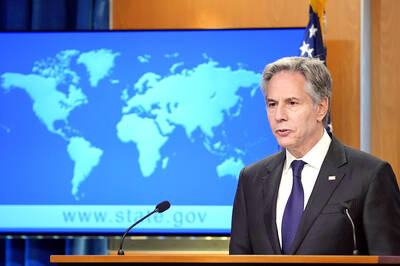
Beijing is continuing to commit genocide and crimes against humanity against Uyghurs and other Muslim minorities in its western Xinjiang province, U.S. Secretary of State Antony Blinken said in a report published on Monday, ahead of his planned visit to China this week. The State Department’s annual human rights report, which documents abuses recorded all over the world during the previous calendar year, repeated language from previous years on the treatment of Muslims in Xinjiang, but the publication raises the issue ahead of delicate talks, including on the war in Ukraine and global trade, between the top U.S. diplomat and Chinese

HYPOCRISY? The Chinese Ministry of Foreign Affairs yesterday asked whether Biden was talking about China or the US when he used the word ‘xenophobic’ US President Joe Biden on Wednesday called for a hike in steel tariffs on China, accusing Beijing of cheating as he spoke at a campaign event in Pennsylvania. Biden accused China of xenophobia, too, in a speech to union members in Pittsburgh. “They’re not competing, they’re cheating. They’re cheating and we’ve seen the damage here in America,” Biden said. Chinese steel companies “don’t need to worry about making a profit because the Chinese government is subsidizing them so heavily,” he said. Biden said he had called for the US Trade Representative to triple the tariff rates for Chinese steel and aluminum if Beijing was


 RSS
RSS